Get Full Government Meeting Transcripts, Videos, & Alerts Forever!
Get email alerts on the K 12 Education Special Education topic
No spam. Unsubscribe anytime.
Supervisors hold hearing after SFUSD misses special-education hires; city offers short-term support
Summary
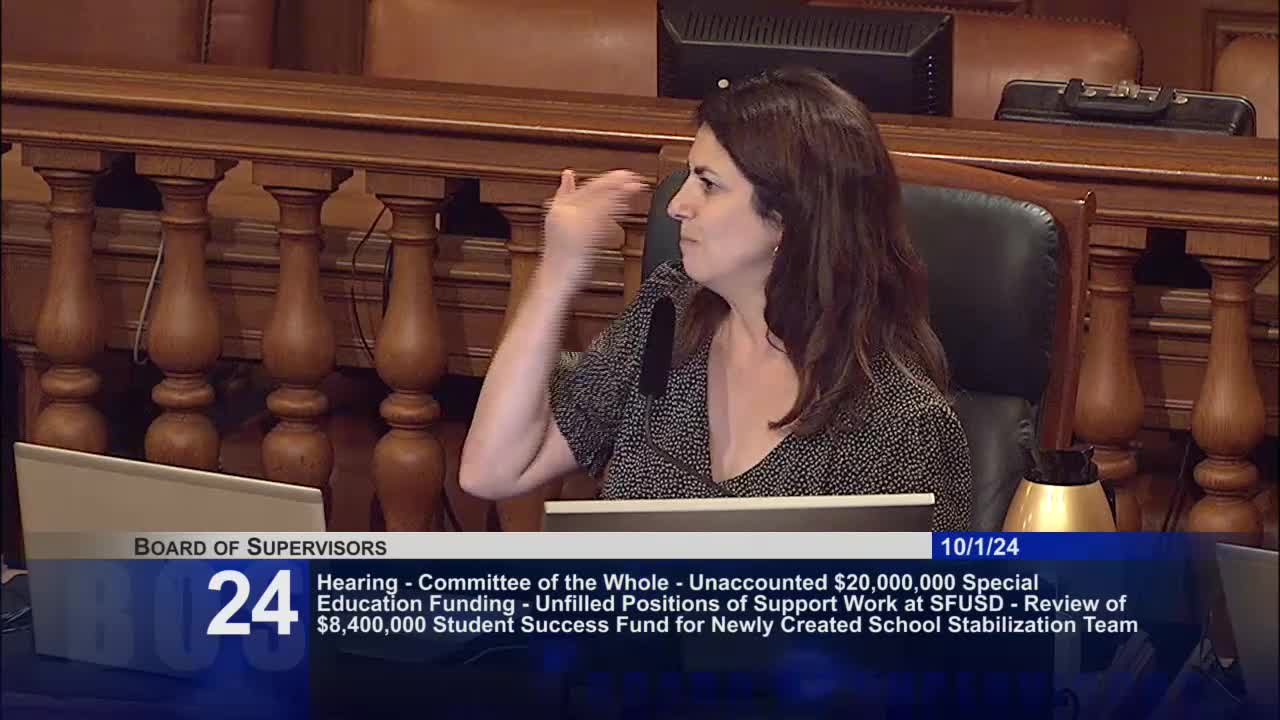
The San Francisco Board of Supervisors convened a Committee of the Whole on Oct. 1 to examine why San Francisco Unified School District (SFUSD) special-education positions were not staffed at the start of the 2024–25 school year and how roughly $20 million to $30 million in special-education budget authority went uncommitted.
The San Francisco Board of Supervisors convened a Committee of the Whole on Oct. 1 to examine why San Francisco Unified School District (SFUSD) special-education positions were not staffed at the start of the 2024–25 school year and how roughly $20 million to $30 million in special-education budget authority went uncommitted.
The hearing, called by Supervisor Joel Safaie, brought SFUSD Superintendent Matt Wayne; Board of Education President Matt Alexander; Maria Hsu, director of the Department of Children, Youth and Their Families (DCYF); and city officials who described immediate and longer-term steps to restore staffing and assess what caused the lapse.
Why it matters: SFUSD serves about 49,000 students and the district’s special-education budget this year is roughly $224 million. Many students with Individualized Education Programs (IEPs) receive services in general-education classrooms, so vacant special-education teachers and paraprofessionals can affect a wide swath of students. Parents, educators and advocates said missing or late services have already harmed students’ learning and asked for clear remedies and accountability.
What city officials said: Maria Hsu said Mayor Breed established a city “school stabilization team” to help SFUSD shore up operations and staffing. The team, co-chaired by Hsu and Phil Ginsburg (Rec and Park), includes representatives from the controller’s office, human resources, the treasurer’s office and the mayor’s education policy staff. Hsu said the city will not repurpose school-site grants already allocated to campuses; instead, $8.4 million of unspent student-success fund dollars and one-time city funds were identified to help with emergent needs such as bolstering HR and payroll capacity, rapid hiring assistance, and supports for families affected by school transitions.
SFUSD response: Superintendent Wayne said SFUSD increased the special-education budget during 2023–24 but that reconciliation and operational breakdowns—compounded by separate state oversight and a hiring freeze triggered during budget review—meant positions that had been identified or candidates who had received offers could not be onboarded before classes began. Wayne said the district ultimately increased special-education funding by $30 million after the school year started and that hiring is now underway. He described steps to expedite onboarding, use substitute and contracted providers where necessary, and implement a new integrated HR/payroll/finance system.
Board of Education role and requested audit: Board President Matt Alexander described the staffing lapse as “completely unacceptable” and said the board requested an independent review by the city controller to determine what happened and prevent recurrence. Maria Hsu and Superintendent Wayne supported an independent assessment: the controller’s office will review processes, and the district has also contracted a fiscal crisis management team for deeper program and systems analysis.
Scope of impact and compensatory services: SFUSD officials said there were roughly 64 vacant special-education classroom teacher positions and about 209 vacant classified support (paraeducator) positions at the time of the hearing; vacancies are distributed across early education, elementary, middle and high schools. The district said it is tracking site-level impacts and will provide compensatory services where students legally require make-up instruction.
Parents, advocates and public comments: Dozens of parents, disability-rights advocates, current and former district employees, and community advocates urged a broad audit that includes fiscal forensics plus lived experience—calling for family input, review of past audits and stronger timelines for restitution and remediation. Several public speakers also called for the city to preserve Prop G (the Student Success Fund) dollars for direct school-site programs and cautioned against using the fund to cover central-office reforms.
Next steps: The supervisors filed the hearing record. The city controller will perform an independent assessment of the district’s budgeting and operational decisions; the mayor’s stabilization team will continue short-term operational supports; and the district will present unaudited actuals and interim budget reports as part of the regular state reporting schedule. The Board of Education and SFUSD officials pledged to provide more specific counts of impacted students and timelines for hires and compensatory services.
What remains unresolved: Parents and supervisors pressed for (1) a clear public accounting of the $20–30 million that was identified as unallocated or frozen; (2) a firm plan for ensuring the remaining vacancies are filled before impacts accumulate; and (3) limits on how one-time city funds tied to the Student Success Fund will be used so that the money reaches school sites and intended student programs.
The board said it will continue oversight and follow up with the controller’s review and additional hearings.