Get Full Government Meeting Transcripts, Videos, & Alerts Forever!
Get email alerts on the Land Use Development topic
No spam. Unsubscribe anytime.
Board upholds planning department finding; 2395 Sacramento project cleared of further CEQA review
Summary
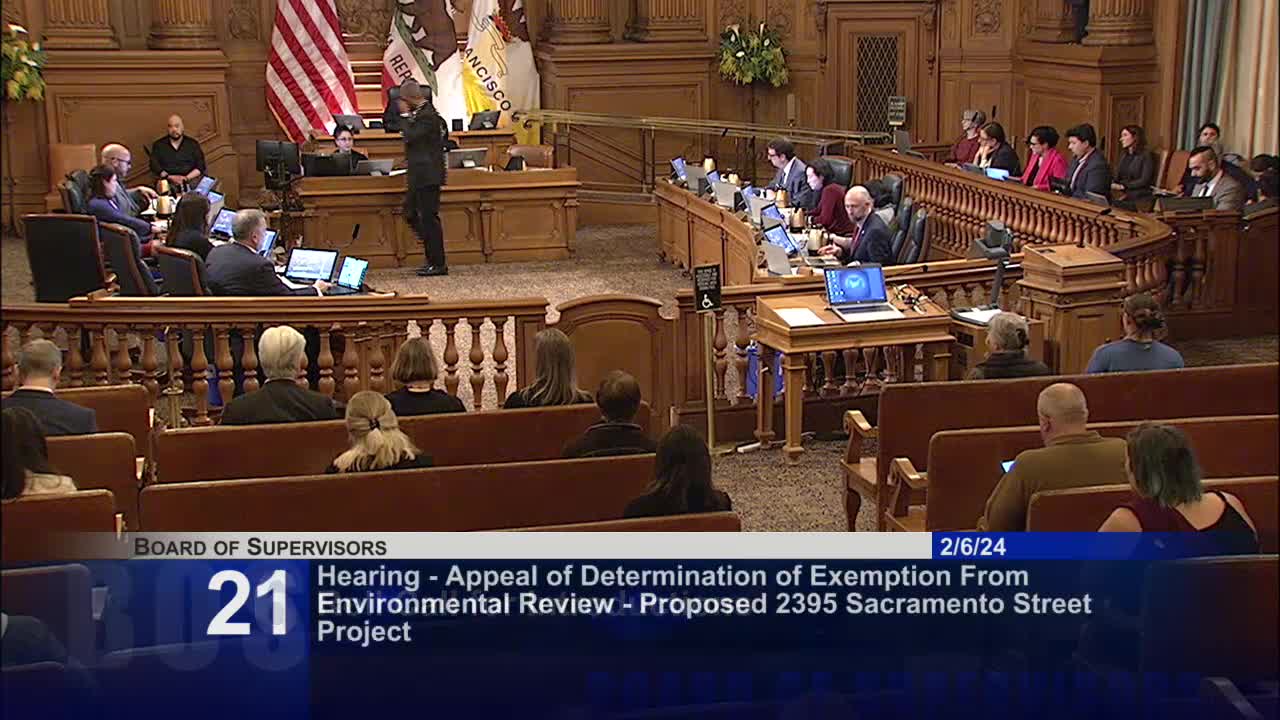
The San Francisco Board of Supervisors voted 10–1 on Feb. 6 to uphold the planning department’s general plan evaluation and deny an appeal seeking a project‑level CEQA review for the 2395 Sacramento Street redevelopment, a proposed 24‑unit project that includes rehabilitation of the Lane Medical Library, a designated city landmark.
The San Francisco Board of Supervisors voted 10–1 on Feb. 6 to uphold the planning department’s general plan evaluation (GPE) and its finding that the proposed redevelopment at 2395 Sacramento Street is exempt from further California Environmental Quality Act review under CEQA Guidelines section 15183. Supervisors rejected an appeal from neighbors and preservation advocates who had asked for a project‑level environmental impact report.
The vote followed a nearly five‑hour public hearing during which the appellant’s counsel, Richard Drury, argued that the project—rehabilitation of the Lane Medical Library (City Landmark No. 115) and construction of a 24‑unit, seven‑story residential building—requires a full EIR because a prior, programmatic EIR for the city’s housing element does not analyze site‑specific impacts. “If this were allowed to proceed, no residential project in the city would ever need to do CEQA review again,” Drury said, citing differences in height and unit count from the assumptions in the housing‑element analysis and raising concerns about vibration, air emissions and the treatment of interior murals.
Planning department staff disputed that characterization. Lisa Gibson, the department’s Environmental Review Officer, said the department performed a project‑level evaluation that applied the housing element EIR’s analytical framework to identify project‑specific impacts and mitigation. “We conducted over 150 pages of project‑level documentation, including technical studies, and concluded that mitigation measures identified in the housing element EIR, tailored to this project, reduce impacts to less‑than‑significant levels,” Gibson said. Rich Ducray (planning staff) confirmed that the review addressed both exterior and interior historic features and included mitigation and a monitoring program.
Architectural historians and community groups testified on both sides. Bridget Maley and other preservation professionals urged fuller environmental review, saying the planning analysis had not adequately addressed the library’s interior murals, historic fabric and the relationship between the landmark building and the adjacent Temple Sherith Israel. Opposition speakers, including representatives from neighborhood groups and housing advocates, said the proposal preserves the landmark, provides 24 infill units in a high‑resource neighborhood and had already undergone certificate of appropriateness and planning commission review.
Project counsel Tuya Catalano told the board the sponsor was not maximizing state density bonus allowances and had worked with planning and neighborhood stakeholders. The sponsor’s team said the project includes three on‑site inclusionary (below‑market) units; the remaining 21 units are market rate.
Supervisor Aaron Peskin cast the lone no vote. The motion to affirm the planning department’s determination was made on the floor by Supervisor Ahsha Safaí (roll‑call and motion sponsors were recorded in the clerk’s file). After the vote, the board directed that the project’s mitigation monitoring and reporting program be used to track implementation of the historic‑resource measures the planning department adopted.
Why it matters: the decision sustains the planning department’s application of CEQA streamlining under section 15183—streamlining authorized when a project is consistent with a general plan EIR—while requiring the department’s tailored mitigation measures to be applied during permitting. Opponents warned that accepting the department’s approach here could limit project‑level CEQA review in other contexts; supporters said it speeds housing delivery while protecting historic resources through tailored mitigation and review.
Votes at a glance: the board voted 10 ayes, 1 no (Peskin) to affirm the department’s general plan evaluation and deny the appeal. The planning department and project sponsor said a mitigated negative declaration would have identified similar mitigation measures and that the GPE did not omit project‑level analysis, only relied on a programmatic substrate.
Next steps: the project retains the approvals granted by the Historic Preservation Commission and Planning Commission; enforcement of mitigation will be carried out through Planning’s mitigation monitoring program and through permit review. Any future legal challenges would be filed in court; the board’s action is a local legislative/administrative determination based on the record presented to it.