Get Full Government Meeting Transcripts, Videos, & Alerts Forever!
Get email alerts on the Homelessness topic
No spam. Unsubscribe anytime.
Mayor Breed tells supervisors San Francisco has helped 13,000 households exit homelessness; urges quick use of new conservatorship tools and cameras
Summary
Mayor London N. Breed told the Board of Supervisors on Dec. 12 that the city has helped more than 13,000 households exit homelessness since 2018 and urged fast implementation of recently enacted conservatorship tools, along with expanded surveillance technology and a mix of police and social services to address street-based problems.
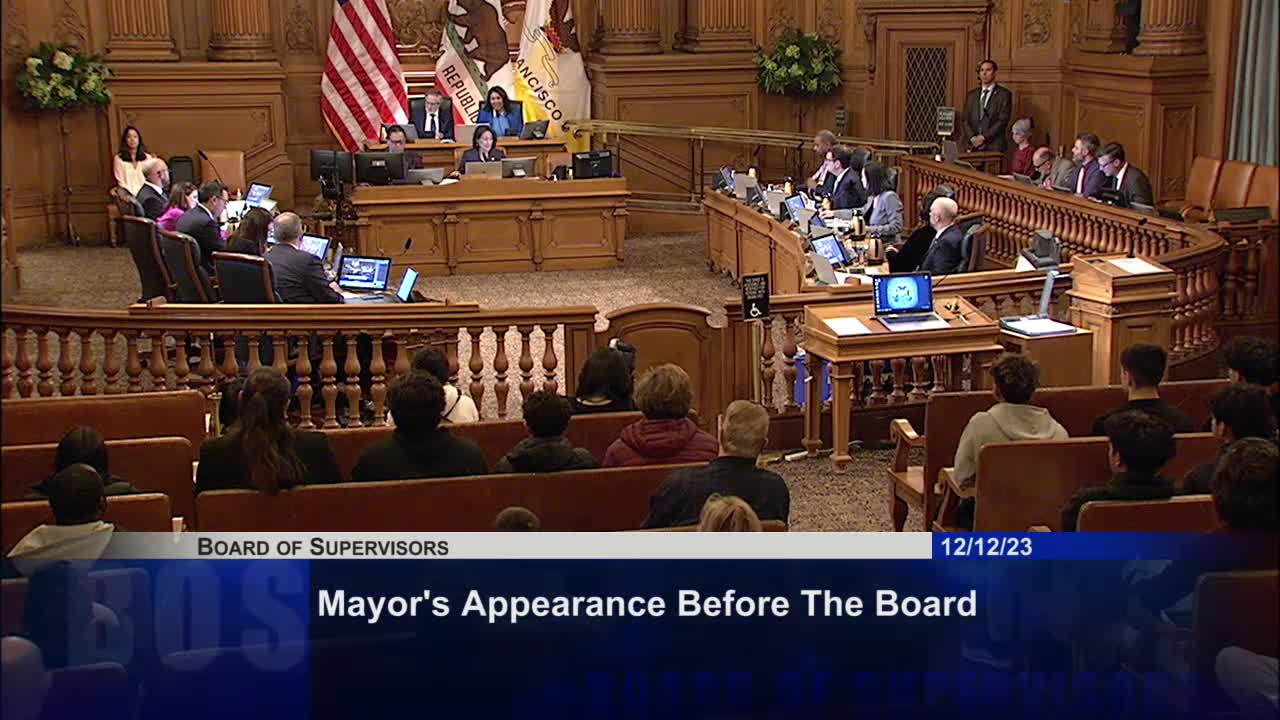
Mayor London N. Breed told the San Francisco Board of Supervisors on Dec. 12 that since 2018 the city has helped more than 13,000 households leave homelessness and that San Francisco is moving quickly to use a new conservatorship law and other tools to address street conditions.
"Since 2018, we have now helped over 13,000 households exit homelessness," Mayor London N. Breed said at the board's legislative chamber. "We have cut the bureaucracy to move housing projects faster. We've streamlined ... and improved strategies to fill vacancies." She credited state programs, including Project Homekey, for delivering funding for more than 800 units.
The mayor framed her comments as part of a broader public-safety strategy that she said requires a mix of enforcement, outreach and technology. "It's not a one thing or another. It's all of it," Breed said, describing measures that include additional police staffing, retired-officer ambassadors on commercial corridors, expanded social services and a state grant to deploy cameras and license-plate-reader technology at intersections across the city.
Why this matters: Breed's remarks came during the board's scheduled mayoral appearance, a forum for supervisors to pose policy questions. The mayor's combination of housing claims, enforcement plans and an explicit push to implement a new conservatorship law highlight continuing tensions on how San Francisco balances shelter, services and public-safety responses on encampments and street crime.
Board members questioned the specifics of speed and process. Supervisor Chan, speaking for District 1, said merchants in the Outer Richmond raised concerns about a recent violent incident and asked for both more social services and police resources. Chan read a resident's question asking whether adding more officers downtown had been tried before and whether funding for social services might be more effective.
"What is your immediate plan for action to expand both social services as well as public safety resources in District 1?" Supervisor Chan asked.
Mayor Breed answered that the administration has increased recruitment for the police department, deployed retired-officer ambassadors on Clement Street and added funding for nonprofits and a community youth center in the district. She also emphasized shelter and housing placements, and said outreach teams had brought about 1,500 people into shelter so far this year — a figure she said represents about 37% of people encountered by outreach teams, with the remainder already sheltered or declining help.
Breed also said San Francisco will move quickly to implement the new conservatorship law, and she urged the board's support to remove procedural delays. "While other counties are waiting to implement this new conservatorship law for a year or two, San Francisco is moving full speed ahead," she said.
Supervisor Chan challenged the administration's timeline for rolling out a state-funded license-plate-reader grant, asking why the grant announcement in September had not led to immediate implementation. Chan also pressed for adherence to board processes: he noted that certain grant acceptance steps require board policy adoption before funds can be accepted, and that the item for the license-plate-reader grant was on the board's calendar for approval that day.
Breed acknowledged a one-month delay between announcement and ordinance introduction and urged greater collaboration with the board's budget committee to expedite public-safety measures. "We asked for support from the budget committee and didn't receive the same kind of support, which has led to a four-week delay in implementing this policy," she said.
What was not decided: The mayor urged action and asked for the board's cooperation, but no new ordinance or funding authorization was adopted at the mayoral appearance itself; the license-plate-reader grant and related departmental actions remained subject to the board's legislative process.
Meeting context: The exchange included extended questioning by at least one supervisor and covered operational details (recruitment and ambassador programs), program counts (shelter placements), and policy-level disputes about timing and process. The discussion did not replace formal votes but was used to press the administration for greater speed and transparency.
Ending note: Breed closed by saying the city will continue adding shelter and housing and pushing tools meant to reduce the harms associated with encampments, while supervisors signaled they would press the administration for clearer timelines and adherence to board approval processes.