Get Full Government Meeting Transcripts, Videos, & Alerts Forever!
Get email alerts on the Reparations topic
No spam. Unsubscribe anytime.
San Francisco supervisors accept advisory committee's reparations plan and direct creation of an Office of Reparations
Summary
After a public hearing with hundreds of speakers, the Board of Supervisors accepted the final report from the African American Reparations Advisory Committee and filed a resolution to establish an Office of Reparations to begin implementing recommendations including financial payments, housing and education measures.
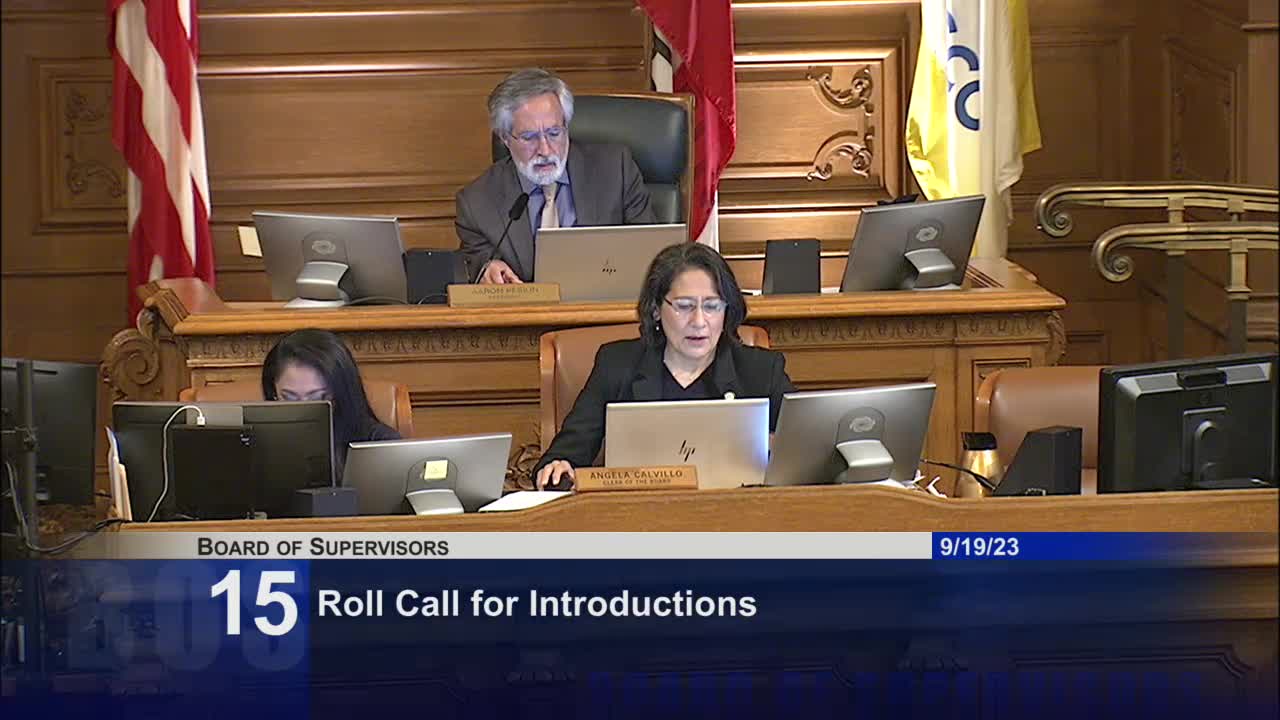
The San Francisco Board of Supervisors on Sept. 19 accepted the final report of the African American Reparations Advisory Committee and moved to file a resolution directing creation of an Office of Reparations to begin implementing the committee's recommendations.
The action followed a daylong committee-of-the-whole hearing in which the committee's chair and vice chair presented the report's findings and more than 150 people gave public comment in the chamber and by phone. Supervisor Walton introduced the board resolution to accept the report and to push for funding and an office to begin turning recommendations into programs. The clerk recorded the matter as "heard and filed."
The committee's final report -- presented by Chair Eric McDonald and Vice Chair Tanisha Hollins and supported administratively by Human Rights Commission Director Dr. Cheryl Davis -- lays out more than 100 policy recommendations grouped under education, economic empowerment (including housing), health, and public policy. The committee recommended, among other items, a formal city apology, an Office of Reparations to staff implementation and eligibility work, investments in housing and black business ownership, education initiatives including support for historically Black colleges and related pipelines, and a set of short- and long-term programs intended to close racial wealth and health gaps.
"It has been my distinct honor... to carry this work," said Eric McDonald as he introduced the committee's findings. Dr. Cheryl Davis told the board, "Dreamkeeper is not reparations," distinguishing the city's Dreamkeeper Initiative (ongoing community investments) from the committee's reparations blueprint while urging the board to fund implementation steps that the Human Rights Commission can begin advancing immediately. Vice Chair Tanisha Hollins appealed for urgency: "This is a moment when we are calling on you to be exactly who we know San Francisco is."
Committee members and speakers repeatedly stressed housing and economic remedies. Hollins told the board the committee continued to call for financial reparations and cited an "assessment" figure in the report text. The committee also recommended a stakeholder authority to prioritize and guide implementation, and it asked the board and mayor to stand up an Office of Reparations to staff benefits, eligibility research, outreach and an execution plan.
Public comment included long lines of supporters from across San Francisco's civic and nonprofit sectors, clergy and community groups, as well as many residents who described personal and family histories of displacement, discrimination and loss of opportunity. Several nonblack community leaders and Jewish and Asian American organizations spoke in favor. A smaller number of callers expressed opposition. Reverends and longtime neighborhood leaders urged the board to move quickly; Reverend Amos Brown told the board, "Just do it."
Board members from multiple districts praised the committee's work and said they would press to translate the report into funding and concrete programs. Several supervisors described existing or planned local actions that overlap with committee priorities: housing preservation and acquisition strategies, investments in public housing repairs and workforce pipelines, and proposals to direct city-owned leasing and procurement toward black-owned businesses.
Supervisor Walton said he would introduce a resolution to accept the final report and to prioritize standing up the Office of Reparations, and the clerk subsequently recorded the matter as heard and filed. No roll-call vote on the report itself was recorded in the meeting minutes; the clerk noted the report was accepted and the item filed for the record.
What's next: committee members and Human Rights Commission staff urged the board to fund the office and to begin immediate steps the report identified as implementable while the committee continues to wind down. The committee is scheduled to sunset in January 2024; the advisory members asked that the new office carry forward the work and that a community stakeholder body help set priorities.
The board's acceptance of the report sets in motion an administrative and budgetary process: the mayor controls release of many city funds, and supervisors said they would press to convert the policy recommendations into concrete budget items and ordinances. The report itself lists a wide range of program and policy paths, from lump-sum payments and housing subsidies to educational investments and culturally specific health services.
The hearing, which drew standing-room attendance and dozens of callers, was a civic milestone in San Francisco's long-running conversations about displacement, redevelopment and racial inequity. The board and the new Office of Reparations, if funded, will be responsible for prioritizing which recommendations to implement first and for identifying funding sources to pay for them. "What do you want history to say?" McDonald asked the board at the hearing. "We hope you will do right by Black San Franciscans," Hollins said.