Get Full Government Meeting Transcripts, Videos, & Alerts Forever!
Get email alerts on the Police Reform topic
No spam. Unsubscribe anytime.
Supervisors Hear Update on DOJ Reform Recommendations for SFPD; Department Seeks Final Compliance by April 2024
Summary
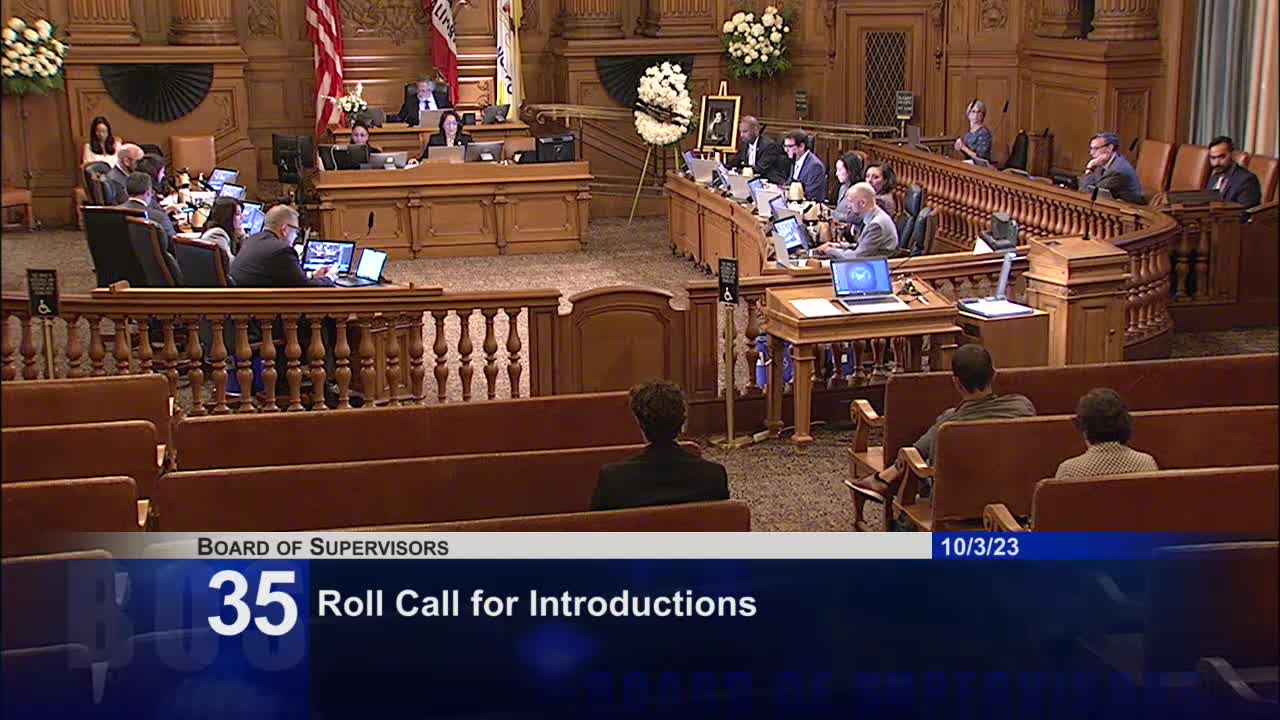
The Board of Supervisors convened as a committee of the whole on Oct. 3 to receive an update on implementation of the U.S. Department of Justice27s 2016 assessment of the San Francisco Police Department.
The Board of Supervisors convened as a committee of the whole on Oct. 3 to receive an update on the implementation of recommendations from the U.S. Department of Justice27s 2016 assessment of the San Francisco Police Department.
City and outside consultants reported sustained progress on changes to policy, training and data systems but cautioned that implementation and sustainability remain incomplete. The California Department of Justice continues to serve as an oversight partner, and consultants said the current implementation phase is scheduled to conclude in April 2024.
Deborah Kirby, a consultant with Jensen Hughes, reviewed the history and aims of the collaborative reform process that followed the DOJ assessment published Oct. 12, 2016. She told the board the original review identified 94 findings and 272 recommendations and said the current phase groups remaining work into five project plans covering use of force, bias, community policing, a management dashboard and personnel practices. "Reform is not finite," Kirby said. "Policing has challenges continuously." She said the department had made measurable reductions in use of force and had developed several policy innovations, including a published disengagement policy she described as rare for large U.S. departments.
SFPD Chief Bill Scott and department staff described technical and staffing barriers that remain. Chief Scott said the department is completing a management dashboard designed to help identify disparate policing patterns and to support training and personnel decisions. "That dashboard . . . will give us an opportunity to really dig into this more in terms of trying to understand what these trends mean," Scott told the board. He said accurate, timely data is critical to understanding patterns of stops and force and that some gaps in information technology remain.
Supervisors pressed SFPD on racial disparities and data reliability. Supervisor Walton noted continuing disproportionality in stops and use of force and asked what the department is doing to address it. Scott said the department27s decline in overall force has been significant and that some reductions among Black residents have been larger than for other groups, but he also said the city must pair policing with investments that address root causes. Several supervisors asked about recent media reports alleging race fields were misreported in stop forms; SFPD said it will increase spot checks and auditing but acknowledged that the unit responsible for audits has been understaffed in recent years.
Board staff and city consultants said about 27 recommendations remain open, with some of the most difficult tied to information-technology upgrades. Catherine Maguire, executive director of the Strategic Management Bureau, said the April 2024 timeline is the target for this phase and that Cal DOJ and Jensen Hughes will assess the department after that point. SFPD said a new records management system and an early intervention system are in progress and that several policies produced under the reform initiative have been implemented.
Supervisors and consultants also discussed community engagement. Kirby said COVID-era disruptions limited in-person outreach and that the department needs to complete community policing work and restore robust two-way communication with neighborhood groups.
Public comment included both praise and sharp criticism of the department and the reform process. After question-and-answer, the board agreed, without recorded objection, to continue the related agenda item to a future date: a request from Supervisor Walton to continue follow-up hearings was granted and the board set a continuation to May 21, 2024, in order to allow more time for updates and assessments.
The hearing materials and consultant reports are posted by the department and the California Department of Justice; board members and the department said they expect further progress reports before April 2024.