Get Full Government Meeting Transcripts, Videos, & Alerts Forever!
Get email alerts on the Public Safety Drug Markets topic
No spam. Unsubscribe anytime.
Mayor Breed details stepped-up enforcement, treatment efforts to shut down Tenderloin and SoMa drug markets
Summary
Mayor London Breed told the Board of Supervisors the city has increased arrests and seizures and is coordinating with state and federal partners while expanding outreach and treatment, and she urged stronger laws and a public dashboard to track progress.
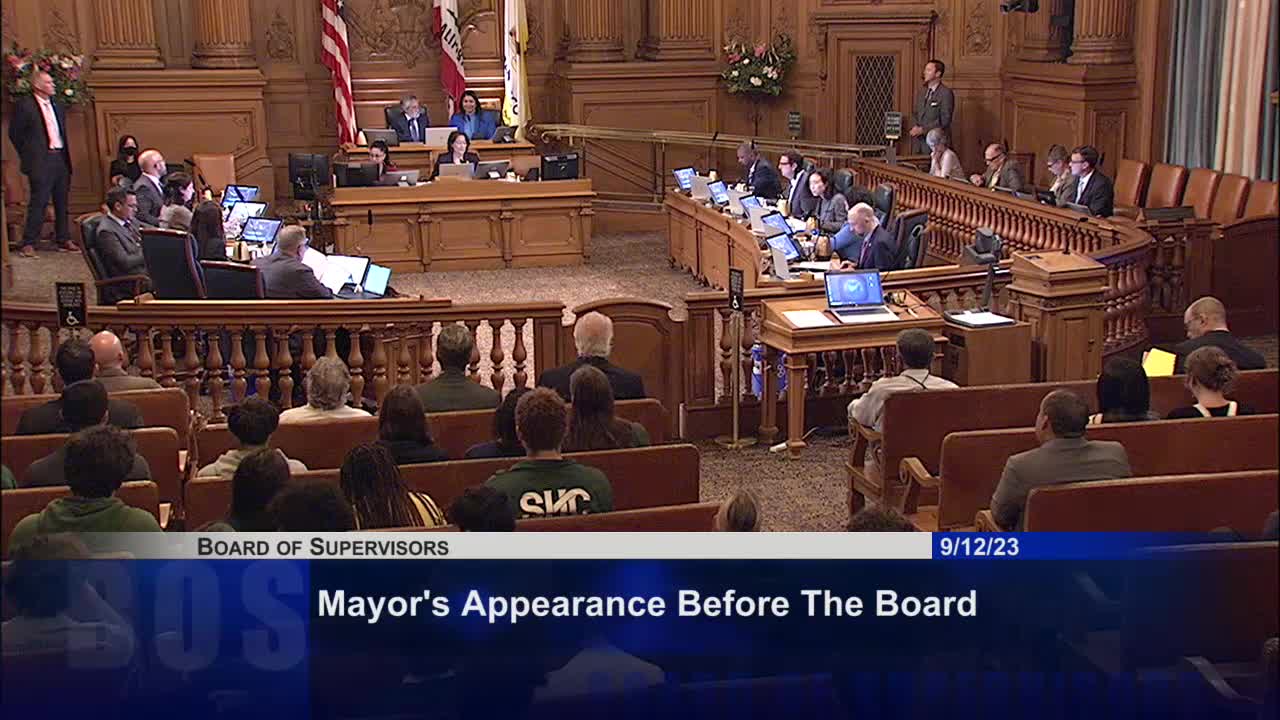
Mayor London Breed told the San Francisco Board of Supervisors on Sept. 12 that the city has intensified enforcement and coordinated with state and federal partners to shut down open-air drug markets in the Tenderloin and South of Market neighborhoods.
Breed said local officers in the Tenderloin Police District have made 616 arrests for drug sales so far this year and that the city has seized “over 200 pounds of fentanyl,” roughly 2.5 times what was seized during the same period last year. She said the California Highway Patrol has made more than 100 drug arrests and seized about 40 pounds of fentanyl, and that the California National Guard is expanding support for San Francisco investigations. Breed said the U.S. Drug Enforcement Administration and the U.S. Attorney’s Office are taking cases to federal court and that the district attorney has filed 566 drug cases this year.
The mayor said city teams have also tried to reduce public drug use through outreach: in August the public-health street-care team interacted with about 300 people in the Tenderloin and South of Market and offered services; Breed said seven people accepted mental-health support and eight accepted substance-use treatment during that effort. She also said the city has added 350 treatment beds and is pushing for more state funding.
Breed described enforcement as part of a combined approach. “We are going to hold people accountable who are breaking the law and creating chaos, and we are going to continue to help those who are in need,” she said. She also urged stronger state laws to compel treatment, praising local support for SB 43 by state Sen. Susan Eggman while saying changes in law alone will not solve the problem.
Board President Peskin asked for more detail on the city’s “command center” response and the dashboard of metrics. Breed said the dashboard is being set up but emphasized accuracy and interagency coordination before publicly releasing data. She added that the structure of the command center had changed, with the Police Department taking a lead role alongside public-health and other agencies.
On the command center’s direction, Breed said it emphasizes partnership among law enforcement and health and human services and that representatives from the Department of Public Works, jail health and other city agencies now sit together to coordinate services before and after arrests. “They need to know that they have a place to go or resources at any time in order to get healthy,” Breed said, adding that removing bureaucracy would let the city move faster when emergency authority is needed.
Breed credited federal and state leaders for assistance and named Police Chief Bill Scott, Sheriff Paul Miyamoto and District Attorney Brooke Jenkins as partners. She also thanked former U.S. House Speaker Nancy Pelosi and Governor Gavin Newsom for assistance and resources.
Why it matters: Board members who represent the Tenderloin and SoMa neighborhoods have repeatedly raised safety and public-health concerns related to open-air drug markets. The mayor’s update ties enforcement, outreach and state-level policy changes together and signals an administration emphasis on combined enforcement and treatment. Councilmembers asked for clear metrics and a public dashboard to measure progress.
What’s next: Breed said the city will publish data when it is available from partner agencies and is continuing to expand treatment capacity and enforcement coordination. President Peskin said the board will continue oversight and asked that the command center’s metrics and structure be reported back to the board.