Get Full Government Meeting Transcripts, Videos, & Alerts Forever!
Get email alerts on the Overdose Prevention topic
No spam. Unsubscribe anytime.
Mayor, supervisors spar over Tenderloin overdose prevention as city closes consumption site
Summary
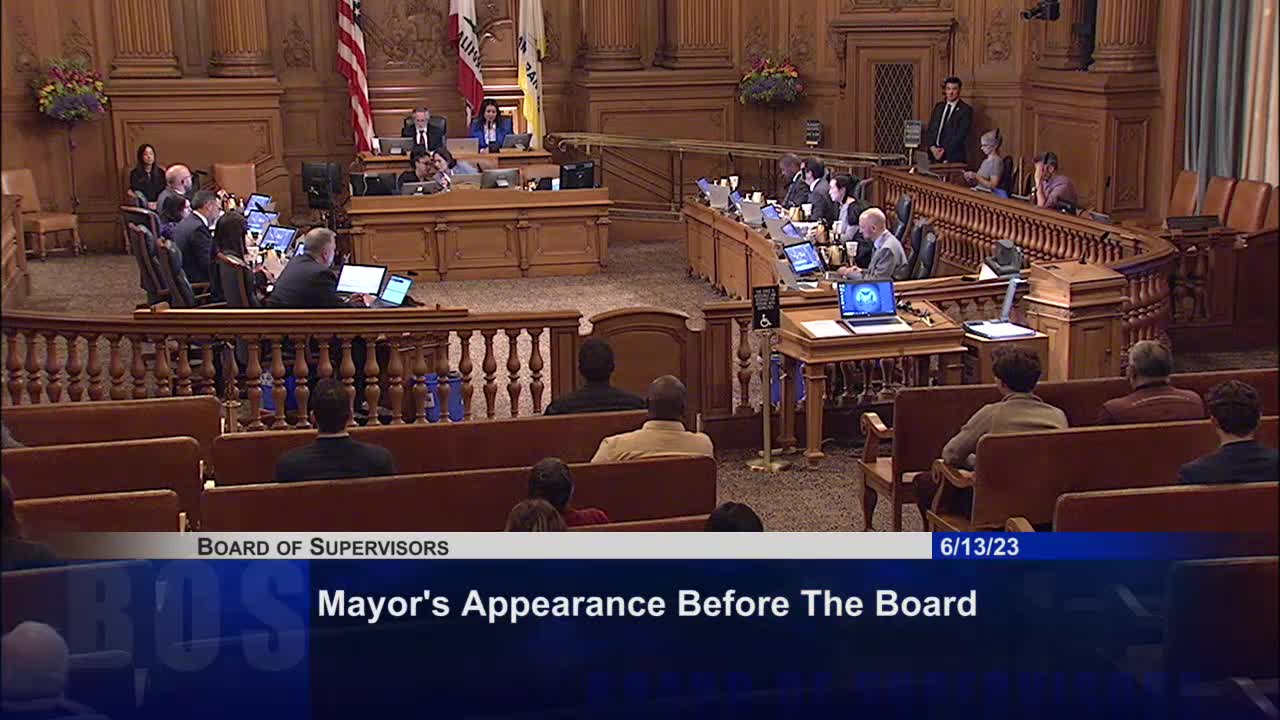
Mayor London Breed and Supervisor Dean Preston traded sharply worded remarks June 13 at a San Francisco Board of Supervisors meeting over the city's overdose-prevention plan and whether the administration has done enough to open a Tenderloin wellness hub after the Tenderloin linkage center closed in December 2022.
Mayor London Breed and Supervisor Dean Preston traded sharply worded remarks June 13 at a San Francisco Board of Supervisors meeting over the city's overdose-prevention plan and whether the administration has done enough to open a Tenderloin wellness hub.
Breed said the city has made arrests and offered services as part of a recent enforcement effort addressing open-air drug markets, and she disputed the board's characterization that the administration is not acting. "As of yesterday, 38 people have been arrested or cited under this effort," Breed said, adding that only three of those arrested identified as San Francisco residents and that, she said, none of those released had accepted offered services.
The dispute matters because the administration and the Department of Public Health (DPH) announced an overdose-prevention plan in September 2022 that described “wellness hubs” as a central element. Supervisor Dean Preston said the mayor and DPH committed at a public hearing last October to opening one such hub in the Tenderloin by June 30, 2023, and he said DPH had not issued a request for proposals to operate a site there after the Tenderloin linkage center was closed in December 2022.
Why it matters: The conversation puts two policy approaches against each other — a model of low-barrier, city-funded wellness hubs similar to a New York approach versus an enforcement-led approach combined with offers of services — and centers on the question of whether the city has followed through on a specific timeline for the Tenderloin.
Details and positions
Supervisor Preston said the Tenderloin closure in December preceded a sharp rise in overdose deaths and that providers were ready to open a hub if the city would move. He asked whether DPH would issue an RFP for a Tenderloin wellness hub by the June 30, 2023 deadline the board had been given.
Mayor Breed responded that she supports opening such sites but raised legal and operational concerns, saying federal legal issues, potential impacts on licensing for service providers, and community opposition in parts of the Tenderloin had complicated faster action. "If we could open these particular centers, we would," Breed said, adding that many constituents in the Tenderloin want more public safety.
Breed framed the response to open-air drug markets as a combination of enforcement and treatment. She said her administration's outreach teams had treated about 4,500 people with substance use disorder in the last year and that outreach workers make repeated offers of services; she told the board that many people offered services decline them. "Addiction is powerful," she said. "We know to be successful in changing lives, we need to be ready to meet people at the right moment with the services they need."
Supervisor Preston pushed back that the city's overdose-prevention plan — written by DPH and endorsed by the mayor — expressly notes that punitive policies have not been effective at reducing deaths and that incarceration increases overdose risk. He asked whether the mayor would follow the public-health advice and end policies that specifically authorize arresting and incarcerating people because those policies increase fatal overdoses.
Breed replied with a personal account of family members and friends affected by substance use, said arrests have produced opportunities for people to enter treatment, and rejected the idea that the administration should be limited to nonpunitive responses. "When we need to make an arrest because someone's breaking the law and needs to be held accountable and can potentially be forced into treatment or services, I'm going to do so," she said.
Clarifying details from the meeting
- Tenderloin linkage center closed: December 2022 (as stated by Supervisor Preston). - Commitment on opening a Tenderloin wellness hub in public hearing: administration committed to opening one hub in the Tenderloin no later than 06/30/2023 (per Supervisor Preston's statement). - Arrests cited by Mayor Breed: 38 people arrested or cited in the recent enforcement effort; 3 identified as San Francisco residents; "0 have accepted" the offered services (breed's account at the meeting). - DPH treatment figure cited by Mayor Breed: DPH treated about 4,500 people with substance use disorder in the last year (as quoted by the mayor at the meeting). - RFP status: Supervisor Preston said the Department of Public Health had not issued an RFP to open and operate a Tenderloin wellness hub as of the June 13 meeting.
Discussion vs. decision
The exchange on June 13 was a question-and-answer and public accountability exchange during question time. No formal board action (vote or ordinance) was taken at the meeting to create, fund, approve, or require a specific site or RFP. Several board members and the mayor expressed positions and asked for follow-up; Supervisor Peskin offered to facilitate a meeting between the mayor and Supervisor Preston to try to resolve remaining disagreements.
What to watch next
Supervisor Preston and Mayor Breed agreed on the record to continue discussions. The practical next items to watch are whether DPH issues an RFP for a Tenderloin wellness hub, whether a site is specified and funded in the mayor's budget or by a separate action, and whether any legal guidance changes that the mayor cited are resolved.
Ending
The meeting highlighted a continuing split between enforcement-oriented and public-health-oriented approaches to open-air drug markets and overdose prevention in San Francisco. Board members framed the issue as urgent as overdose deaths continue to rise; the administration framed its response as a mixture of enforcement and outreach while pointing to legal and community constraints that, Breed said, limit how quickly certain sites can be opened.