Get Full Government Meeting Transcripts, Videos, & Alerts Forever!
Get email alerts on the Police‑equipment topic
No spam. Unsubscribe anytime.
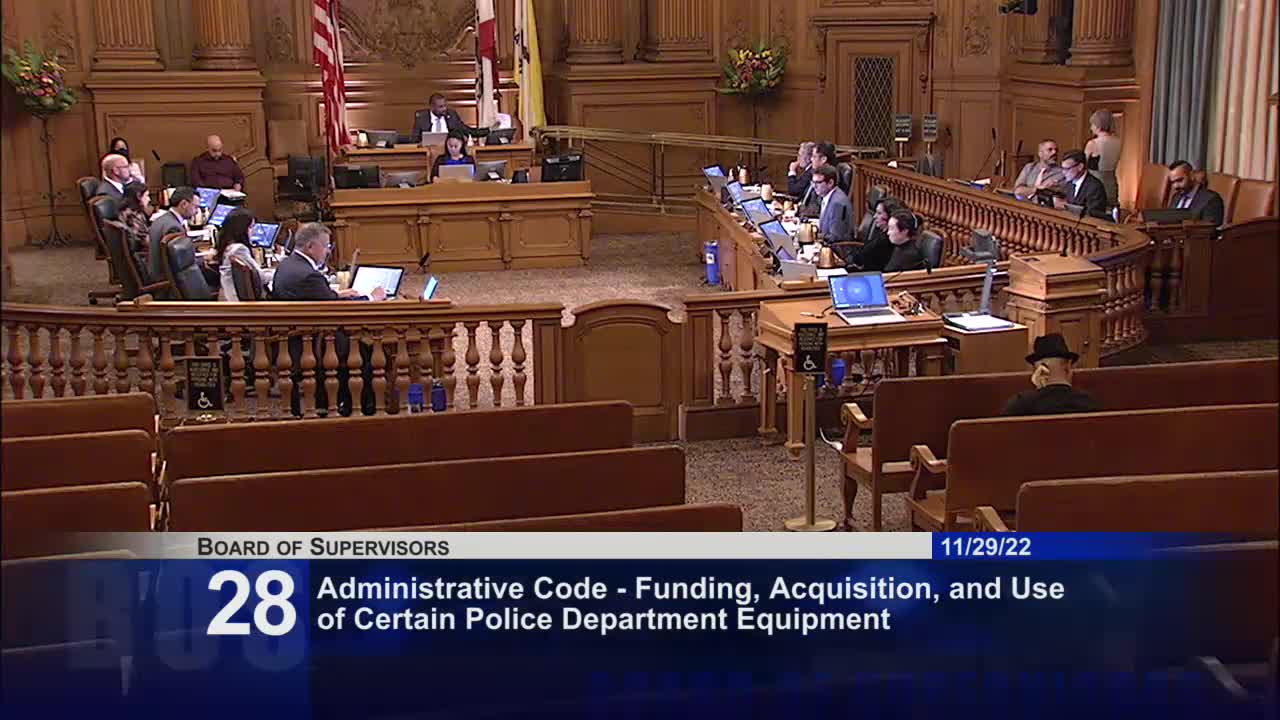
Board approves police equipment policy but narrows language on robot deadly‑force use after heated debate
Summary
After several hours of debate, the San Francisco Board of Supervisors voted 8–3 on first reading to approve a use‑of‑equipment policy implementing state law AB 481, adding a clause that limits when an unmanned ground vehicle may be used as a deadly‑force option and who may authorize that use.
The San Francisco Board of Supervisors on Nov. 29 approved, on first reading, a city ordinance adopting a comprehensive police use‑of‑equipment policy required by Assembly Bill 481, including a narrowly written condition under which an unmanned remotely piloted ground vehicle (robot) may be used to deploy deadly force.
The board voted 8–3 on the amended ordinance after a prolonged debate that focused almost entirely on whether the policy should allow robots to be used as a deadly‑force option and, if so, under what guardrails.
Supporters, including the policy’s sponsor, Supervisor Aaron Peskin, said the ordinance implements state law while adding explicit constraints. Peskin offered an amendment that the board adopted to replace the original phrase “outweighs any other force option available to SFPD” with more specific language requiring that officers “cannot subdue the threat after evaluating or using alternative force options or de‑escalation tactics,” and that only the chief, assistant chief of operations, or deputy chief of special operations may authorize use of robots as a deadly‑force option. Peskin said the revised wording was intended to create a “very narrowly crafted high barrier” for any such deployment.
The item came to the full board after six Rules Committee hearings and months of public comment. Opponents on the board — most vocally Supervisor Shamann Walton, Supervisor Dean Preston and Supervisor Hillary Ronan — characterized the robot provision as morally and practically dangerous and warned it could normalize remote killing.
“I am against this. I’m against it no matter what,” Supervisor Ronan said on the record, arguing that robots lack human situational awareness and their use would widen disparities in policing. “We should absolutely not allow robots to use force in San Francisco.”
Assistant Chief David Lazar of the San Francisco Police Department defended the policy and the department’s existing robotic tools, saying the devices in SFPD’s inventory are not autonomous and have been used for situational awareness for more than a decade. “These are not autonomous robots. These are trained police officers that would utilize a robot,” Lazar said, describing scenarios — including an active shooter or a suspected suicide bomber — in which robots, he said, could reduce risk to officers and the public.
Other supervisors urged more precise guardrails. Supervisor Ronan proposed replacing “outweighs” with language requiring officers to first try de‑escalation and other force options; that proposal failed 6–5. The compromise amendment advanced by Peskin was adopted 9–2 in a divided procedural vote and the full amended ordinance passed 8–3 on first reading, with Walton, Preston and Ronan dissenting.
The Rules Committee record and public letters to the board show broad engagement from civil‑rights groups (including the ACLU and the Public Defender’s Office), technology ethicists, and community members focusing on the robot question. Supporters stressed that AB 481 makes the board the appropriate body to set a local policy; critics said the board should ban weaponizing robots outright. Several supervisors said they expect to continue refining the policy language before the ordinance’s second reading.
The ordinance, as amended, retains the longer equipment list the department had in inventory and requires departmental reporting and oversight provisions required by state law. The version approved on first reading creates an explicit authorization procedure and narrowly worded condition under which robots might be used as a lethal option, but it does not ban such use.
The board referred remaining technical language to the city attorney for final drafting and approved the amended ordinance on first reading; the item will return for a second reading vote as required for ordinance adoption.
Evidence in the record includes multiple Rules Committee hearings and public comment spanning the morning and afternoon on Nov. 28–29 and the full‑board session where the amendment and divided votes were taken.
The board also adopted a related set of amendments requiring reporting and stronger oversight across the equipment list, and the city attorney advised that the amendment as adopted was operationally feasible for the department.
What’s next: The ordinance will return for second reading and final passage; supervisors and advocates said they expect further amendment language and oversight measures before final adoption.