Get Full Government Meeting Transcripts, Videos, & Alerts Forever!
Get email alerts on the Public Safety Policing topic
No spam. Unsubscribe anytime.
Mayor Breed backs ban on pretextual stops but says city cannot unilaterally bar all traffic enforcement
Summary
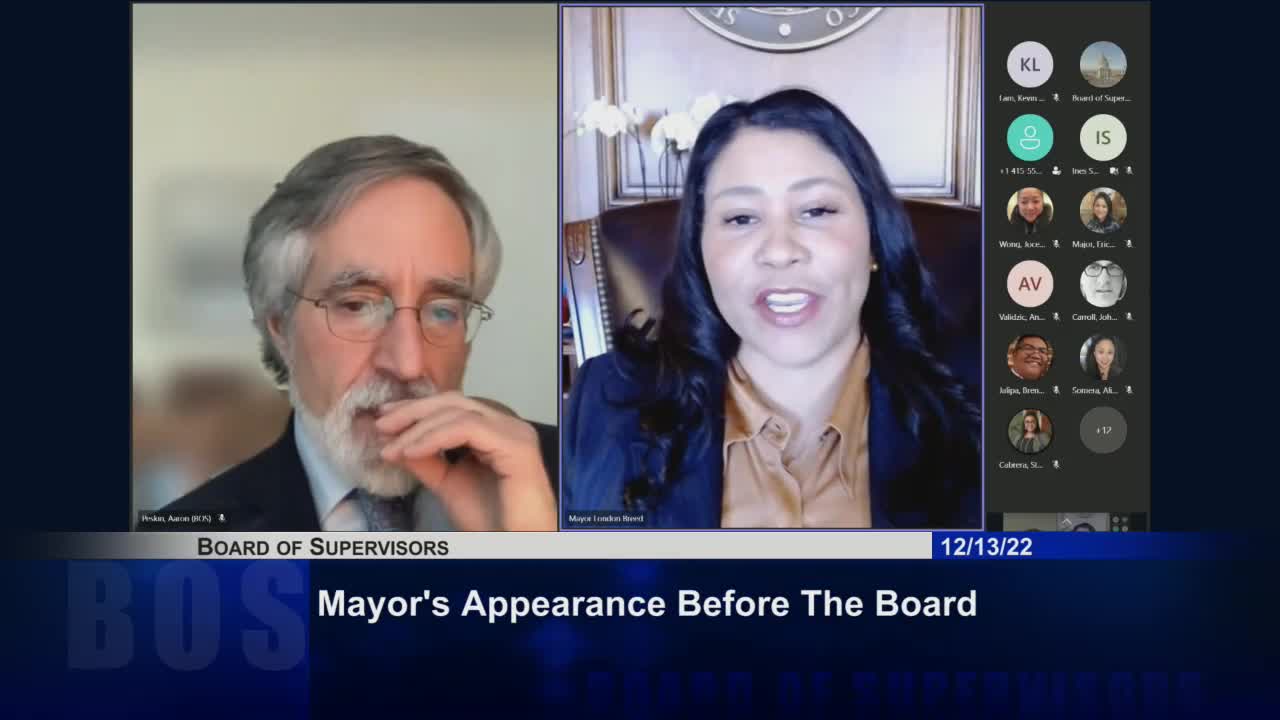
At a Dec. 13 San Francisco Board of Supervisors meeting, Mayor London Breed told supervisors she supports banning pretextual traffic stops but opposes a blanket prohibition on traffic enforcement and raised legal concerns about city-run safe consumption sites.
Mayor London Breed told the San Francisco Board of Supervisors on Dec. 13 that she supports banning pretextual stops — traffic stops initiated on minor violations when the officer's real intent is to investigate more serious crimes — but she said a blanket ban on traffic enforcement would be unsafe and inappropriate.
"I do support it, supervisor," Breed said in response to questions about pretextual stops, adding that she wants officers to base traffic stops on "reasonable suspicion, concrete reasons that an officer must make a record of rather than a mere hunch." She said other jurisdictions have adopted similar policies and seen early positive results.
Breed contrasted that endorsement with her opposition to a separate police commission proposal she called "seriously problematic": a complete ban on police enforcement of a number of moving violations. "Banning the police from enforcing moving violations and dangerous behavior that could result in injury or death makes absolutely no sense," Breed said. "Enforcement is critical to deter people from participating in these activities."
The mayor also discussed the city's efforts on overdose prevention and safe consumption sites. She told the board she remains supportive of safe consumption programs in principle but described substantial legal hurdles to city-operated or city-funded supervised consumption sites. She said the city attorney's office has briefed her on federal legal risks to employees and that the administration is "working aggressively with the Department of Justice on this issue." "This is 1 of the biggest holdups to why we have not moved forward," Breed said.
Supervisor Dean Preston pressed the mayor about the Tenderloin Linkage Center, a temporary facility that closed Dec. 5. Preston said the center had been a key part of a city plan and asked whether the mayor would commit to opening a safe consumption site in the Tenderloin "immediately or at the latest by the end of this fiscal year" as laid out in the Department of Public Health plan. Breed did not commit to an immediate opening, repeating legal concerns and saying the center had "face[d] significant challenges" and was never intended to be a permanent solution.
Breed urged a "balanced approach," pairing public health investments with enforcement against open-air drug markets. "We need both the services and we need accountability," she said.
Why this matters: The exchange highlights a split between elected officials and the police commission over traffic enforcement policy and shows the mayor's dual stance: willing to change police practice on pretextual stops while resisting broader limits on enforcement and cautioning about legal exposure for city-run supervised consumption. The mayor's stated willingness to work with federal authorities and nonprofits signals potential paths forward but leaves timetables uncertain.
Discussion vs. decision: The mayor's remarks were an expression of policy preference and description of ongoing legal work; no citywide ordinance or binding change to enforcement policy was adopted at the meeting. Supervisors and advocates asked for clearer timelines and actions, particularly regarding services in the Tenderloin.
Ending: Supervisors said they will continue to press for actions on the overdose plan and for clarity on legal pathways to supervised consumption, and the mayor reiterated willingness to discuss the issues with the board and other stakeholders.