Get Full Government Meeting Transcripts, Videos, & Alerts Forever!
Get email alerts on the Homelessness Street Conditions topic
No spam. Unsubscribe anytime.
Mayor says more shelter beds, behavioral health outreach and state law changes needed to address Castro street conditions
Summary
Supervisor Rafael Mandelman pressed Mayor London Breed about lingering encampments, open drug use and safety in the Castro; the mayor cited substantial new shelter and treatment capacity coming online, increased outreach staffing, coordination among departments, and the need for changes in state law to compel care in some cases.
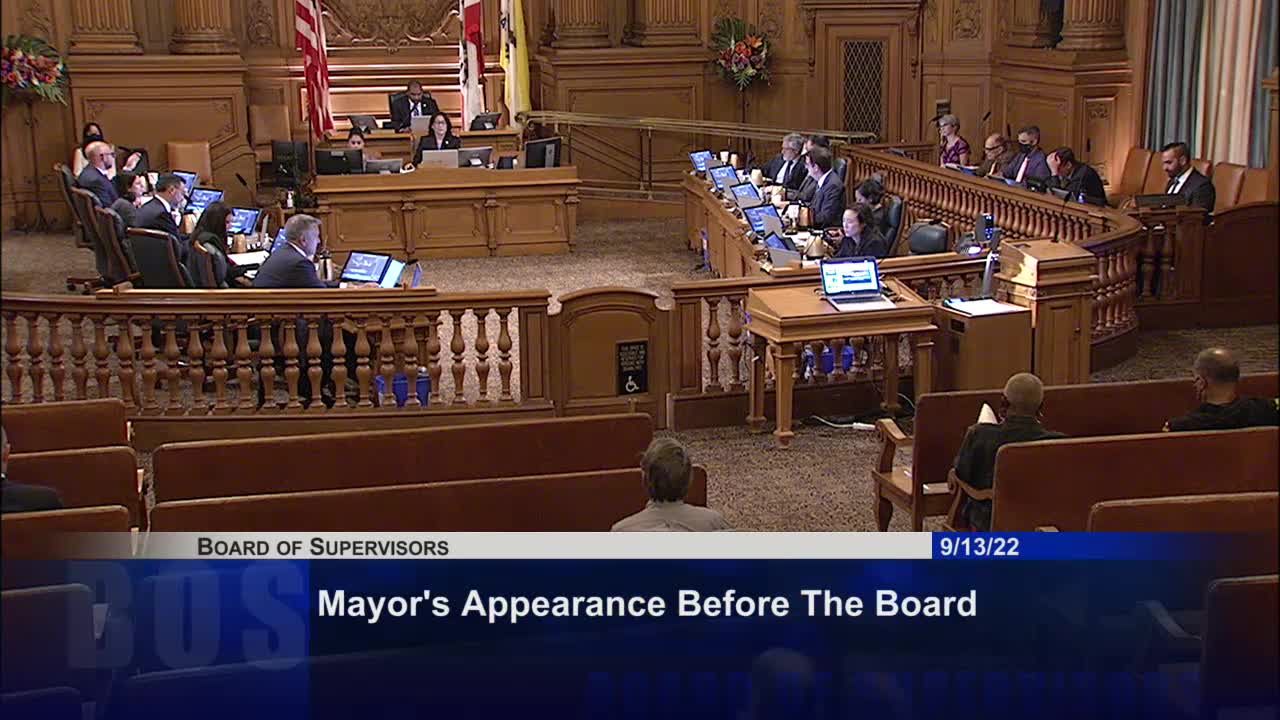
Supervisor Rafael Mandelman told the Board of Supervisors on Sept. 13 that Castro residents remain troubled by encampments, open drug sales and people in crisis, and asked whether the city has a realistic path to improve conditions within a reasonable timeline.
Mayor London Breed said San Francisco has significantly expanded shelter and housing capacity and behavioral health services since 2020, and that the city is adding both short‑term beds and long‑term supported housing. Breed said the city is “on track to open 294 new treatment beds of our committed 400 behavioral health beds” and noted the city’s existing inventory of supportive housing and “over 9,000 housing units.”
Still, Breed said, some people repeatedly refuse offers of shelter and services. She described two parallel responses: faster departmental coordination to identify people who have declined multiple offers and a plan that will “not allow individuals to continue to disrupt the neighborhoods,” and a renewed push for state law changes to permit more conservatorship options for people who won’t accept care. "Care Court will add a new tool for certain individuals," Breed said, referring to state legislation the mayor expects to help, and she said broader conservatorship reforms failed in the state legislature this year but will be pursued again.
Breed said the Department of Public Health has added behavioral health outreach teams working in the Castro with police and other homeless outreach teams. "With this improved coordination, we will identify when someone has clearly rejected our help and a different intervention is required," she said. She asked the supervisors to support police involvement where criminal behavior is present and to back implementation of Care Court when it is available.
Mandelman and Breed both emphasized that the city is continuing to bring additional shelter and treatment resources online and that some progress has been made since 2020. Mandelman pressed the mayor for a clear timeline and for continued coordination with Castro merchants and neighborhood groups; the mayor committed to ongoing collaboration and to returning with more data and proposals as services come online.
Ending: The exchange was part of mayoral question time and contained no binding votes. Breed framed the problem as a combination of capacity additions, enforcement for those who refuse repeated offers of help, and the need for state‑level legal tools to treat some individuals involuntarily when necessary.