Get Full Government Meeting Transcripts, Videos, & Alerts Forever!
Get email alerts on the Behavioral Health Funding topic
No spam. Unsubscribe anytime.
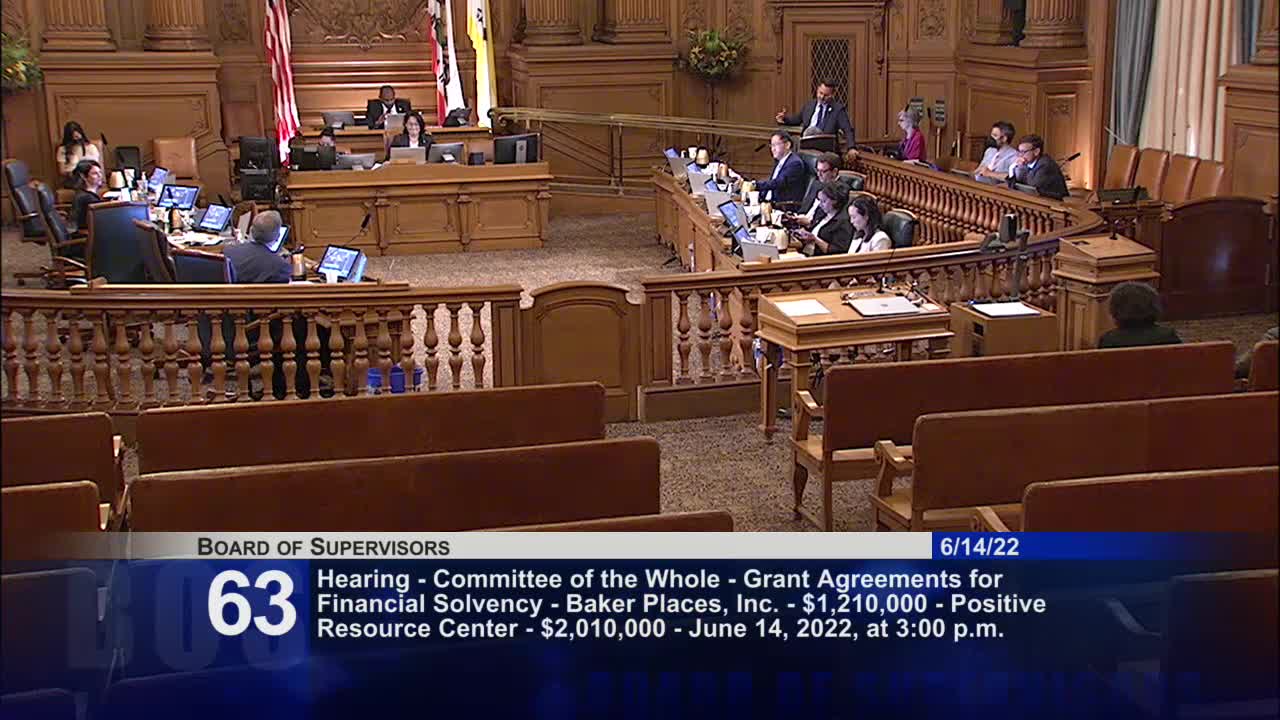
Board approves reduced emergency grants after heated debate over Baker Places and Positive Resource Center solvency
Summary
After extensive questioning, the Board of Supervisors approved a reduced, emergency appropriation to help Baker Places and the Positive Resource Center (PRC) stabilize payroll and operations. DPH and the agencies said deficits and pandemic impacts created a fiscal crisis that threatened continuity of behavioral‑health services.
The Board of Supervisors approved an amended emergency grant package on June 14 to help Baker Places and the Positive Resource Center (PRC) avoid immediate insolvency and preserve behavioral‑health and detox services in San Francisco.
DPH had asked for one‑time, deliverable‑based grants totaling $3.2 million — $1.2 million for Baker Places and $2.0 million for PRC — to keep the agencies operational through the end of the fiscal year and to buy time to develop financial sustainability plans. Baker Places runs detox and residential substance‑use programs and PRC provides related administrative and outreach services and financial assistance.
The request drew intensive questioning from supervisors who said they had not been given sufficient advance information. Supervisor Aaron Peskin, among others, said the scope and timing of the ask were extraordinary and pressed DPH and the agencies for details about the causes of the shortfalls. Deputy finance officer Drew Morell said the department began working with the agencies in mid‑2021 and that a controller’s office analysis identified a combined shortfall of about $3.2 million across the two organizations. "We started hearing from Baker PRC on a deficit begun in 2021," Morell said.
Baker Places and PRC leaders told the board the deficit was driven by long‑running structural gaps, reduced private fundraising during COVID and higher overtime and staffing costs. Baker/PRC CEO Brett Andrews said the organizations had worked with DPH and outside consultants since 2019 to identify and manage a gap at one key program (Joe Healy detox), but the pandemic and turnover in financial staff worsened the picture.
Supervisor Emma Safaí and others criticized the timing — several supervisors said they had been briefed only recently — and argued the agencies should not receive a blanket bailout without more binding long‑term conditions and oversight. Several supervisors said they wanted tighter deliverables and evidence of longer‑term sustainability before voting for a large emergency infusion.
Supervisor Hillary Ronan and others brokered a compromise: the board voted unanimously to approve a substantially reduced emergency package — a combined $1.25 million (amendment adopted June 14) — with stringent conditions. The grants were made explicitly for near‑term payroll and stabilizing operations, were deliverable‑based and required an independent consultant and detailed financial reporting. DPH said payments would be tied to city acceptance of milestones and deliverables and that an independent consultant would review publicly filed financial statements and help craft a sustainability plan.
Board action and oversight: the board adopted Supervisor Ronan’s amendment to lower the immediate appropriation and required DPH to retain an independent consultant, to demand unaudited balance sheets and income statements going back to FY 2017 and to condition future payments on the city’s acceptance of a financial sustainability plan. The ordinances authorizing the grants were approved on emergency reading after the amendment.
Why it matters: Baker Places and PRC operate more than 200 behavioral‑health beds and provide detox services that city officials said would be difficult to replace quickly. DPH warned that if the grants were not approved, services could close and the city would need to identify other providers and potentially disrupt care for people in need of detox and behavioral‑health treatment.
What remains uncertain: Supervisors requested more documentation, including full financial statements, personnel and payroll schedules and plans for rebuilding development/fundraising capacity. Several supervisors said they would follow up in budget hearings and committee sessions to review the consultant’s findings and to consider longer‑term remedies for contracting practices and nonprofit oversight.