Get Full Government Meeting Transcripts, Videos, & Alerts Forever!
Get email alerts on the Transportation topic
No spam. Unsubscribe anytime.
Mayor and supervisors spar over future of pandemic street changes; public provides mixed testimony
Summary
Supervisor Connie Chan pressed Mayor Breed on the future of pandemic-era street measures including JFK Drive, the Great Highway and the slow‑streets program. Breed said departments are collecting data and will present proposals, while hundreds of public commenters expressed both strong support and opposition during general comment.
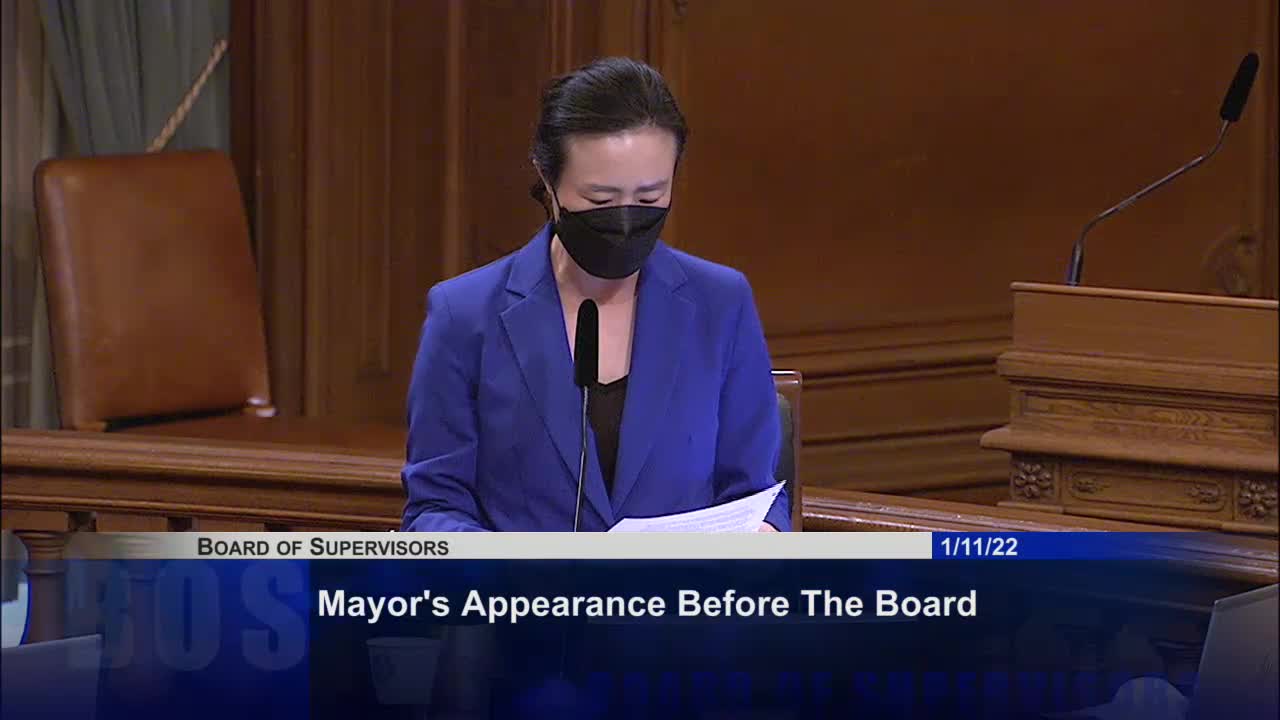
Supervisor Connie Chan asked Mayor London Breed at a Jan. 11 special appearance what the city envisions for pandemic street measures — specifically Great Highway, JFK Drive in Golden Gate Park and the slow‑streets program — and pressed for transparent, inclusive processes that account for access and equity.
"There has been a lot of attention on the future of road measures put in place during the pandemic," Chan said. She told the mayor that last September the Board unanimously passed a resolution calling for a "beach‑to‑bay car‑free connection through the park" if access needs at Eighth Avenue and the parking garage could be addressed.
Breed said the city will rely on departmental analysis and public outreach before adopting long‑term policy. "At the start of this pandemic, our decisions were about prioritizing the health and safety of our citizens," she said. "As we start to look beyond the pandemic, we need to think about what we should continue and what we should reconsider." She said Rec and Park and SFMTA are collecting data on the Great Highway, and SFMTA and Rec and Park plan to bring a Golden Gate Park access and mobility proposal to the Board by spring; SFMTA is also exploring what a permanent slow‑streets program could include and hopes to formalize a proposal by summer.
No final decision
Board members and the mayor described ongoing analysis and outreach; neither the Board nor the administration adopted a binding change to JFK Drive, the Great Highway or slow streets at the Jan. 11 session. Instead, supervisors and the mayor emphasized additional data gathering and community feedback.
Public comment: sharp division
During general public comment following the mayoral appearance, dozens of callers described sharply divided views:
- Supporters said car‑free and car‑light spaces expand safe recreation, encourage walking and biking, reduce pollution and help the city meet climate goals. Parker Day, a District 3 resident, credited agencies and the mayor for pursuing the changes and urged leaders to "double down" on improvements.
- Opponents said closures limit access for people who drive, seniors and visitors with disabilities and create traffic congestion on adjacent neighborhood streets. Sheila Presley, director of education at the de Young Museum, said the museum "houses the city's artwork and should be one of the most accessible buildings in the entire city," and warned that replacement parking is located farther away and "reduces accessibility for those who need it." Other callers raised procedural concerns and alleged insufficient transparency in data collection.
Supervisors press for oversight and hearings
Several supervisors said the city needs an "all hands on deck" response to urgent operational problems — notably testing and school access — alongside careful policy work on street configurations. Supervisor Connie Chan requested a Committee of the Whole hearing at the Jan. 25 meeting to examine the Department of Public Health and the city's testing response; Supervisor Matt Haney and Supervisor Aaron Peskin signaled support for additional oversight and public hearings.
Department process described
Mayor Breed and supervisors described a multi‑step departmental process: Rec and Park and SFMTA are collecting usage and equity data for Golden Gate Park and the Great Highway; SFMTA is surveying residents and reported more than 10,000 responses regarding JFK Drive (Supervisor Chan cited that number). Breed said the departments are reaching out to demographic groups that underresponded to initial surveys, including seniors, communities of color and non‑English speakers, and she requested the departments provide supervisors with engagement records.
What remains unresolved
- No binding action on permanent configuration of JFK Drive or the Great Highway was taken at the Jan. 11 meeting. - Departments are expected to return with formal proposals: a Golden Gate Park proposal by spring and a slow‑streets program proposal by summer. - Supervisors and public commenters asked for clearer data, expanded outreach, and written records of engagement and technical analysis.
Speakers
- Connie Chan — Supervisor, District 1 (government) - London Breed — Mayor (government) - Sheila Presley — Director of Education, de Young Museum (citizen/organization) - Parker Day — Resident (citizen) - Luke Bornheimer — organizer (citizen) - Victoria Bruckner — Resident (citizen)
Authorities
- Board resolution (September 2021) referenced by Supervisor Chan calling for a car‑free connection through Golden Gate Park (referenced_by:["Supervisor Chan remarks 01/11/2022"]).
Discussion vs. decision
The Board held an extended policy discussion and public comment period; no formal action was taken to change the status of JFK Drive, the Great Highway or the slow‑streets program. Departments were tasked to continue data collection and community outreach and to present formal proposals to the Board later in the spring and summer.
Clarifying details
- Public engagement: Supervisor Chan said SFMTA received "over 10,000" survey responses about JFK Drive; the mayor and supervisors said departments are doing additional targeted outreach to underrepresented demographics. - Timelines from the mayor: Rec and Park / SFMTA proposal for Golden Gate Park due to Board by spring; SFMTA hopes to formalize a permanent slow‑streets program by summer.
Community relevance
- Geographies: Golden Gate Park, JFK Drive, Great Highway, citywide slow‑streets network. - Impact groups: pedestrians, cyclists, people with disabilities, seniors, museum visitors, nearby residents, transit users.
Meeting context
- Engagement level: High — extended mayoral exchange and an unusually large public comment queue devoted to park and street closures. - Implementation risk: Medium — any change will require interagency coordination (Rec and Park, SFMTA), outreach to vulnerable populations, and possibly capital or operational investments.
Searchable_tags:["JFK Drive","Great Highway","slow streets","Rec and Park","SFMTA","accessibility","Golden Gate Park"]