Get Full Government Meeting Transcripts, Videos, & Alerts Forever!
Get email alerts on the Homelessness topic
No spam. Unsubscribe anytime.
Board continues Tenderloin emergency hearing after update on new Linkage Center; supervisors press for metrics, beds and policing data
Summary
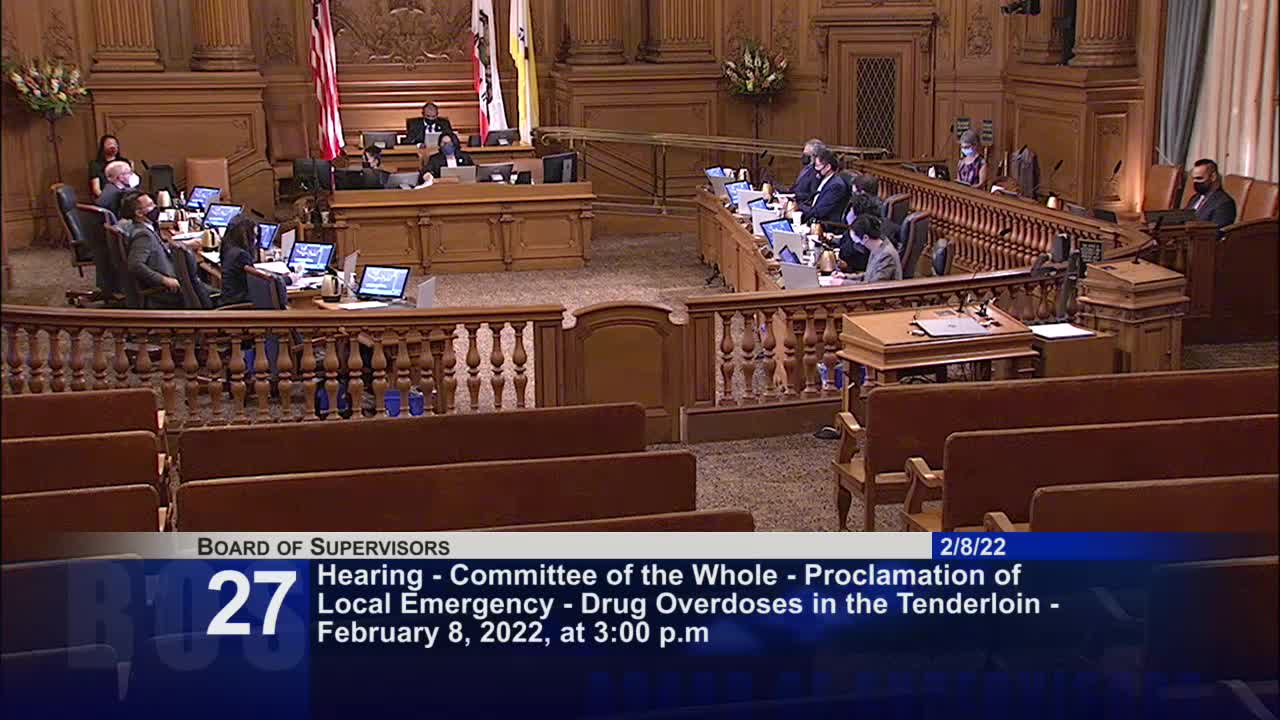
San Francisco city leaders reviewed the city's response to a spike in overdoses and open‑air drug activity in the Tenderloin during a committee‑of‑the‑whole hearing that the Board of Supervisors continued to March 15, 2022.
San Francisco city leaders reviewed the city's response to a spike in overdoses and open‑air drug activity in the Tenderloin during a committee‑of‑the‑whole hearing that the Board of Supervisors continued to March 15, 2022.
The Department of Emergency Management (DEM), the Department of Public Health (DPH), the Department of Homelessness and Supportive Housing (HSH) and other agencies described a set of short‑term operations launched under the mayor's emergency declaration and outlined initial results from a newly opened Linkage Center intended to provide low‑barrier services and connections to treatment, shelter and housing.
DEM director Mary Ellen Carroll told the board the initiative is operating in multiple phases: an initial assessment and engagement phase, an active operations phase that began in mid‑December, and a planned sustained operations phase focused on restoration and recovery. "We started in mid‑December and focused on connecting people to services, intervening in street activity and addressing infrastructure," Carroll said. She described the Linkage Center as a "one‑stop shop" providing basic needs, case management and referrals and said the city plans to expand hours and services.
DPH officials said the center had hundreds to thousands of visits in its first weeks and produced dozens of service referrals. Dr. Hilary Conins said the center logged about 1,800 visits in one week, produced roughly 30–35 referrals per week to substance use or mental‑health treatment in the early weeks, and showed steady growth in linkages as outreach and the center's services stabilized. "Preventing overdose deaths is one of the key goals," Conins said. She said staff had reversed several overdoses at the facility and were expanding medication‑assisted treatment access.
HSH deputy director Emily Cohen said outreach teams had made shelter and housing placements and that the board earlier authorized funding for a 250‑person shelter at 711 Post Street; she told supervisors the department had made roughly 150 shelter placements associated with this effort and had 72 people in a formal housing process.
Police Chief Bill Scott described enforcement work aimed at disrupting street sales while coordinating with the Linkage Center and other services. He said narcotics enforcement and seizures of fentanyl have risen, but that COVID‑related staffing shortages and earlier redeployments to November's Union Square response affected deployment patterns. "Our narcotics detail will continue to enforce sales activities," Scott said, and he said the department had increased visible patrols and special assignments to provide "safe passage" for children and residents in the neighborhood.
Supervisor responses and public testimony emphasized two persistent themes: community members and nonprofits pressed for clearer, outcome‑oriented metrics and more long‑term shelter capacity, while others warned that increased enforcement can raise overdose risks if it displaces markets without increasing services.
Supervisor Aaron Peskin, who represents adjacent neighborhoods and led discussion of a separate City grant to operate shelter services at 711 Post Street, told the board the initial rollout of that shelter had upset local residents but said subsequent meetings with the Department of Homelessness and the operator Urban Alchemy produced commitments on neighborhood engagement, trash pickup and additional street presence. "We are going to start with weekly meetings. I am going to be a constant presence on the 700 block of Post Street," Peskin said. HSH described a letter of collaboration and said parties were negotiating final signatures and a possible purchase agreement for the property to create longer‑term stability.
Community groups and public commenters urged the board to adopt impact metrics that measure reductions in fatal overdoses, placements into shelter and permanent housing, and equitable outcomes by race and language. Jennifer Friedenbach of the Tenderloin Emergency Coalition presented a community‑draft set of "impact metrics" and asked DEM to adopt measurable goals tied to the initiative's objectives.
The board voted unanimously to continue the public hearing and committee review of the proclamation of local emergency and related matters to March 15, 2022, and, earlier in the meeting, adopted a separate allocation authorizing a grant agreement for operations at 711 Post Street (Urban Alchemy) after extended public discussion. No formal changes to the emergency order itself were made at the hearing; supervisors asked departments to return with more data on outcomes, arrests and deployment patterns.
Why it matters: The Tenderloin represents the intersection of public health, law enforcement and homelessness policy in San Francisco. City officials said the Linkage Center and nightly operations are intended to reduce overdose deaths while offering pathways into treatment and shelter, but the board and community groups pressed for clearer, disaggregated metrics, additional shelter beds and sustained neighborhood accountability for street conditions.
What happens next: The board will reconvene the public hearing on March 15, 2022, as a committee of the whole to review updated metrics and operations reports. Departments said weekly public operational updates will continue and that they would present revised impact metrics within weeks.
Quotations: "The Linkage Center aims to promote a thriving community and save lives through overdose prevention," Director Mary Ellen Carroll said. "We have naloxone widely throughout the facility that guests and staff may access," Dr. Hilary Conins said. "We are going to start with weekly meetings. I am going to be a constant presence on the 700 block of Post Street," Supervisor Peskin said.
Ending: The board's March 15 review is expected to include new, outcome‑oriented metrics and updated data on shelter placements, referrals and enforcement activity; supervisors said they will monitor whether operations reduce fatal overdoses while protecting the rights and safety of Tenderloin residents and visitors.