Get Full Government Meeting Transcripts, Videos, & Alerts Forever!
Get email alerts on the Public Safety Policy topic
No spam. Unsubscribe anytime.
Supervisors order gap analysis of Police Code Article 25 to modernize private‑security oversight
Summary
Following complaints of harassment by private security, the Board directed the police department and controller to analyze what is required to implement and modernize Article 25 of the Police Code, including complaint processes, nondiscrimination measures and penalties.
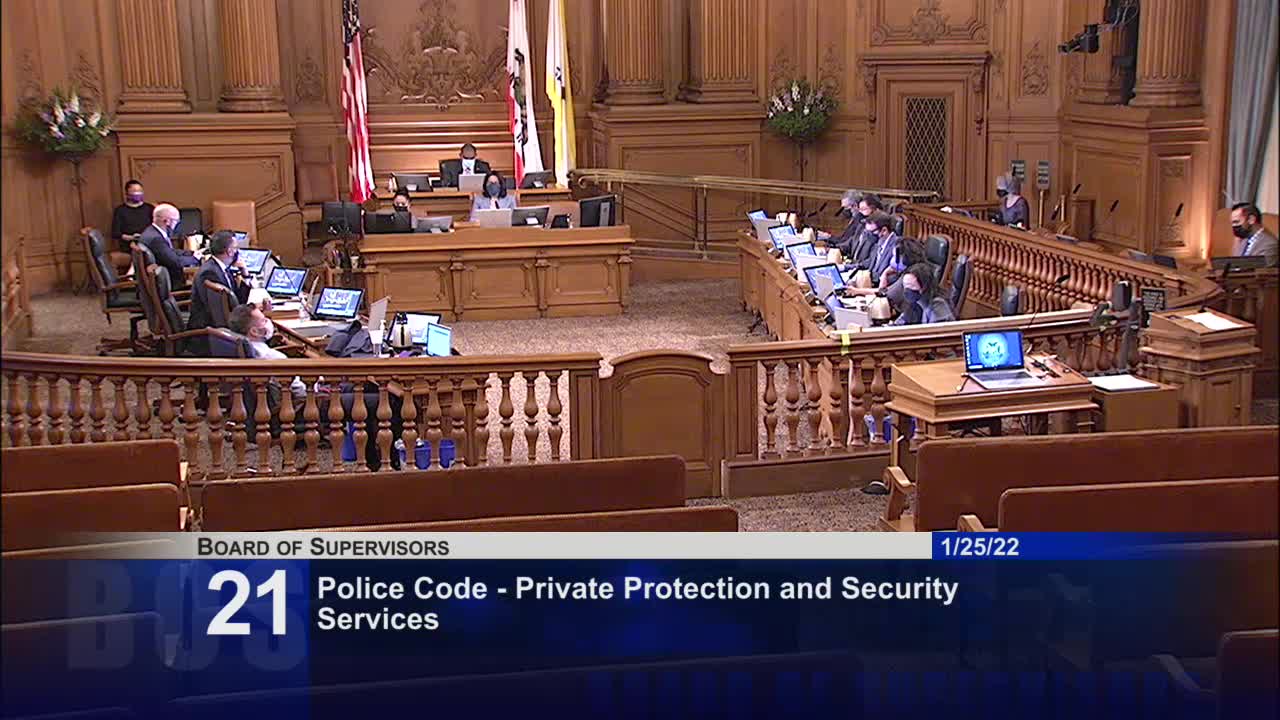
San Francisco — The Board of Supervisors voted unanimously on Jan. 25 to require the Police Department, in consultation with the Controller’s Office, to conduct a gap analysis of Article 25 of the Police Code and to report back on steps needed to implement or modernize local oversight of private security firms.
Why the board acted: The ordinance was introduced after community complaints that private security guards had harassed residents and after staff discovered that Article 25 — a 1972 framework that requires private security firms to register with the Police Department and for the chief to issue ID cards — had not been meaningfully implemented. Sponsors said the law is outdated and lacks explicit nondiscrimination and complaint processes now expected under modern standards and state licensing rules.
What the analysis must cover: The ordinance requires the Police Department to determine what it would take to implement Article 25 practically, to identify any portions preempted by state law, and to recommend updates such as an appeals process for denied or revoked registrations, nondiscrimination and bias‑elimination requirements for registrants, penalties for discriminatory practices and improper firearm drawing, and a public complaint process.
Timeline and next steps: The board directed the Police Department to produce the analysis within six months of passage and to work with the Controller’s Office and California Department of Justice staff as necessary. The analysis is intended to feed subsequent ordinance drafting or administrative changes.
Debate and support: Sponsors and several supervisors cited examples of alleged racial profiling and confrontations between security personnel and community members. The police chief’s office and the police commission were described on the record as cooperative in the effort; Supervisor Stephanie and multiple colleagues were recorded adding their names as co‑sponsors.
What it does not do: The ordinance does not itself change licensing at the state level; sponsors acknowledged state licensing and the risk of preemption and asked the analysis to explicitly address those questions.
Quote: “We unearthed Article 25… it’s not currently implemented in any meaningful way,” sponsor Supervisor Stephanie said during floor remarks.