Get Full Government Meeting Transcripts, Videos, & Alerts Forever!
Get email alerts on the Public Space Shared Spaces topic
No spam. Unsubscribe anytime.
Board adopts permanent ‘Shared Spaces’ rules after hours, enforcement and agency roles win last‑minute debate
Summary
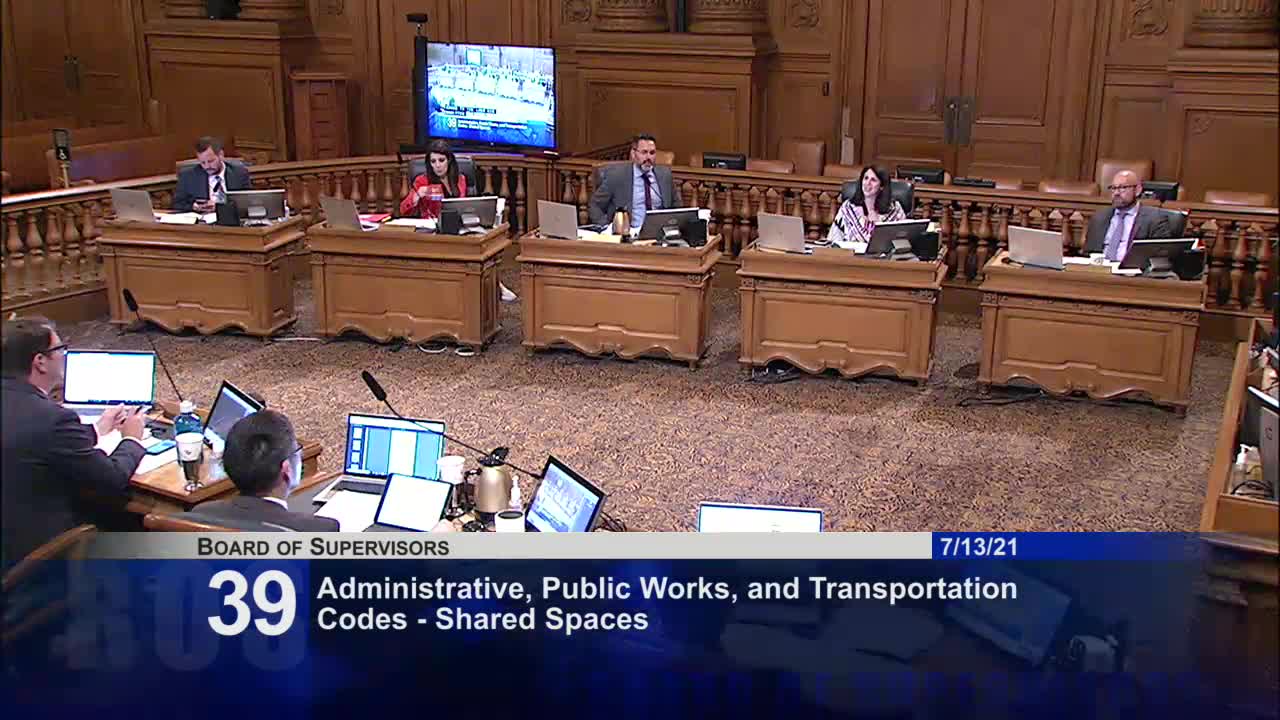
San Francisco supervisors on July 13 adopted an amended ordinance to make the COVID‑era “shared spaces” program permanent after a lengthy debate over which agency should lead the program and whether businesses may secure curbside shared space overnight.
San Francisco supervisors on July 13 adopted an amended ordinance to make the COVID‑era “shared spaces” program — which lets businesses expand onto sidewalks and curbside parking — a permanent program, after a contentious debate over which city department should administer it and whether businesses may secure curbside shared space overnight.
The debate centered on two issues: whether Planning or the Department of Public Works (DPW) should be the coordinating agency for permitting and whether fixed commercial parklets and movable commercial parklets should be allowed to be secured overnight. Supervisor Safai proposed a suite of amendments to move administration to Planning and to allow permittees to secure curbside shared space overnight between midnight and 7 a.m.; several supervisors amended those hours during floor debate.
“Planning has done tremendous work to shepherd this program,” Supervisor Safai said in support of returning administration to Planning, and asked that the department “provide holistic coordination… taking into account land use, transportation, public space and urban design.”
Opponents said DPW is the day‑to‑day permitting and enforcement agency for sidewalks and curbside uses. “The department that issues the permit should be accountable,” said Supervisor Peskin, who argued DPW is better positioned to issue and enforce curb permits. Peskin warned that moving oversight to Planning without more staffing would simply shift work and later require funding increases.
Supervisors also debated whether the ordinance should require a public seating element when the space is not activated for commercial use, and how much access the public should have when a business is not operating. Supporters of public access — including Supervisor Preston and Supervisor Ronan — said the city is exchanging public right‑of‑way for private economic benefit and should retain robust public access when businesses are not operating.
Two separate amendment votes were recorded on the floor. The first motion (to replace multiple references to DPW with Planning and related coordinating duties) passed 7‑4. A second amendment that would explicitly permit permittees to secure curbside shared spaces overnight passed 6‑5 after a friendly change narrowing the hours. After amendments were adopted, the chamber passed the ordinance on first reading unanimously.
Supervisors said the ordinance will be monitored and likely tweaked after experience in implementation. The ordinance includes design standards, insurance requirements for permittees, and a requirement that programs provide some alternative public seating tied to curbside shared spaces.
The Board’s action keeps in place a recovery tool the city’s restaurant and small‑business community said they depend on while adding new coordination and reporting requirements supervisors said would help monitor equity, public access and enforcement.