Get Full Government Meeting Transcripts, Videos, & Alerts Forever!
Get email alerts on the Transportation Finance topic
No spam. Unsubscribe anytime.
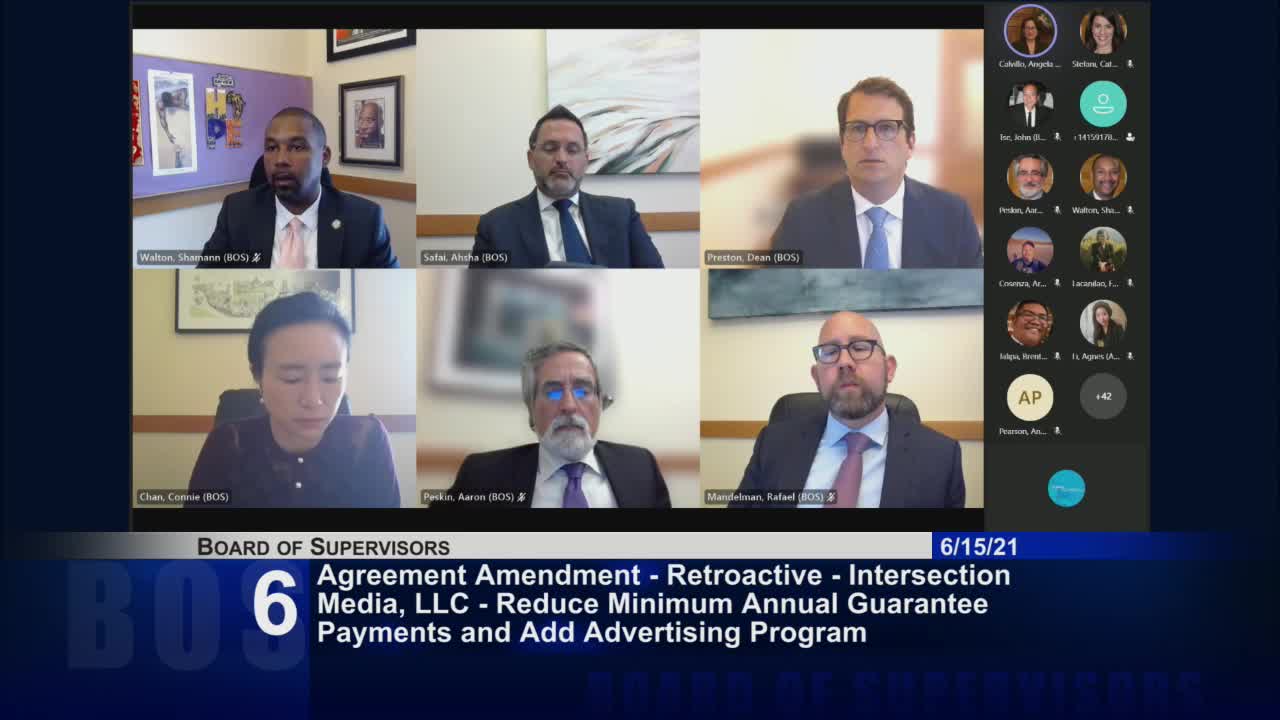
Board approves MTA advertising contract amendments; supervisors debate $13.55 million waiver and links to service restoration
Summary
The Board of Supervisors approved two measures reducing minimum annual guarantees on transit advertising contracts. Supervisor Aaron Peskin and others supported the packages; Supervisor Dean Preston pushed for clarity on whether federal relief funds used to cover the reductions could otherwise restore suspended transit service.
The San Francisco Board of Supervisors on June 15 approved two resolutions that retroactively reduce minimum annual guarantee payments in municipal transit advertising contracts and extend related agreements, measures the Municipal Transportation Agency (MTA) said were needed because advertising revenue fell sharply during the COVID-19 pandemic.
Supervisor Dean Preston pressed MTA officials for detail at the hearing, saying he was "troubled by this item" and describing the action as effectively "waiving $13,600,000 in money that we are getting from COVID relief" (he later acknowledged the figure as $13,550,000). Preston asked whether spending federal relief funds in this way would reduce money otherwise available to restore suspended transit lines.
Gail Stein of the MTA said the $13,550,000 amount covered revenue losses from the start of the pandemic through June 30, 2022, and cited contract language allowing the agency and contractor to "negotiate in good faith to reduce the minimum annual guarantee" when a defined reduction in vehicles occurred. Jonathan Ruers of the MTA explained that advertising is one of several operating revenue sources for the agency and that federal relief rules allow the agency to claim revenue losses for reimbursement by the Federal Transit Administration.
Preston pressed MTA officials on whether collecting the revenue rather than accepting the reduction would change timelines for restoring service. MTA staff said the money would be general operating revenue that could be used for transit service; they added that the $13.55 million figure represented a ceiling on potential losses and that actual amounts could be lower depending on future advertising performance.
The board voted 6-4 to approve the first advertising amendment involving the vehicle/Intersection contract (item 6). Several supervisors, including Preston, voted no. A separate resolution (item 7) on transit-shelter advertising and Clear Channel Outdoors, which proponents said protected jobs and shelter maintenance, passed unanimously.
Actions: The board recorded the votes as follows: item 6 passed by a vote of 6 ayes, 4 noes; item 7 passed by a unanimous vote of 10 ayes.
Ending: The MTA said additional advertising revenue, if collected, would be treated as operating funds and applied toward transit service. Supervisors who opposed the waiver said they wanted clearer assurance that the agency27s revenue choices would not impede service restoration.