Get Full Government Meeting Transcripts, Videos, & Alerts Forever!
Get email alerts on the Small Business Relief topic
No spam. Unsubscribe anytime.
Supervisors hold wide hearing on COVID economic pain; restaurants, venues and small businesses press for grants and outdoor dining
Summary
Board members heard multi‑hour testimony from city analysts, economic-development officials, the public health officer and hundreds of small business owners and workers. Presenters described steep revenue declines and urged direct grants, rent relief and a permanent shared‑spaces policy.
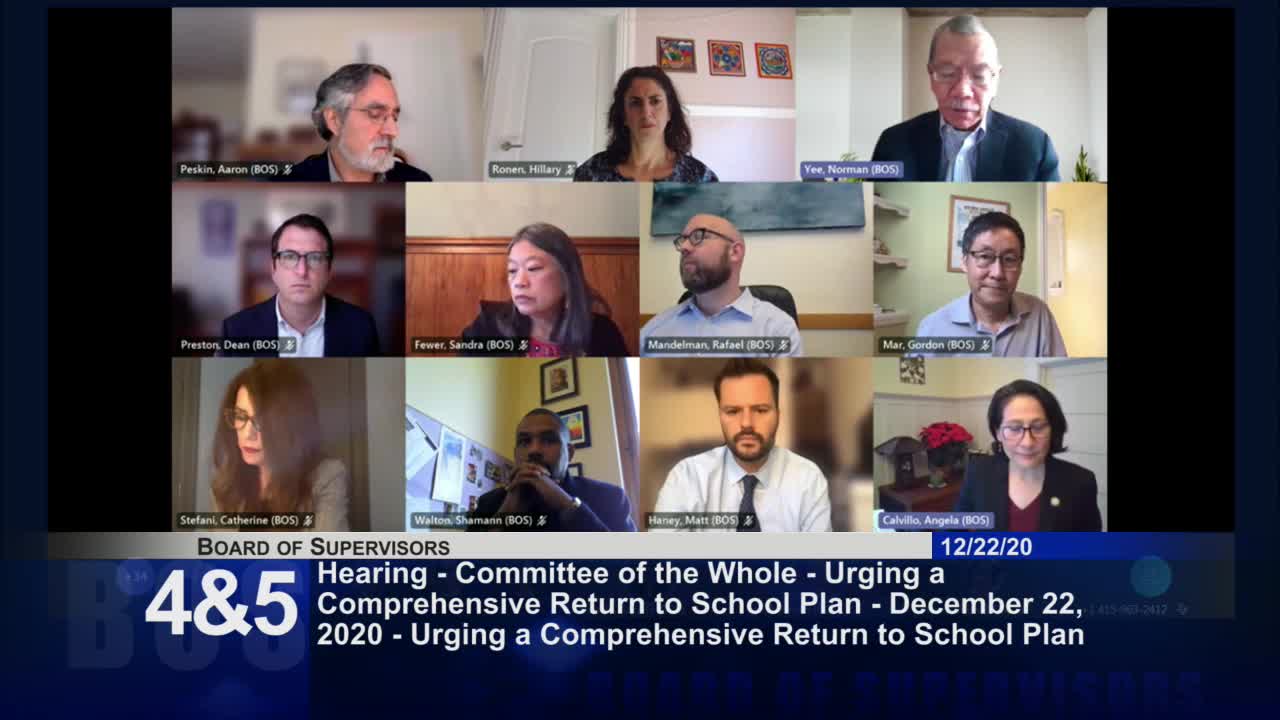
San Francisco supervisors convened a marathon hearing Tuesday focused on the economic pain of the pandemic, drawing presentations from city analysts and agencies and more than two dozen public commenters who described mounting debt, lost customers and closures in restaurants, entertainment venues, personal‑care and neighborhood retail.
The hearing combined staff briefings and a broad public comment period on items 6 through 8 on the agenda: the local impacts of the recent regional stay‑at‑home order, a resolution urging Congress to pass dedicated restaurant relief, and a call for the California government to allow outdoor dining as soon as public health data permit.
City analysts outlined steep declines in taxable sales, the disproportionate effect on leisure and hospitality employment and preliminary estimates of unpaid commercial rent. Fred Brusseau of the Budget and Legislative Analyst’s office said the federal Paycheck Protection Program and Economic Injury Disaster Loans had steered billions to Bay Area businesses but left gaps. Brusseau presented a Census pulse estimate that as many as several thousand San Francisco small businesses reported temporary closures in early December, and he estimated unpaid retail rent in the city could be in the low tens of millions per month.
Controller Ted Egan said San Francisco’s economy is split: "We have two economies," he said. Office‑based, high‑wage sectors have generally held up as workers operate remotely, he said, while neighborhoods dependent on tourism and foot traffic have been devastated. "San Francisco consistently has more businesses closed than other big cities in the state," Egan said.
Director Brooke Torres of the Office of Economic and Workforce Development reviewed local relief the city has provided — roughly $24 million in loans and grants and $19.5 million in worker assistance — and urged continued coordination to help businesses access incoming federal and state funds. The city’s Office of Small Business reported having served more than 5,100 businesses since March and said many applicants still lack access to federal programs because of language or banking barriers.
The city’s Entertainment Commission and Small Business Commission urged targeted help for live music venues and nightlife, structures that city and business speakers called at special risk because they have been closed for months and often face high fixed costs. "Without financial support the need to remain closed while incurring ongoing revenue loss and continued high overhead may lead to the permanent closure of live music venues across San Francisco," Entertainment Commission Director Maggie Weiland told supervisors.
Public health: Dr. Susan Philip, acting public health officer, explained why officials tightened the region’s rules in December. "There is much more virus circulating in San Francisco now than there ever has been before," she said, citing daily new‑case rates and clustered forecasts. Dr. Philip warned the board the region had less than a cushion of intensive‑care capacity and described how the local stay‑at‑home order aimed to preserve hospital capacity. She told supervisors the science supports outdoor activities as lower‑risk than indoor ones but said the decision to restrict activities responds to current levels of community transmission: "Once your case rate per 100,000 is above 25, it really becomes widespread transmission," she said.
Public testimony: More than 100 callers joined the hearing; dozens of small business owners and employees described six‑figure revenue losses, unpaid rents and a reliance on loan products they said increased debt. Many asked the city for grants rather than additional loans or deferrals, and asked that temporary parklet and shared‑spaces programs, which enabled outdoor service over the summer and fall, be extended or made permanent. "We need grants, not more loans," one restaurateur said. Entertainment and venue operators urged a dedicated local fund to stabilize performance spaces, and multiple speakers urged the board to pressure state or federal authorities to permit outdoor dining sooner.
What DPH said: Dr. Philip told the board that case investigation and contact‑tracing data are limited and incomplete during a surge and that public health officials rely on hospital and case‑rate markers to guide region‑wide reopening and rollbacks. She said the city would lift the stay‑at‑home restrictions only when local ICU capacity rose and cases fell for consecutive weeks.
What happened: The hearing produced no immediate vote on a policy change; supervisors and staff signaled they will pursue multiple follow‑ups, including exploring how to prioritize small‑business relief if federal or discretionary local funding becomes available and potential extensions of shared‑spaces programs. Several supervisors said they would seek to make small‑business relief a budget priority and to press for grants and targeted funds for venues and neighborhoods most at risk.
What’s next: Supervisors proposed additional measures during the same meeting, including a draft ordinance and resolutions to prioritize small‑business relief, push for a permanent shared‑spaces program and create a venue recovery fund. The Board asked city departments to stay engaged and to help coordinate outreach so businesses can access incoming federal and state aid quickly.
Why it matters: Small businesses are concentrated employers in neighborhood commercial corridors and have been hit hardest by the stay‑at‑home orders and the collapse of visitor and commuter traffic. Business owners said quick and targeted fiscal support will determine whether many can survive and whether San Francisco’s neighborhood retail and cultural scene can recover.