Get Full Government Meeting Transcripts, Videos, & Alerts Forever!
Get email alerts on the Public Health topic
No spam. Unsubscribe anytime.
Board reenacts emergency ordinance to protect residential-hotel occupants and requires DPH protocols
Summary
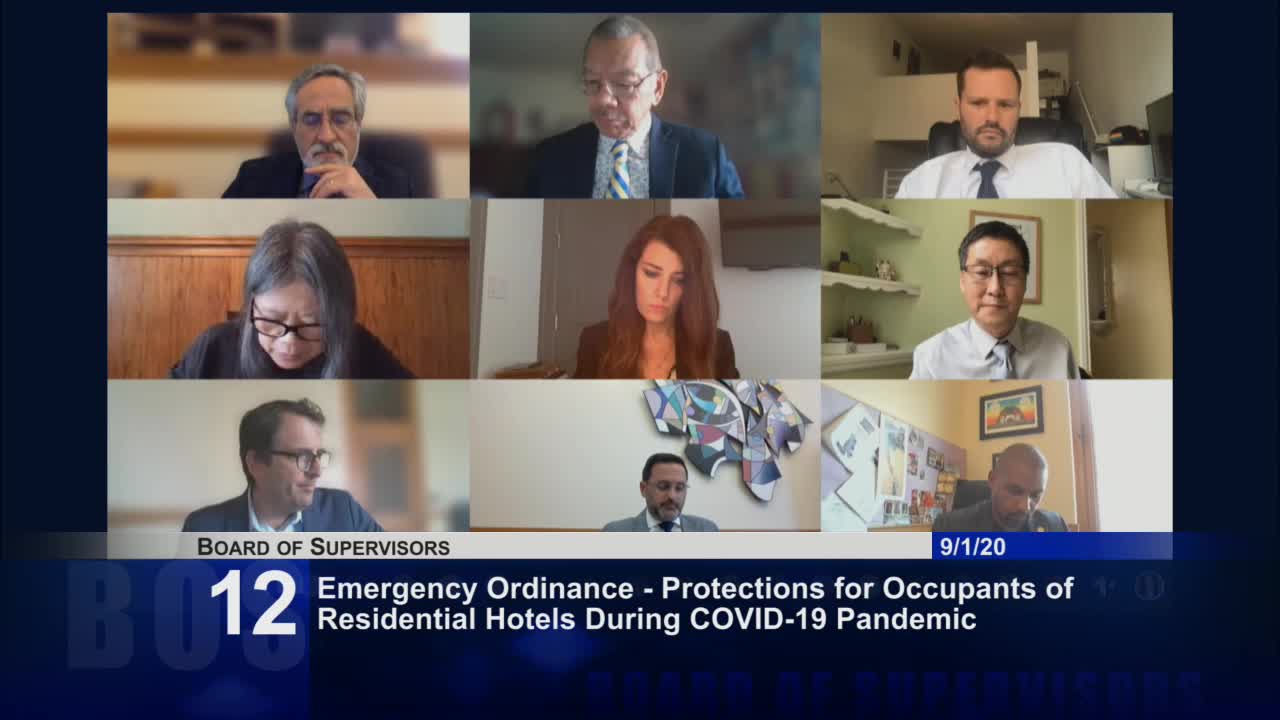
The Board reenacted an emergency ordinance (revising Emergency Ordinance 84-20) to strengthen protections for residential-hotel (SRO) occupants during COVID-19 and directed the Department of Public Health to develop prevention, notice and tracking protocols; the ordinance passed unanimously after a small amendment on mask provision.
The San Francisco Board of Supervisors on Sept. 1 reenacted an emergency ordinance to extend and clarify COVID-19 protections for occupants of residential hotels (single-room occupancy, or SRO, buildings).
The ordinance reenacts and amends Emergency Ordinance No. 84-20 and directs the Department of Public Health (DPH) to develop SRO-specific prevention, notice, treatment, resources and tracking protocols. The measure is written as an emergency ordinance and required a two-thirds vote (eight votes) for final passage; the board voted unanimously in favor.
Supervisor Aaron Peskin, sponsor of the reenactment, thanked the Department of Public Health and community advocates and presented a non-substantive amendment during the meeting requiring DPH to "provide or cause to be provided" necessary face coverings to SRO residents and workers within 12 hours after receiving confirmation that an area of an SRO has been occupied by someone exposed to COVID-19. The city attorney reviewed and cleared the amendment.
The ordinance also restates city policy regarding solitary hotel placement and SRO isolation/quarantine authority under County public-health guidance and requires DPH to prepare protocols for prevention, protection, notice, treatment, resources and tracking for SRO residents. Supporters said the ordinance codifies protections for a vulnerable group with high densities and shared facilities.
The measure passed on a unanimous roll call (11-0). The board recorded the vote without further amendments and directed staff to implement the ordinance and report back where required.
Why it matters: SRO residents are among the city—s most vulnerable due to shared bathrooms and communal spaces; the ordinance seeks to ensure rapid notification, supply of PPE and coordinated isolation/quarantine support during the COVID-19 public-health emergency.