Get Full Government Meeting Transcripts, Videos, & Alerts Forever!
Get email alerts on the Transportation topic
No spam. Unsubscribe anytime.
Board upholds Planning Departmentdecision that Slow Streets Phase 1 is exempt from CEQA after heated hearing
Summary
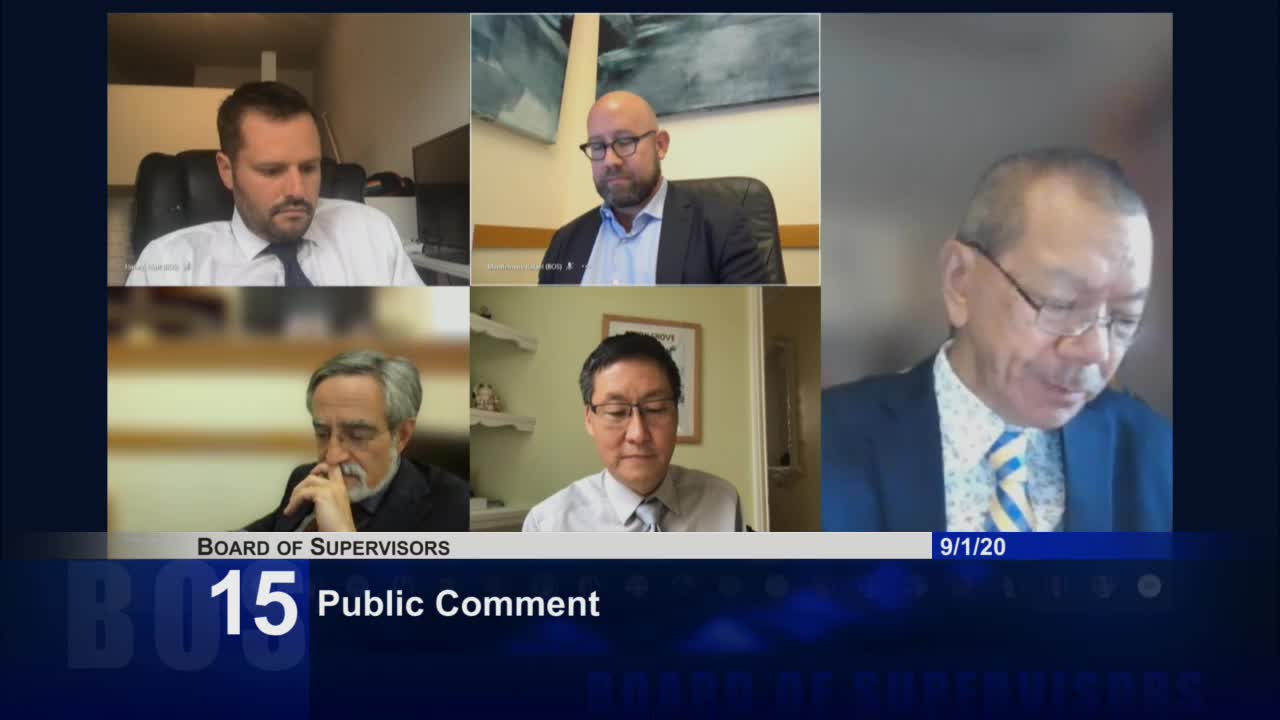
After nearly three hours of testimony for and against Slow Streets Phase 1, the San Francisco Board of Supervisors voted 11-0 to affirm the Planning Department—s determination that the MTA—s temporary Slow Streets Phase 1 project qualified for a statutory emergency exemption under CEQA.
The San Francisco Board of Supervisors voted 11-0 on Sept. 1 to affirm the Planning Department—s finding that the Municipal Transportation Agency—s (MTA) Slow Streets Phase 1 project is statutorily exempt from environmental review under the California Environmental Quality Act (CEQA).
The vote came after a public hearing that drew residents, neighborhood groups and dozens of callers who both supported and opposed the project. The board—s action affirms the planning department—s determination that the project qualified as an emergency statutory exemption under CEQA guidelines (Gov. Code/PRC guidance cited in the hearing).
The project, launched by the MTA in late April as the city responded to COVID-19, temporarily restricts through motor-vehicle traffic on selected residential corridors to provide more space for walking and bicycling while social distancing. The planning department and MTA officials told the board the project uses movable barricades and temporary signage and that any future permanent infrastructure would require a separate public process and environmental review.
At the start of the hearing, Laura Lynch, senior environmental planner for the Planning Department, told the board that COVID-19 meets the statutory definition of an emergency and that the Slow Streets Phase 1 effort is intended to "temporarily provide limits to vehicular traffic ... to provide individuals walking or bicycling with additional space to safely maintain necessary 6 feet of separation." Lynch said the department had posted and issued CEQA determinations for the project as required by local and state procedures.
Appellants and many callers urged more study. Mary Miles, representing the Coalition for Adequate Review, argued the project—s scope had expanded beyond a temporary emergency response and said the record lacked evidence that sidewalks were inadequate to allow social distancing or that closing streets would "prevent or mitigate loss of life or essential government services." Miles said she had asked the board to continue consideration until MTA—s subsequent phases and paperwork could be considered together. "An accurate and finite project description is the basic requirement of CEQA to enable informed decision making," Miles said.
Shannon Hake, Slow Streets program manager at the MTA, said the program initially deployed materials quickly when shelter-in-place orders left people with fewer transportation options and Muni running at reduced levels. Hake said the program—s outreach included a project website and a public survey that received more than 5,000 responses, with "85% of the survey responses ... very supportive of the program." She said five of the 12 corridors originally identified in Phase 1 were implemented and seven were removed because of conflicts with emergency access, loading, or commercial needs.
Members of the public told the board they used the slow streets for exercise, to allow children to learn to ride bicycles, and to help maintain mental and physical health during the pandemic. Opponents said the closures caused traffic to divert onto other streets, raised public-safety and emergency access concerns and lacked adequate signage or enforcement.
Supervisor Matt Haney, among those who spoke in support of affirming the exemption, argued that the pandemic is a "sudden unexpected occurrence" that affects life and health and that allowing MTA to deploy temporary measures to facilitate social distancing fit the emergency exemption. Several colleagues agreed that the MTA—s materials were temporary and that any permanent elements would require separate review.
After questions to planning and MTA staff about materials, outreach and emergency access, Supervisor Aaron Peskin moved to approve the planning department—s determination and to table the motions that would have reversed it or directed findings. Supervisor Preston seconded the motion. The roll call vote was 11 in favor, none opposed.
The board—s action affirms the Planning Department—s statutory-exemption determination for Slow Streets Phase 1; the Planning Department and the MTA said any future proposals to make curb or roadway changes permanent would be subject to additional environmental review and public process.
Why it matters: The vote preserves city authority for rapid, temporary responses to public-health emergencies while leaving a pathway for later, fuller review if the MTA or other agencies propose permanent street changes.