Get Full Government Meeting Transcripts, Videos, & Alerts Forever!
Get email alerts on the Public Safety Curfew topic
No spam. Unsubscribe anytime.
San Francisco supervisors delay vote on mayor's emergency curfew after tense debate and heavy public comment
Summary
After a day of testimony from police and sheriff officials and more than an hour of public comment, the San Francisco Board of Supervisors authorized procedural findings to consider the mayor's emergency declaration but did not concur in the curfew. The board voted 6–5 to continue final action to a special meeting on Thursday.
The San Francisco Board of Supervisors on Tuesday approved procedural findings that allowed the board to consider Mayor London Breed’s May 31 emergency declaration and related curfew, but it stopped short of concurring in the curfew itself and voted to continue final action to a special meeting on Thursday.
The procedural votes — required under the Sunshine Ordinance and the Brown Act to consider items that arose after the agenda was posted — passed unanimously. Deputy City Attorney Anne Pearson told the board that state law requires the board to concur in a mayoral declaration of local emergency within seven days, and that actions taken under the declaration (including a curfew) remain in effect while the declaration stands.
Why it matters: The mayor’s declaration and the curfew, issued after protests over the Minneapolis killing of George Floyd escalated in San Francisco, would allow police to enforce a citywide 8 p.m.–5 a.m. curfew and was justified by city officials as a tool to prevent violent unrest and property damage. Opponents said the measure risked sweeping infringements on free speech and would fall disproportionately on black and brown residents and essential workers who must travel during those hours.
San Francisco Police Chief Scott described a rapid escalation in downtown unrest over the weekend and the rationale for the curfew and mutual-aid requests. "If we didn't do something and give our police force... more tools to deal with this situation, I think we would have likely had a repeat the following night," Chief Scott said, urging the board to give the city time to respond to mobile groups that were setting fires and looting.
Sheriff Paul Miyamoto backed the need for additional resources to protect life and property and said the vast majority of arrestees cited and released after weekend incidents did not remain in the city jail. He also described preparations to protect jail health and minimize COVID-19 risk among people in custody.
A regional response: The mayor requested and the state provided mutual-aid officers; Chief Scott said 208 officers from other counties arrived to assist. The police chief reported 87 arrests for curfew violations on Sunday night and dozens of looting incidents in multiple neighborhoods that law enforcement tied to mobile groups moving through the city after dark.
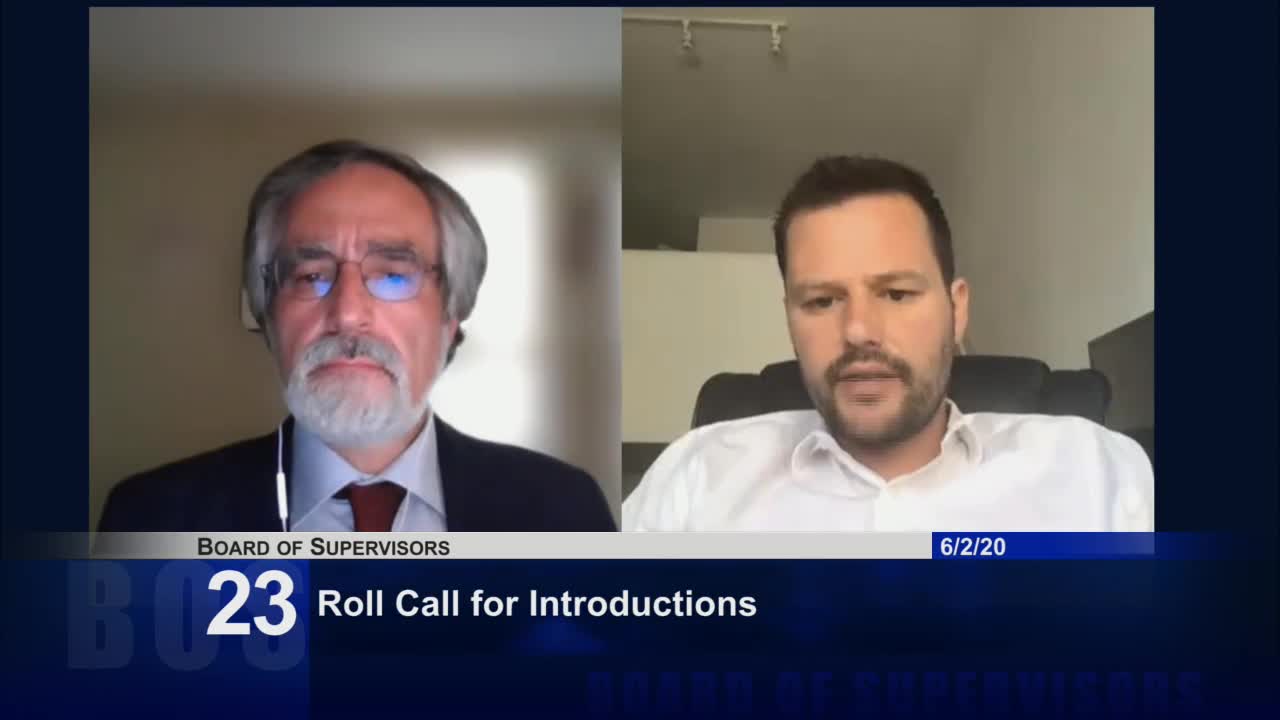
Board debate and vote: Supervisors were sharply divided over whether to give the mayor and police expanded authority. President Yee proposed postponing a final concurrence so the board could reassess rapidly changing conditions, a course that ultimately carried by a 6–5 vote to continue the matter to a special Board meeting on Thursday. The roll call on that motion recorded six ayes — Supervisors Mandelmann, Marr, Peskin, Stephanie, Yi and Feuer — and five noes — Supervisors Haney, Preston, Ronan, Safaie and Walton.
Several supervisors urged narrower actions or daily reassessment. "I need the justification every single day," Supervisor Ronan said, explaining she was not comfortable approving an indefinite curfew without a requirement for frequent review. President Yee said he was "inclined" to allow the declaration to lapse automatically at seven days if the board took no action, then reconsider if the mayor reissued an order.
Public comment: More than three dozen callers addressed the board in a lengthy public-comment period. Many urged the supervisors to reject or rescind the curfew, citing concerns about racial bias, policing tactics and the risk of arresting peaceful protesters. Several health-care workers and residents described fears that the order would subject essential workers to policing while traveling to and from shifts. Other callers supported the curfew as necessary to protect businesses and public safety.
Legal and procedural context: Deputy City Attorney Anne Pearson explained that a mayoral emergency declaration becomes subject to board concurrence within seven days under state law; if the board does not concur, the declaration and any actions taken under it terminate. The mayor’s curfew was issued as an emergency action tied to the declaration and would therefore remain in effect only while the declaration stands.
Next steps: The matter is scheduled for a special meeting on Thursday, when the board will revisit the mayor’s emergency proclamation and the curfew. Board members said they would expect regular briefings and new data — on arrests, arrests’ demographics, arrests for violent acts versus peaceful protest-associated citations, use-of-force incidents, and regional conditions — before taking final action.
Context: The votes and discussion occurred amid national protests over police use of force and concerns about the health risks of mass gatherings during the COVID‑19 pandemic. City leaders described a difficult balance between protecting residents and preserving constitutional freedoms; the board’s Thursday session will be the next formal opportunity to resolve whether San Francisco will concur in the mayor’s emergency actions.