Get Full Government Meeting Transcripts, Videos, & Alerts Forever!
Get email alerts on the Budget topic
No spam. Unsubscribe anytime.
Board narrowly backs interim city budget after heated debate over police funding and vote threshold
Summary
The San Francisco Board of Supervisors approved interim budget ordinances for fiscal years 2020–21 and 2021–22 after an extended debate over police staffing increases, legal advice about unanimous votes, and how the interim measure limits new spending for the coming quarter.
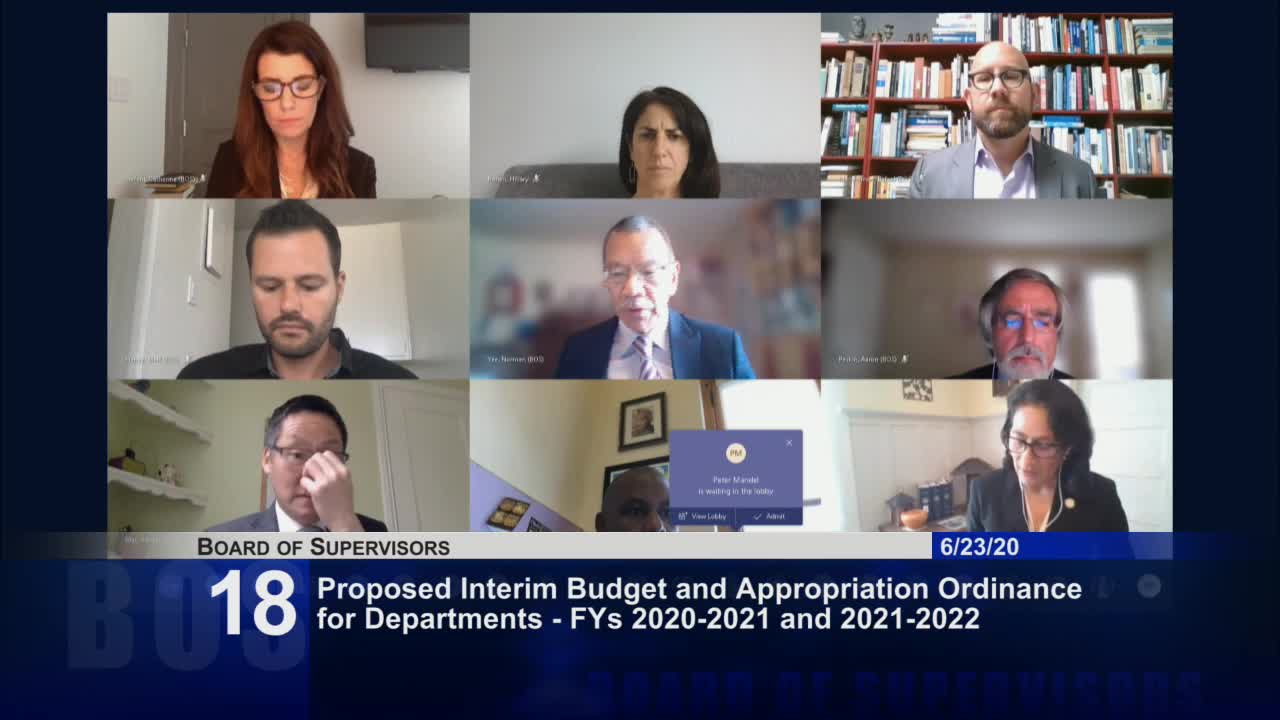
The San Francisco Board of Supervisors voted unanimously on June 23 to adopt interim budget measures that provide three months of spending authority while the city crafts a final budget for fiscal year 2020–21.
The measures — items 19 through 21 on the agenda — appropriate estimated receipts and expenditures, enumerate positions for the coming fiscal years and approve the interim operating budget for the Office of Community Investment and Infrastructure. The board approved item 19 (the interim appropriation ordinance) and items 20–21 (salary ordinance and successor-agency interim budget) by roll call, each vote recorded as 11 ayes.
Why it matters: San Francisco faces a multi‑hundred‑million‑dollar projected shortfall for the coming two fiscal years. The interim budget gives the city authority to pay bills immediately but limits new spending, hiring and capital outlays while a full budget is negotiated. Supervisors said they expect larger trade‑offs when the mayor delivers a proposed budget by Aug. 1 and the board takes up amendments in August and September.
What the board debated: The meeting included more than an hour of detailed questioning from supervisors about specifics in the proposed budget. Supervisor Aaron Peskin and others pressed City Controller Ben Rosenfield to explain a roughly $43 million year‑over‑year increase shown in the police department budget. Rosenfield and controller staff said most of that increase reflects wages and benefits embedded in the second year of a budget the board approved last year — items such as pension and closed labor contracts — and stressed that the interim budget is a stopgap with controls that prevent filling new positions or incurring new capital expenditures during the interim period.
Supervisor Gordon Mar and others expressed a broader concern: approving the interim ordinance at “status quo” levels could blunt efforts underway to reallocate resources, including calls from the mayor and some supervisors to reduce police funding and redirect money to community programs. Board members sought clarity about whether measures taken in committee or by the mayor (including one‑time reductions in the current fiscal year) affect July 1 appropriations; Rosenfield and city staff explained those one‑time reductions do not change the interim year appropriations effective July 1.
A separate, unexpected legal issue arose when Deputy City Attorney Anne Pearson told the board of longstanding written advice — dating to 1969 and 1990 — that the city attorney’s office has historically said the full board must adopt the annual budget unanimously. Pearson said the office will re‑examine that advice this week and provide updated guidance before next week’s final vote. Several supervisors said that guidance, if unchanged, could affect how they vote on the final ordinance.
Controls and limits: The controller’s office said that during the interim period, the city will not allow filling newly authorized positions, spending on new equipment, or starting capital projects without specific interim exceptions. Controller Rosenfield said interim exceptions can be requested and approved in urgent cases but none were before the board on June 23.
What passed: The board recorded unanimous approval (11–0) of the interim appropriation ordinance (item 19) and the related actions (items 20 and 21). The votes were recorded by roll call.