Get Full Government Meeting Transcripts, Videos, & Alerts Forever!
Get email alerts on the Government Ethics topic
No spam. Unsubscribe anytime.
Board amends rules to delegate subpoena authority to oversight committee amid meet-and-confer dispute
Summary
The Board of Supervisors amended internal rules to delegate authority to the Government Audit and Oversight (GAO) Committee to administer oaths and issue subpoenas, drawing extended debate over checks and balances and a required meet-and-confer with the Municipal Executives Association.
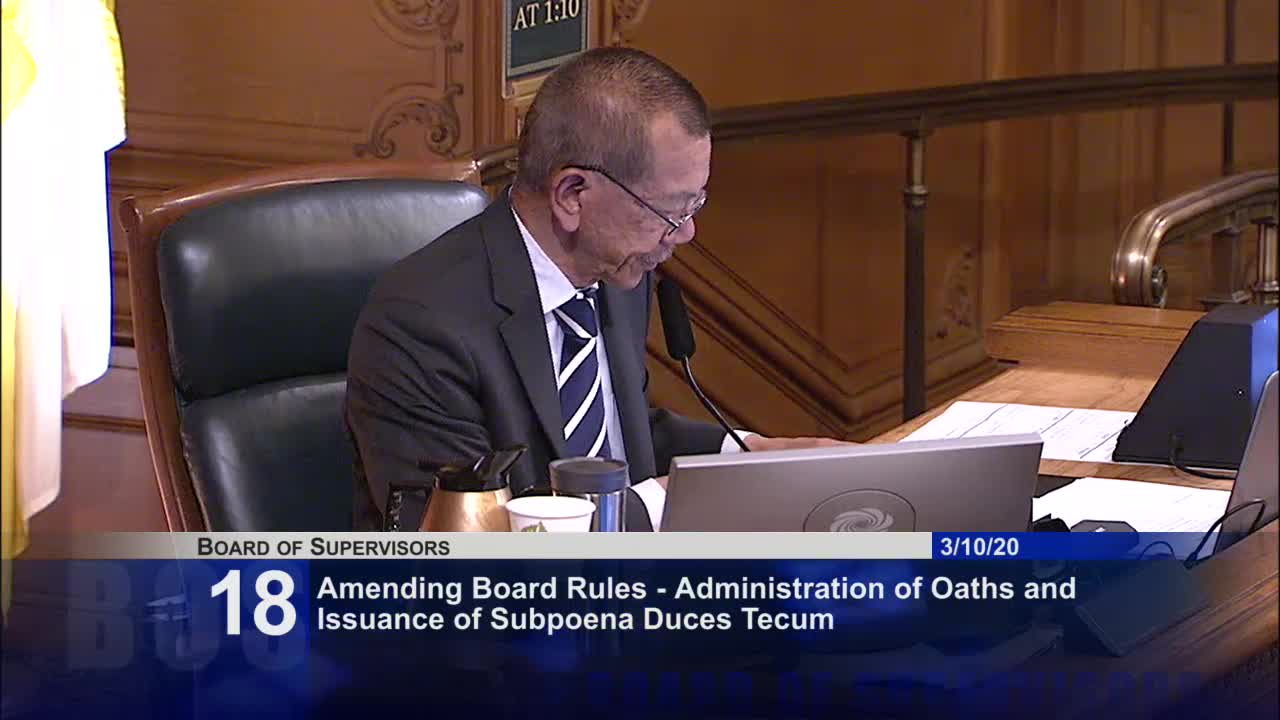
The San Francisco Board of Supervisors voted on March 10 to amend its rules to delegate to the Government Audit and Oversight Committee the authority to issue subpoenas and to administer oaths for witnesses, including certain provisions affecting department heads. The change is intended to speed the board's use of its investigative powers following a series of corruption allegations, but it prompted debate about concentrating authority in a small committee and about labor process requirements.
Supervisor Aaron Peskin, sponsor of the measure, said the amendment is designed to make the board's "unlimited power of inquiry" more usable and timely, citing the multiweek process the board experienced when it used subpoenas during the Millennium Tower inquiry. "We want to get that information '' in as close to real time as a government can get," Peskin said.
Opposition and procedural concerns were raised by several supervisors, notably Supervisor Ronan and Supervisor Safaie, who argued that giving two committee members delegated subpoena power risked concentrating authority and that the board should retain majority control for such coercive tools. Deputy City Attorney Anne Pearson said the Municipal Executives Association (MEA) had asserted the rule change could affect members' working conditions and that Department of Human Resources (DHR) had granted an opportunity to meet and confer; under the city's labor agreements and state law, the board should allow that process to proceed before finalizing certain clauses.
In response, Peskin moved to remove the specific clauses that the city attorney said were subject to meet-and-confer and to duplicate the file in committee so the board could bring those clauses back after meet-and-confer is complete. The amended board rule was adopted as presented with those clauses removed; supervisors said the president has the power to reconstitute the committee if any abuse of authority occurs.
Why it matters: The change is aimed at accelerating the board's ability to use subpoenas and to obtain sworn testimony for oversight investigations into government operations. Advocates said the change is needed to improve legislative oversight; critics warned of concentration of power and of potential labor-law and due-process implications.
What happens next: DHR and the MEA will meet and confer on the removed clauses; the board pledged to revisit the oath-of-department-heads provisions after the labor process is complete. The board president retains the authority to change committee assignments if the GAO's use of delegated authority is abused, supervisors said.