Get Full Government Meeting Transcripts, Videos, & Alerts Forever!
Get email alerts on the Housing topic
No spam. Unsubscribe anytime.
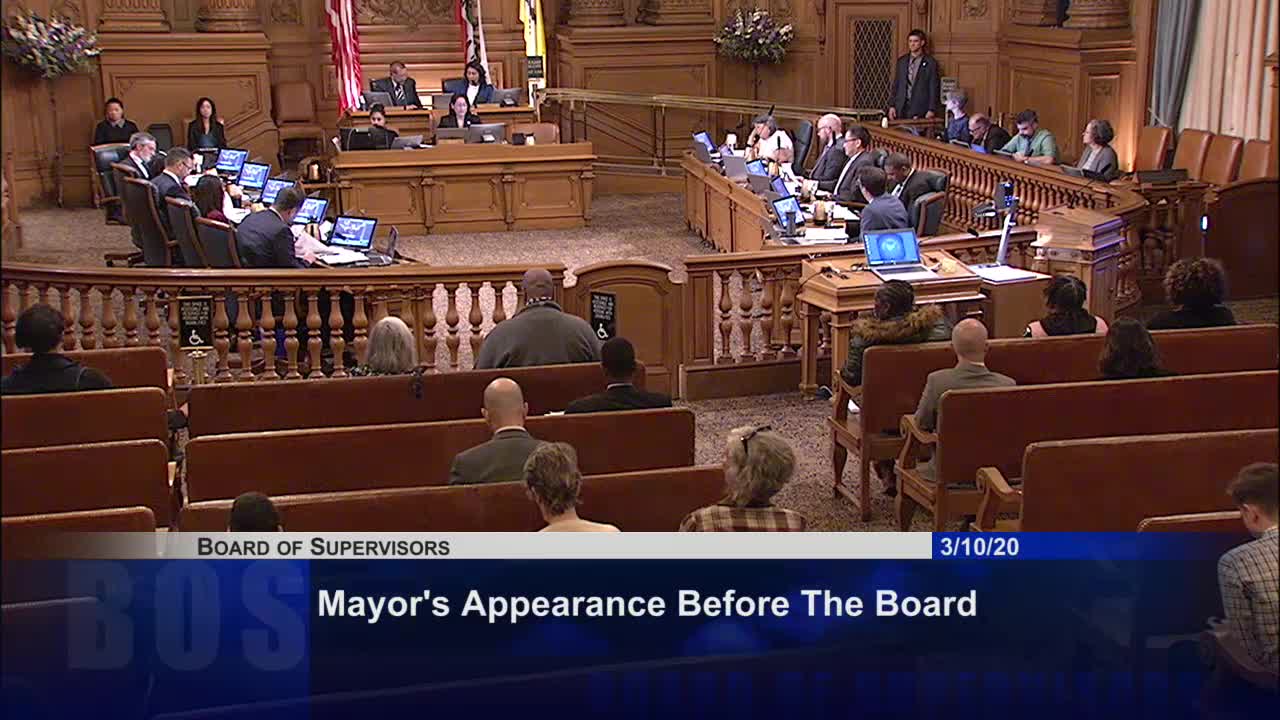
Mayor to issue eviction directive as supervisors press for tenant and small-business relief
Summary
Mayor London Breed said she will sign a mayoral directive to implement eviction protections during the COVID-19 local emergency; Supervisor Preston and others introduced legislation to ban nonpayment and no-fault evictions during the state of emergency and urged the governor to waive conflicting state rules.
Mayor London Breed and members of the Board of Supervisors on March 10 discussed a package of measures to blunt the economic impact of COVID-19 on low-wage workers, small businesses and renters, including the mayor's plan to sign a directive that would immediately provide local eviction protections while the board and state consider complementary legislation.
"We don't need to wait for legislation in order to move forward with a moratorium on evictions," Breed told supervisors during a special question period. "My plan '' is to sign a directive as mayor in order to make this so," she said, adding that her office had already been working with the city attorney and other departments to develop an implementable approach.
Supervisor Aaron Peskin, Supervisor Ahsha Safai and others pressed the mayor and DPH to take aggressive steps. Supervisor Rafael Mandelman, Supervisor Matt Haney and Supervisor Dean Preston outlined additional proposals to assist workers and businesses, including tax-payment deferrals, low-interest loans, and expansion of unemployment and disability benefits in coordination with the state.
Supervisor Preston said he will introduce an ordinance to prohibit evictions during the state of emergency for tenants who cannot pay rent because of coronavirus-related income loss and to bar elective/no-fault evictions (for example, Ellis Act or owner move-in) during the emergency, with limited exceptions. Under the ordinance described by Preston, tenants would be required to notify landlords and provide documentation that lost income was due to the public-health emergency; landlords would be barred from charging late fees for rent delayed under the ordinance. Preston emphasized the ordinance would not forgive rent; landlords could pursue unpaid rent after the emergency by non-eviction civil remedies such as payment plans or small-claims actions.
The mayor said city staff were also working on short-term relief measures for businesses and workers, including delaying tax payments, coordinating no-interest loan programs with financial institutions, and targeted assistance to shelter-dependent residents and hotel workers. She told the board her delegation to Sacramento was seeking state-level measures to expand unemployment and disability coverage so more workers could qualify.
Why it matters: Supervisors said preventing eviction during a health emergency is essential both to public health and to avoid a secondary housing crisis. Mayor Breed and supervisors called for rapid local action while also seeking state support for broader measures.
What happens next: The mayor's office said it would issue a directive and would work with Supervisor Preston's office on the ordinance; the board and mayor also pledged to pursue state coordination for supplemental relief.