Get Full Government Meeting Transcripts, Videos, & Alerts Forever!
Get email alerts on the Healthcare Access topic
No spam. Unsubscribe anytime.
Board urges state to rescind Medi‑Cal pharmacy reimbursement changes after pharmacies warn closures threaten HIV, hepatitis and behavioral‑health care
Summary
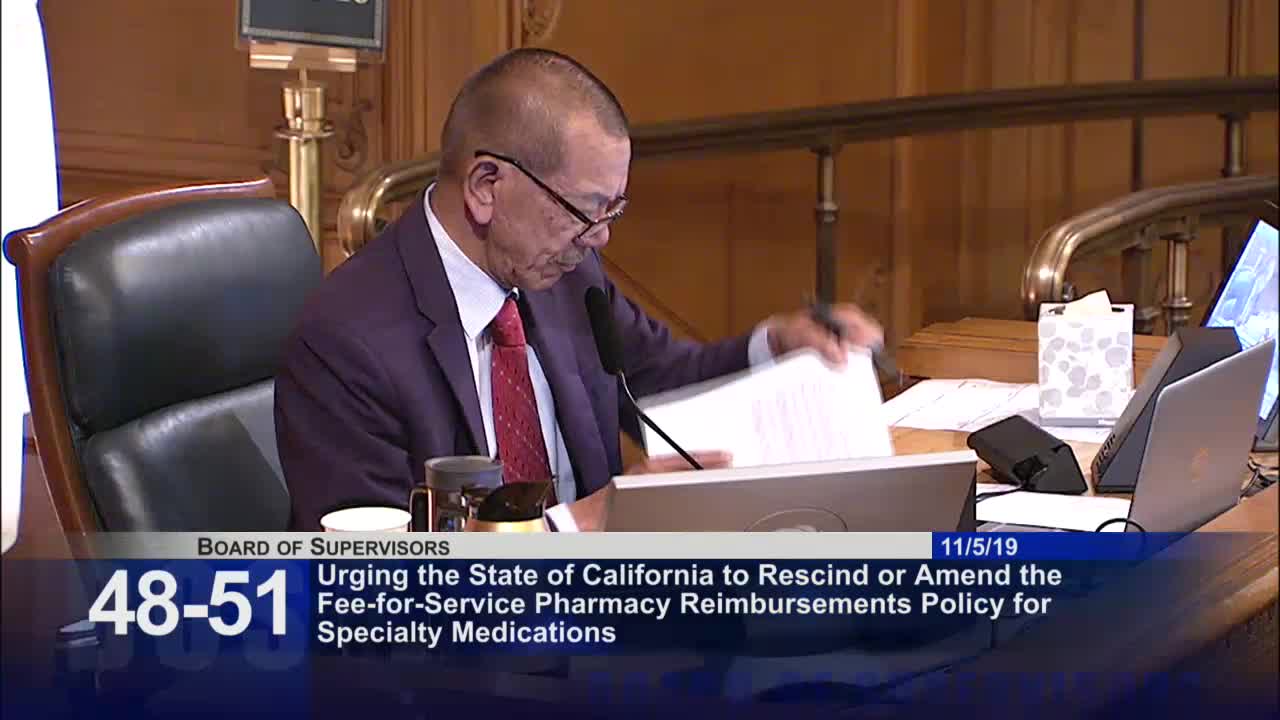
Following testimony from pharmacists and health providers, the Board unanimously adopted a resolution asking the state Department of Health Care Services to rescind or amend a new Medi‑Cal fee‑for‑service reimbursement policy that pharmacies say reimburses specialty medications below purchase cost.
The San Francisco Board of Supervisors voted unanimously Tuesday to urge the California Department of Health Care Services to rescind or amend a new Medi‑Cal fee‑for‑service policy that reduces reimbursement rates for specialty medications, a change local pharmacists and clinics said threatens access to care for people with HIV, hepatitis C and serious behavioral‑health conditions.
Supervisor Hillary Ronan introduced the resolution and thanked pharmacists and community advocates who testified at the meeting. “Mission Wellness and other community pharmacies serve clients with complex needs — often people who are unhoused or marginally housed — and they go above and beyond to provide deliveries and special packaging,” Ronan said.
Pharmacists and clinicians told the board the new state reimbursement schedule pays less than pharmacies’ acquisition costs for certain specialty drugs. Maria Lopez, owner and pharmacist at Mission Wellness Pharmacy in the Mission District, told supervisors the change has “had a devastating impact” on Mission Wellness and other community pharmacies that provide bubble‑pack medication packaging and home delivery for vulnerable Medi‑Cal patients.
“Community‑based pharmacies represent the most accessible health care providers to vulnerable patients,” Lopez said during public comment. She and other speakers warned that closures or service reductions at neighborhood pharmacies would hinder San Francisco’s efforts to control HIV and hepatitis C and to maintain behavioral‑health medication adherence.
Speakers from the San Francisco AIDS Foundation, Ward 86 at San Francisco General Hospital and the California Pharmacists Association also urged the board to press the state to reverse or modify the policy.
Supervisor Ronan said her office is coordinating with state lawmakers, including Senator Scott Wiener, to pursue legislative or administrative remedies if the state department does not act. The board adopted the resolution without objection.
The resolution requests that the board urge DHCS to rescind or amend the policy and asks the city’s delegation to work with local advocates to find a state solution. No binding state action can be taken by the board; the measure is a formal plea to the state and a public record of the board’s position.