Get Full Government Meeting Transcripts, Videos, & Alerts Forever!
Get email alerts on the Community Benefit District topic
No spam. Unsubscribe anytime.
Tenderloin Community Benefit District renewed after ballot and public hearing; budget to increase toward $2M
Summary
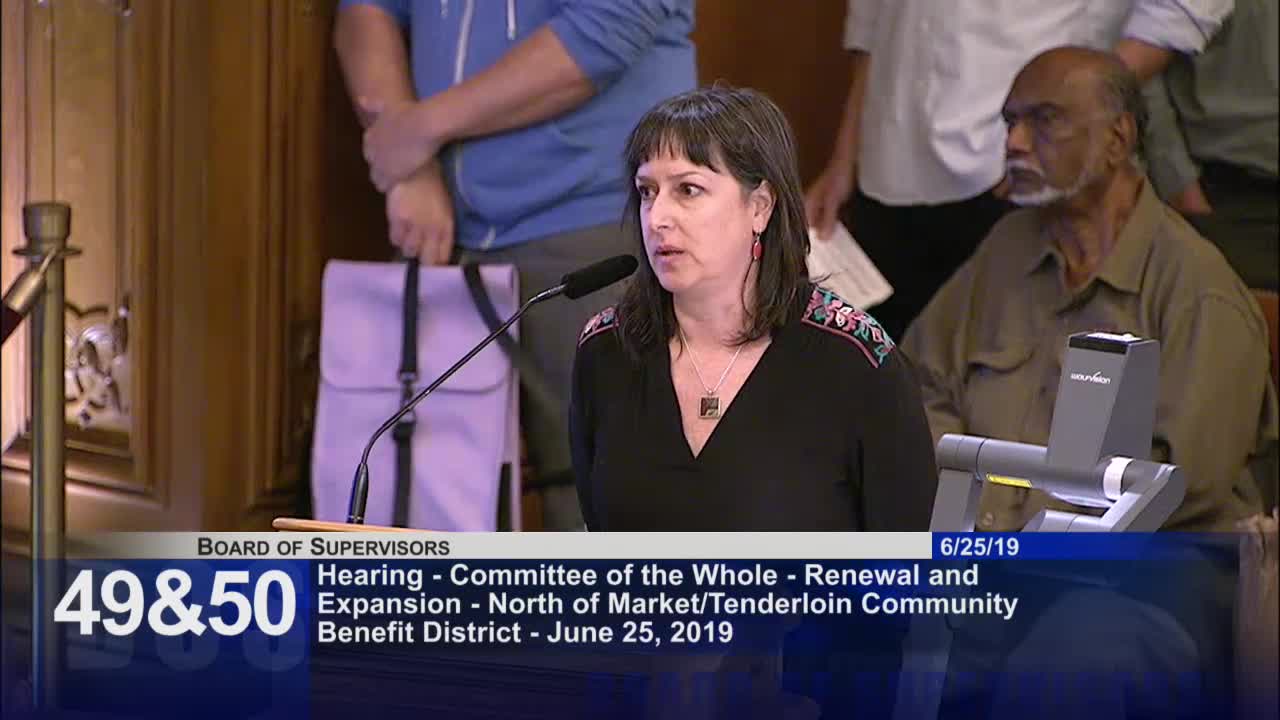
After a committee‑of‑the‑whole hearing with hours of public testimony, the Board of Supervisors certified the ballot results and approved renewal and expansion of the North of Market/Tenderloin Community Benefit District. Weighted ballots returned 83.44% in favor; the board then authorized the renewed assessment.
The Board of Supervisors on June 2019 voted to establish the renewal and modest boundary expansion of the North of Market/Tenderloin Community Benefit District (TLCBD) after a public hearing and an affirmative weighted ballot tally. The Department of Elections reported the return weighted ballots in favor at 83.44% with 16.66% against, and the Board approved the resolution establishing the renewed 15‑year assessment district.
Why it matters: The Tenderloin CBD provides street‑level cleaning, Safe Passage corner captains, a camera network, neighborhood‑pride programs and workforce pathways for residents. Renewal increases the annual assessment from about $1.1 million to just under $2.0 million per year and funds expanded cleaning, safety and economic development work in one of the city's most intensive social‑service neighborhoods.
What the renewal will fund: In presentations to the board Simon Bertrand, executive director of the Tenderloin CBD, described the proposed budget and service priorities: a micro‑neighborhood cleaning approach with one clean‑team member assigned to each of seven subareas, an expanded camera network, Safe Passage volunteer corner captains and neighborhood‑pride and economic development initiatives. Bertrand told the board, "Most of the money, 67%, is spent on clean and safe supplemental services." The proposed assessment also exempts the marketing / economic development portion from non‑profit assessments, lowering the assessment on nonprofit property owners.
Public input and local support: The hearing drew long testimony from property owners, homelessness service groups, neighborhood residents and businesses. Supporters included business groups, the Boys & Girls Club, Saint Francis Hospital and neighborhood nonprofits, and many Tenderloin residents and volunteers for Safe Passage described daily work keeping sidewalks passable and helping children and seniors cross busy streets. Several speakers reported measurable results: the CBD's clean teams reported picking up more than 350,000 pounds of trash last year, removing more than 22,000 needles and addressing thousands of instances of human or animal waste.
Opposition and concerns: A minority of speakers opposed the expansion on principle, arguing community benefit districts can privatize public space oversight, or raising concerns about how assessments are set. The board and CBD staff addressed those concerns by describing community governance on the CBD board and by highlighting community‑driven programs such as Safe Passage and employment for formerly unhoused residents.
Board action: The Board convened as a committee of the whole for the hearing, received the Department of Elections ballot tabulation and, after no majority protest was found, voted to adopt the resolution ordering the levy and collection of assessments for the renewed and expanded district.
Ending: The renewal gives the Tenderloin CBD a 15‑year reauthorization and funding to continue and expand street cleaning, safety, camera and neighborhood‑economic programs. City and CBD leaders said implementation will continue to emphasize hiring locally and coordinating with city departments on public‑safety and sanitation goals.