Get Full Government Meeting Transcripts, Videos, & Alerts Forever!
Get email alerts on the Economic Development topic
No spam. Unsubscribe anytime.
Board approves SoMa West Community Benefit District with nonprofit assessment reductions and governance requirements
Summary
The Board of Supervisors approved formation of the SoMa West Community Benefit District, accepting an amended management plan that reduces assessments on nonprofit-owned parcels and specifies governance representation; the resolution passed unanimously.
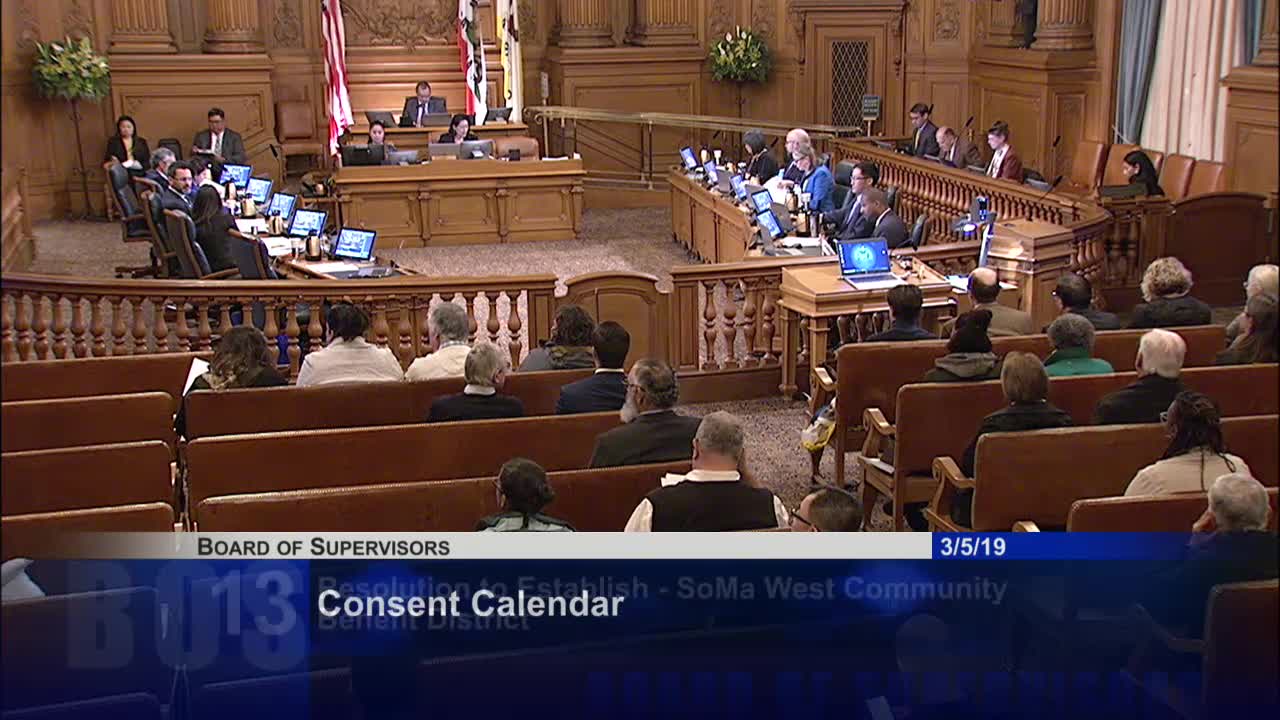
The San Francisco Board of Supervisors on March 2019 approved a resolution forming the SoMa West Community Benefit District and accepted an amended management plan that reduces assessments on nonprofit-owned parcels and commits to a broadly representative governing board.
Supervisor Haney, the item sponsor, told the board she spent the month since the prior hearing negotiating with the steering committee, affordable housing providers, developers, nonprofits and the Office of Economic and Workforce Development to produce a revised plan and amendments. She said the amendments address the future governing board composition and nonprofit parcel assessments and asked colleagues to vote to form the district.
According to staff, the governance amendment (management plan, section 6, page 29) requires the nonprofit owners association bylaws to ensure representation from nonprofit housing entities, cultural organizations/districts, educational institutions, small business owners, and both property‑owning and non‑property‑owning residents. The second amendment revises the assessment formula: the marketing and communications share (7.56%) was removed from nonprofit parcels, and nonprofit housing parcels were granted a negotiated reduced assessment (described in the engineer’s report and management plan). Staff said the steering committee chose a 40% reduced rate for nonprofit housing parcels and that the CBD will fundraise to cover the 40% difference in a manner consistent with Proposition 26 and “articles 13 a, c and d of the state constitution.”
Deputy City Attorney John Givner advised the board that when an underlying document is changed, the board typically accepts the amended document without amendment and then adopts the resolution; the board followed that practice. After a roll call the measure was adopted without objection.
The measure was adopted with unanimous support. The board recorded the vote as 11 ayes when the item concluded.