Get Full Government Meeting Transcripts, Videos, & Alerts Forever!
Get email alerts on the Housing Inclusionary topic
No spam. Unsubscribe anytime.
Board passes Divisadero inclusionary ordinance raising on‑site rental requirements; supervisor touts neighborhood engagement
Summary
The Board of Supervisors approved on first reading amendments to the planning code aimed at increasing on‑site affordable housing in the Divisadero neighborhood commercial transit district, setting higher inclusionary rates for pipeline and future projects.
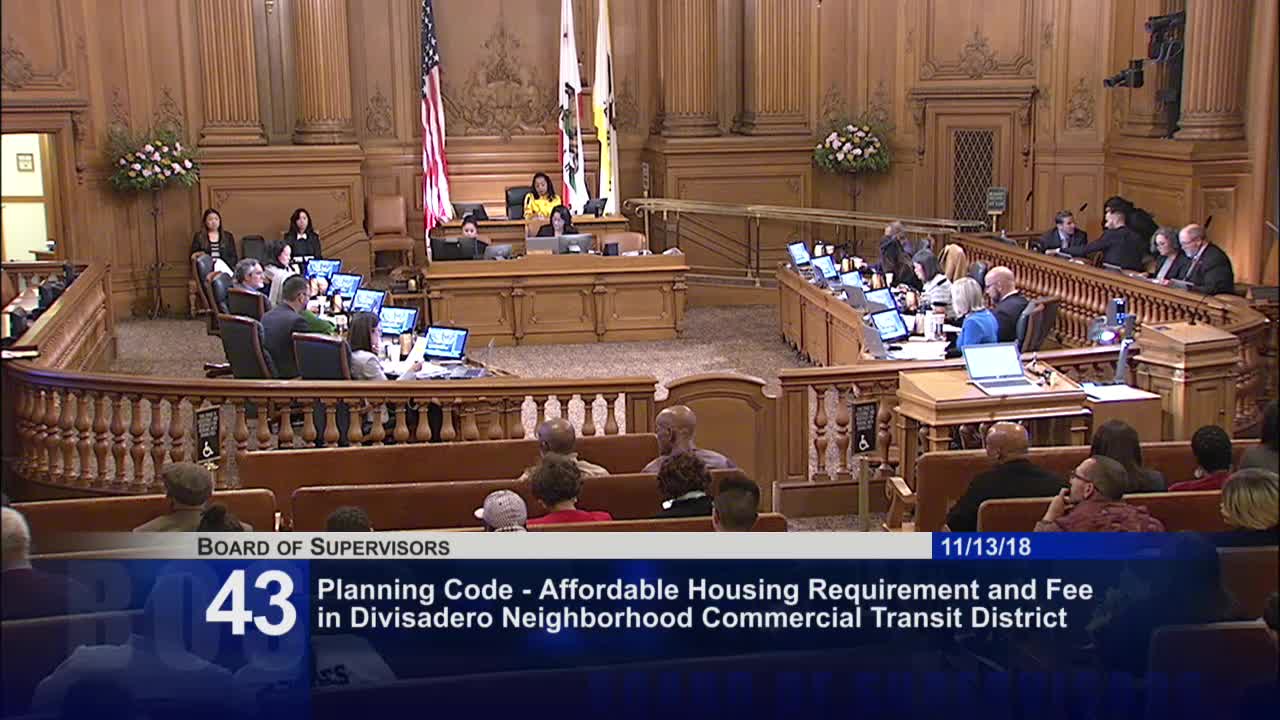
The board approved on first reading an ordinance to amend the planning code to require additional on‑site affordable housing — or payment of a fee — for sites that obtained greater development potential from a 2015 Divisadero rezoning.
Supervisor Katy Tang (transcript: Supervisor Brown introduced and led discussion) said she had consulted extensively with neighborhood groups and said the most common community comment was to keep building heights to 65 feet in the corridor. Brown described the final package as reflecting community input and as aligning the neighborhood option with the citywide inclusionary and HomeSF frameworks.
What the ordinance does - Inclusionary increase: Supervisor Brown stated on the record that the ordinance sets a 20% on‑site rental requirement for two pipeline projects (including 650 Divisadero) and 23% for future projects, "which follows Home SF tier 1," she said. The ordinance ties the Divisadero neighborhood standard to the citywide frameworks for inclusionary housing and the Home SF density bonus options. - Process: The measure affirms the CEQA determination and makes required planning findings. The board approved the ordinance on first reading (as amended on the floor) and accepted technical cleanup changes during the meeting.
Board vote and context The measure passed on first reading after board discussion and an amendment was accepted on the record. Supervisor Brown emphasized the long community process and said the approach was designed to ensure housing would be built and to maximize on‑site affordability where feasible.
Outlook Supporters expect the change to increase on‑site affordable units coming through projects that benefit from the 2015 rezoning, while balancing neighborhood height and design preferences. The ordinance will return for second reading and final adoption under the city’s normal ordinance schedule.