Get Full Government Meeting Transcripts, Videos, & Alerts Forever!
Get email alerts on the Energy Clean Power Sf topic
No spam. Unsubscribe anytime.
SFPUC defends Clean Power SF rates as PG&E bankruptcy and CPUC exit-fee changes loom
Summary
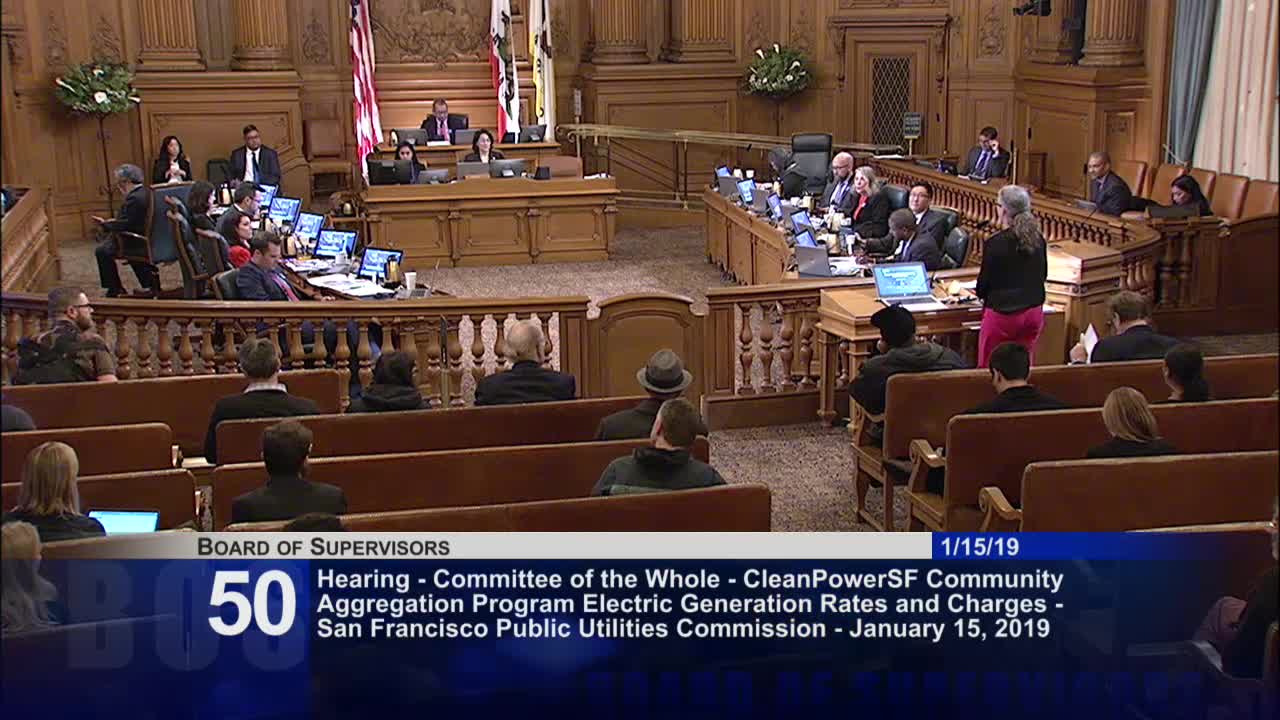
At a Jan. 15 Board of Supervisors hearing, San Francisco Public Utilities Commission officials outlined a plan to lower Clean Power SF generation rates, described risks from Pacific Gas & Electric’s (PG&E) pending bankruptcy, and said the city is exploring acquisition of local distribution assets if needed.
San Francisco Public Utilities Commission officials told the Board of Supervisors on Jan. 15 that they will reduce Clean Power SF generation rates to remain competitive with PG&E, and that they are preparing for financial risks tied to PG&E’s announced intent to file for bankruptcy.
The discussion focused on a California Public Utilities Commission decision that changed the methodology for PG&E’s so‑called exit fee — a recurring charge that can appear on customers’ bills after they enroll in a community choice aggregation (CCA) program — and on how those changes could affect Clean Power SF’s rates and cash flow.
Why it matters: Clean Power SF serves municipal customers and, increasingly, residential accounts through the city’s community‑choice aggregation program. The SFPUC described a two‑part approach: reduce its generation rates by the amount PG&E cuts its generation rates, and provide a monthly bill credit to cover any increase in PG&E’s exit‑fee charges. Commissioners said this will protect existing and newly enrolled customers while preserving the program’s ability to pursue clean‑energy investments.
Barbara Hale, assistant general manager for power at the SFPUC, said the commission is "leading with affordability" and that the agency expects to enroll roughly 280,000 mostly residential accounts in April, bringing the total active customers to about 365,000. Hale told the board the PUC’s rate action in December was designed to "ensure our customers have competitive rates with PG&E and are protected from these exit fees." (Barbara Hale, SFPUC)
Hale and other SFPUC staff briefed the board on the structure of community choice aggregation under state law (Assembly Bill 117) and explained that, under current CPUC rules, exit‑fee charges can remain on a customer’s bill for decades. "That means the exit fee could appear on a customer's bill for 30 or more years into the future," Hale said.
PG&E’s bankruptcy and cash‑flow risk
The hearing took on new urgency after PG&E disclosed plans to seek Chapter 11 protection. SFPUC officials told the board they are analyzing potential consequences of delayed remittances from PG&E — the company currently handles distribution billing and passes Clean Power SF revenues to the city — and are coordinating with the city controller on mitigation options.
"It is possible that a PG&E bankruptcy could interrupt the remittance of Clean Power SF customer payments to the city," Hale said. The SFPUC said it is reviewing its reserves, credit facilities, and legal options with bankruptcy counsel and the controller’s office to manage a temporary disruption.
Supervisor Aaron Peskin, who called the hearing, said the board should explore all options, including acquiring distribution assets from PG&E. "This is an unparalleled opportunity to move to energy independence," Peskin said. "The city needs to consider acquisition of PG&E facilities where feasible." (Supervisor Aaron Peskin)
SFPUC officials and several supervisors described Proposition A — approved by San Francisco voters in November 2018 to allow the SFPUC to issue revenue bonds for clean‑power facilities — as one financing tool the city could use if it pursued acquisition of local distribution assets.
Board members pressed the SFPUC on contingency planning. Supervisor Walton asked what the PUC is doing now with state leaders to ensure remittances would not be trapped in bankruptcy; Hale said the PUC is working with bankruptcy counsel, exploring statutory and regulatory touch points, and has internal liquidity options and a credit facility to weather some disruption.
Some supervisors urged the city to move more aggressively. Supervisor Catherine Stefani and Supervisor Hillary Ronen said the PG&E crisis showed the limits of relying on investor‑owned utilities for reliability and safety; Ronen urged the city to accelerate a move toward municipal control of distribution where feasible.
Hearing outcome
After public comment the board voted to "file" the hearing record. A motion to file the matter was made by Supervisor Peskin, seconded by Supervisor Safaí (Safaí) Yi, and passed without objection. The SFPUC will finalize rate adjustments after PG&E’s 2019 rates and exit‑fee numbers are finalized at the CPUC, officials said.
What’s next
The SFPUC will return to the board after PG&E’s final 2019 rate and exit‑fee decisions are posted so the agency can make the ministerial adjustments it described. SFPUC staff also said they will report to the mayor and the board with additional analysis of acquisition options and contingency measures for cash‑flow protection if PG&E’s remittances are delayed.
Sources and speakers: Barbara Hale, assistant general manager for power, SFPUC; Harlan Kelly, general manager, SFPUC (present); Supervisor Aaron Peskin; Supervisor Hillary Ronan; Supervisor Walton; SFPUC staff and counsel. The presentation referenced Assembly Bill 117, Senate Bill 901 (notice requirements), and the CPUC’s October 2018 decision on exit‑fee methodology. The board record and public comments are part of the Jan. 15 session.