Get Full Government Meeting Transcripts, Videos, & Alerts Forever!
Get email alerts on the Board Votes topic
No spam. Unsubscribe anytime.
Board adopts a slate of ordinances and resolutions; Transbay bond measure passes 10–1
Summary
At the Dec. 11 Board meeting supervisors passed a package of ordinances and resolutions on environmental enforcement, taxes and housing; a $200 million Transbay bond appropriation carried with one dissent.
The San Francisco Board of Supervisors adopted a range of ordinances and resolutions during its Dec. 11 session, approving rules on refuse separation audits, tax bonds for the Transbay Transit Center and several human‑services appropriations.
Key outcomes at a glance
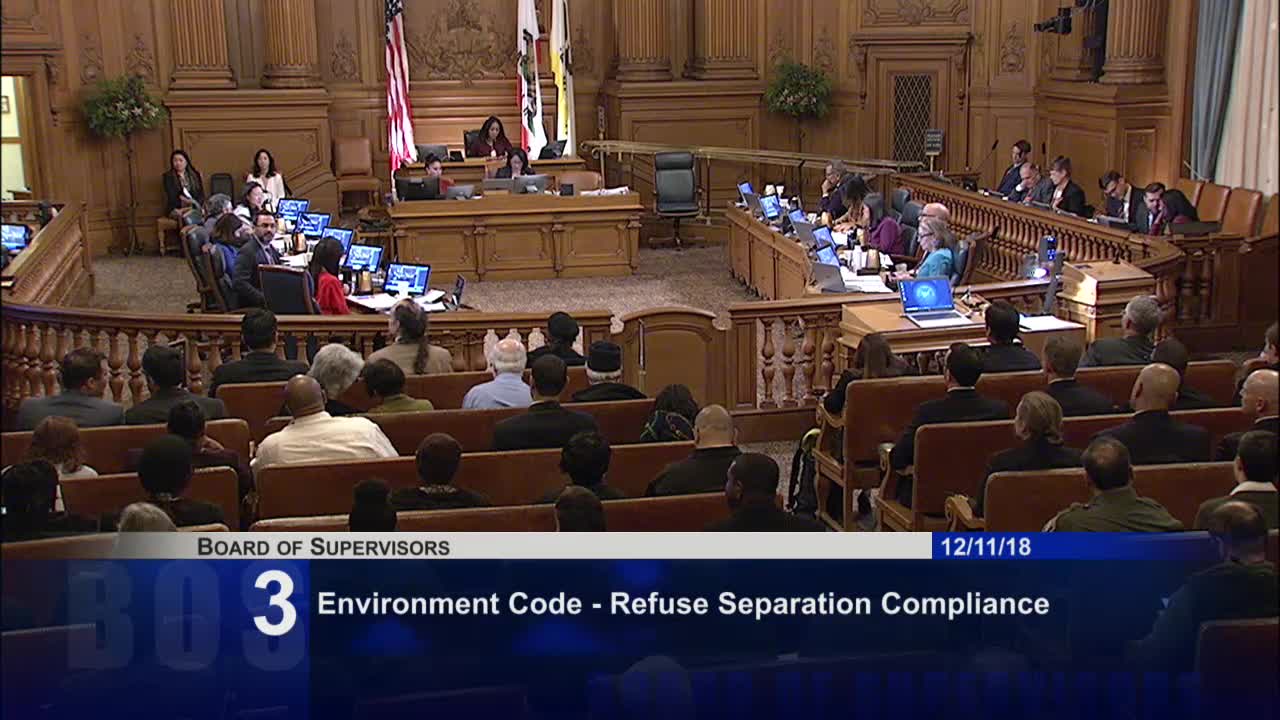
- Refuse‑generator audits: The board approved an amendment to the Environment Code requiring triennial audits of large refuse generators for compliance with waste‑separation rules and establishing enforcement measures. The ordinance was finally passed unanimously (roll not required; chair recorded final passage).
- Transbay Transit Center bonds (Item 4): An ordinance appropriating $200,000,000 of special tax bonds (series 2018 A and B) to finance elements of the Transbay Transit Center and plant infrastructure in FY 2018–19 was finally passed; the roll call recorded 10 ayes and 1 no (Supervisor Aaron Peskin in the dissent).
- Proposition C validation and statute of repose (Item 5): The board approved an amendment to the Business and Tax Regulations Code to permit validation actions and impose a statute of repose related to Proposition C (the measure adopted by voters Nov. 6). The ordinance was finally passed by recorded vote (11 ayes).
- Human services appropriations and staffing (Items 6 & 7): The board approved appropriations of approximately $1.1 million in federal and state revenue across several HSA programs (Supplemental Security Income cash‑out, CalWORKs home visiting, CalWORKs housing support) and added 37 new positions to the Human Services Agency and Department of Public Health to implement the programs. The items passed on the consent call without roll call.
- Ordinances carried on first reading: Several ordinances were passed on first reading during the meeting, including expedited permitting for electric vehicle charging stations (Item 33) and revised harassment‑prevention training rules for city employees (Item 35). The board took those first‑reading votes without recorded roll calls.
- Parking minimums (Item 15): The board approved an ordinance eliminating minimum off‑street parking requirements citywide. The roll call recorded 7 ayes and 4 noes; supervisors Safaie, Supervisor Stephanie (McMahon), Supervisor Gordon Mar, and President Malia Cohen were recorded in dissent (transcript reported four named dissenters).
- Tenant harassment / rent increases (Item 36): The board introduced and passed on first reading amendments clarifying that rent increases imposed in bad faith intended to force tenants from single‑family homes or condominiums covered by local eviction controls may constitute tenant harassment. The ordinance as amended passed on first reading.
Other board actions
The board adopted a broad set of additional administrative and planning ordinances by "same house, same call" or without objection; those items covered topics including child‑care credits against the commercial rents tax, dedication of right‑of‑way, mobile‑caterer permits during seismic retrofits, planning‑code amendments for specific sites, and workplace training and oversight committee adjustments. Several property leases and resolutions authorizing grant acceptance (including a $5.3 million Department of Justice grant for the Police Department) were approved on the consent calendar.
Why it matters: The meeting cleared a mix of operational, revenue and regulatory actions; the notable substantive votes were the Transbay bond appropriation (10–1) and the citywide elimination of parking minimums (passed with some dissent). The Transbay bond vote affects funding available for a major transit facility while parking‑policy changes and tenant‑protection clarifications will shape development rules and renter safeguards.