Get Full Government Meeting Transcripts, Videos, & Alerts Forever!
Get email alerts on the Land Use topic
No spam. Unsubscribe anytime.
Supervisors require more study of shadow, health risks after Mission Street CEQA appeal
Summary
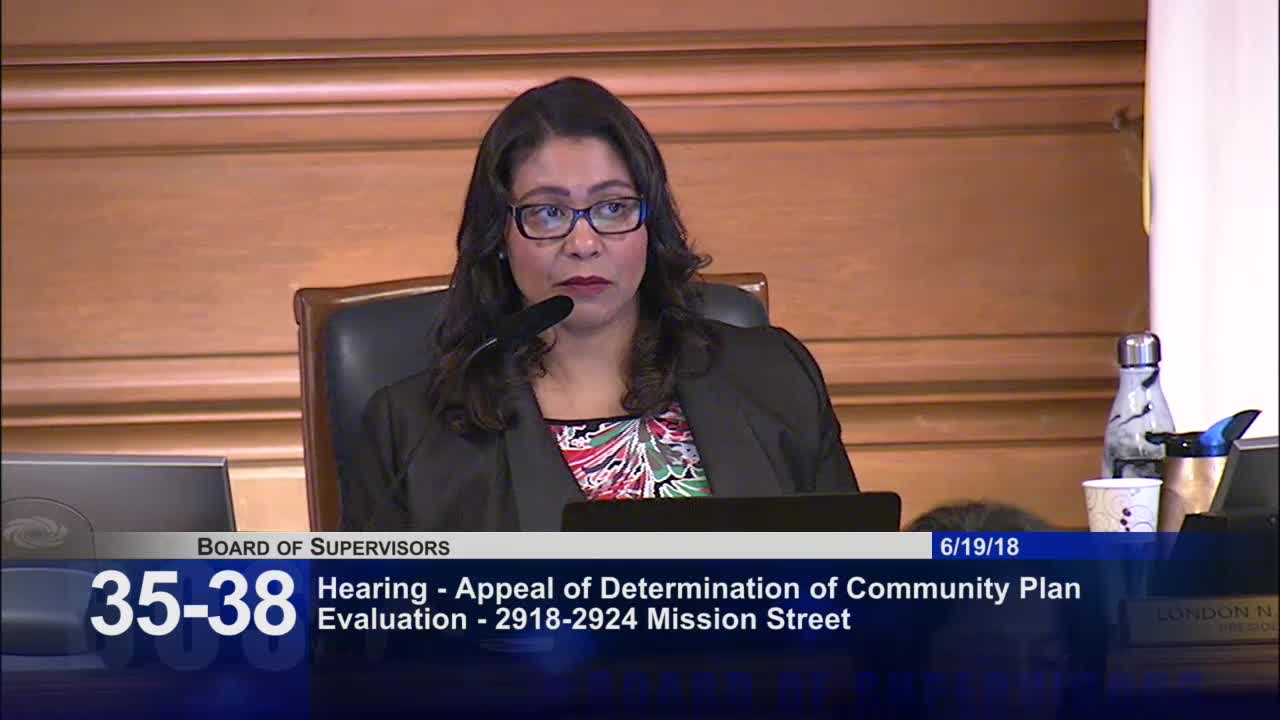
After hours of testimony, the Board of Supervisors voted to table one CEQA determination and direct additional study of shadow and construction impacts on two Zaida T. Rodriguez schoolyards adjacent to a proposed 8‑story Mission Street development.
The San Francisco Board of Supervisors voted unanimously on June 19 to table a key environmental determination for a proposed 8‑story residential project at 2918–2924 Mission Street and to direct additional analysis of shadows and construction‑period impacts on two adjacent schoolyards at Zaida T. Rodriguez School.
The board approved a motion by Supervisor Hillary Ronan, seconded by Supervisor Aaron Peskin, to table Item 36 (the city planning department's community plan evaluation determination) while approving Items 37 and 38 to require preparation of findings and further study addressing the limited questions identified by the board. The roll call showed 11 ayes.
Why it matters: Dozens of neighborhood residents, parents, teachers and local groups told the board they are concerned that the project's shadow, noise, dust and vibration during construction could harm preschoolers and children with special needs who use the two schoolyards next to the site. Appellants also argued the Eastern Neighborhoods program EIR does not reflect the current pipeline of development and therefore underestimates cumulative impacts for traffic, air quality and neighborhood commercial displacement.
Appellant Scott Weaver, speaking for Calle Veinte Cuatro Latino Cultural District Council, told the board the Eastern Neighborhoods EIR and the planning department's CPE (community plan evaluation) do not account for the number of recently proposed or permitted projects in the Mission and that the cumulative build‑out is now larger than the scenarios the EIR studied. "We do need housing," Weaver said in his presentation, "but we should do this thoughtfully and equitably because the future of San Francisco and the Mission is at stake."
Planning staff defended their environmental finding. "The department believes the CPE fully meets the requirements of CEQA and is supported by substantial evidence," said Julie Moore, senior environmental planner. Staff said project‑specific analyses of transportation, air quality and construction noise had been completed and that the Eastern Neighborhoods EIR had anticipated many plan‑level impacts.
Environmental planning staffer Chris Kern told the board the Eastern Neighborhoods EIR expressly recognized that construction near sensitive receptors such as schools could create impacts and identified mitigation measures. "For this CPE," Kern said, "the evaluation focuses on whether this project would have effects substantially more severe than those disclosed in the program EIR," and staff concluded it would not after applying mitigation and current regulatory standards.
Project sponsor representatives reiterated the development's design details and on‑site mitigations. The sponsor said the proposal would replace a one‑story commercial building and surface parking with a mixed‑use, 8‑story, 75‑unit residential building that includes ground‑floor retail and no off‑street parking; the sponsor's counsel said the project will provide bicycle parking, eliminate vehicle access from the alley adjacent to school play areas and pay more than $1.6 million in impact fees. "It is an ideal location for infill housing," said Mark Loper on behalf of the project sponsor.
Speakers were sharply divided. Several teachers, public‑health professionals and parents described the physiological and developmental importance of outdoor play and sunlight for young children and asked the board to require an independent shadow and air‑quality study. "These children are ages 3 to 5 and are in their most formative years," said a Mission Neighborhood Centers staff member. "Whatever damage is done to these children by the project will have a permanent, irreversible and detrimental impact."
Other speakers and housing advocates urged the board to deny the appeal and let the project proceed, saying San Francisco's housing shortage requires infill near transit. Dustin White, who said his 4‑year‑old attends the nearby school and who lives two blocks from the site, told supervisors: "We fully support this project moving forward. If the city cannot build housing projects one block from a BART station on one of the most transit‑served streets, I think the affordability of our city is doomed."
What the board ordered: By tabling the planning department's CPE decision (item 36) and approving motions to prepare findings and address questions (items 37 and 38), the board required additional analysis focused on the limited issue identified in the motion: shadow impacts on the two schoolyards and confirmation that construction mitigations (air‑quality/dust controls, noise attenuation, pile‑driving constraints and monitoring) are sufficient and enforceable for the adjacent special‑needs and preschool populations. The board did not reverse the underlying conditional use or other entitlements; those matters remain subject to separate approvals and permitting processes.
The tabled determination will return to the board after staff prepares the directed analyses and findings. The board did not set a firm date for the return; staff and the project sponsor will coordinate on the next steps.
Ending note: The decision preserved planning staff's broader CEQA finding for now but required extra, targeted work before the project can proceed. Supervisors emphasized they were seeking a narrow, evidence‑based follow‑up on the children's play spaces rather than a reopening of all aspects of the earlier review.