Get Full Government Meeting Transcripts, Videos, & Alerts Forever!
Get email alerts on the Housing topic
No spam. Unsubscribe anytime.
Board denies condo‑conversion at 668–678 Page Street after testimony on eviction of longtime resident
Summary
After days of testimony and a contested court history, the Board of Supervisors denied an application to convert a six‑unit building at 668–678 Page Street into condominiums, citing Planning Commission findings about vacancy, displacement and inaccurate application information related to the longtime resident Iris Canada.
The Board of Supervisors voted Tuesday to uphold the Planning Commission and the Department of Public Works’ decision to disapprove a tentative parcel map that would have allowed conversion of a six‑unit building at 668–678 Page Street into condominiums.
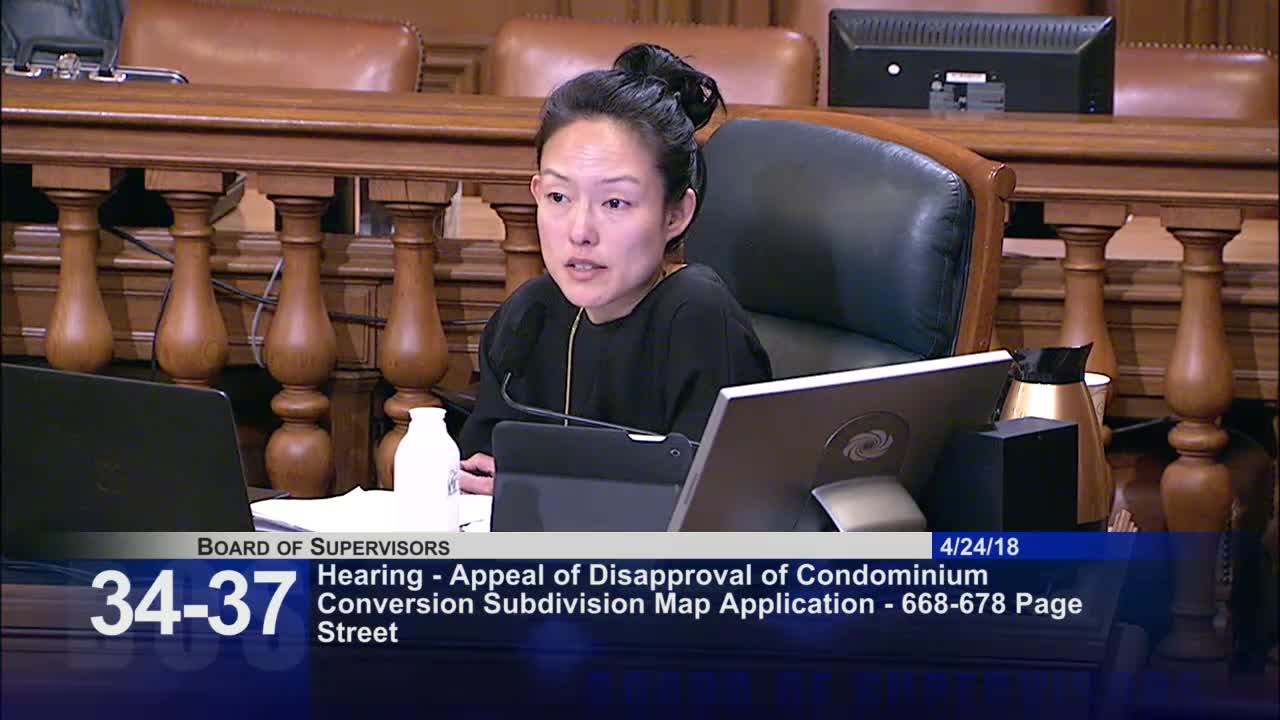
The public hearing focused on the case of Iris Canada, an elderly woman who lived at the property for decades and whose relocation and legal status became central to the commission’s review. Planning staff and advocates for seniors and tenants told the board the sequence of lock changes, removal of possessions by the sheriff and other record evidence demonstrated displacement; the commission found the application incomplete and determined vacancies had been increased and an elderly tenant displaced.
Jeff Pierce and other TIC co‑owners who applied for the conversion told supervisors that Canada no longer lived in the unit after February 2012 and that the superior court determined her life estate had been foreclosed. The applicants argued the building met the legal requirements for condominium conversion under the state Subdivision Map Act and the local subdivision code. They supplied court records and affidavits asserting that Canada had been permanently relocated in 2012.
Planning Department staff said the commission applied subdivision code sections 13.86 and 13.96.4 and concluded the developer’s application contained inaccuracies and that the record evidenced a displacement and increased vacancies. Karen Starr, manager of legislative affairs for the Planning Department, explained the commission has discretion to interpret terms such as “eviction” and “displacement” under the local code and concluded the project was ineligible for conversion.
Speakers opposing the conversion included tenants’ rights groups, community organizations, and multiple residents who said they witnessed the removal of Canada’s possessions and testified she had continued to use the unit. Tommy Avicoli Mecha of the Housing Rights Committee said he was present when the sheriff removed Canada’s belongings and called the condo conversion attempt “profit‑driven” and “immoral.” Senior and Disability Action and other groups urged the board to reject the conversion request.
Supervisor Walton moved to approve the Department of Public Works decision to disapprove the tentative map application (item 35). The motion carried with 10 ayes and 1 no; Supervisor Tang cast the sole dissenting vote.
Why it matters: The board’s vote reinforces an interpretation of the subdivision code intended to prevent condominium conversions that followed or coincided with the displacement of an elderly tenant. The case received extensive public testimony and international media attention because of Mrs. Canada’s age and the disputed circumstances of her removal.