Get Full Government Meeting Transcripts, Videos, & Alerts Forever!
Get email alerts on the Cannabis Regulation topic
No spam. Unsubscribe anytime.
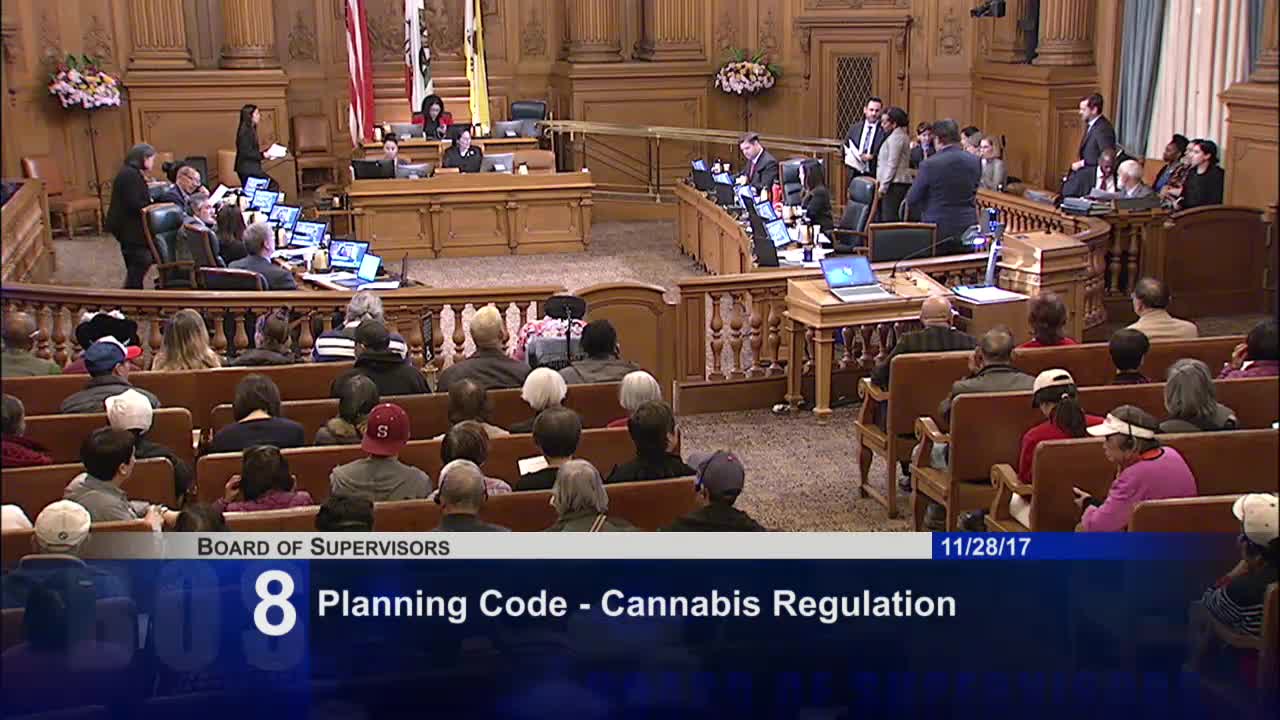
Board approves first-reading of cannabis land-use and business regulations after equity amendments
Summary
After hours of debate and dozens of amendments, the Board passed on first reading two ordinances creating a local licensing, zoning and equity program for adult-use and medicinal cannabis, including a business-equity framework, local-hire targets for equity incubators and procedural requirements for conversions from medical to retail.
The San Francisco Board of Supervisors voted to pass, on first reading, two related ordinances to regulate commercial cannabis activity (items 8 and 9 on the agenda) after a lengthy debate and a series of amendments intended to focus the new market on business equity and neighborhood control.
Supervisor Cohen introduced a package of equity-focused amendments aimed at prioritizing applicants harmed by the war on drugs. Her changes expanded the time window for conviction-history eligibility, extended the years used to qualify by school attendance and residential history, and reduced local-hire requirements for equity incubators from 50 percent to 30 percent (the board later adopted a different overall pathway to reach a 50 percent equity share across permit categories). Cohen also added requirements for existing medicinal-cannabis dispensaries converting to adult-use to submit and make good-faith efforts to implement equity plans.
The board and Office of Cannabis staff also added or amended technical definitions, compliance timelines and rules for the city’s Community Reinvestment Fund. Several supervisors proposed and adopted additional zoning and locational controls during committee and on the floor. The full package includes separate rules for equity incubators (applicants that commit to mentor and hire from specified pools), requirements for operator applications to describe how they will support equity applicants, and a public-education campaign focused on youth that the city council will fund and begin after enactment.
Nicole Elliott of the Office of Cannabis described how permit applications will require equity plans and that the office will develop rules and monitoring protocols to track progress. Supervisors debated whether to set a fixed deadline to reach equity targets; the board instead adopted a phased path that requires the Office of Cannabis to ensure that, for each permit category, equity applicants eventually represent half of the permits before the director may issue non-equity permits (the board later formalized that path in separate amendments).
The ordinances also create land-use and operational requirements, including a conversion process for preexisting medical dispensaries and public-safety-related conditions. On the floor, supervisors amended and clarified language about community reinvestment fund uses, technical definitions, testing-lab requirements and other operational details.
On the vote for items 8 and 9 the Board passed the pair on first reading with a roll call of 10–1 (Supervisor Safaee cast the lone no). The ordinances will return for a second reading and final adoption after the required legislative process and rulemaking by city departments.
What the ordinances do and do not do: the passed first-reading ordinances set the local licensing and zoning framework, create an Office of Cannabis-based permit and equity program, and place procedural requirements on converting medical cannabis businesses to adult-use retail. They do not yet finalize every technical regulatory detail; those will be developed in rules and regulations by the Office of Cannabis and other implementing departments before the second reading and final adoption.
The Board’s action represents the city’s attempt to balance neighborhood concerns, public-safety requirements and a targeted equity program aimed at operators and communities that were disproportionately affected by prior enforcement of cannabis laws.