Get Full Government Meeting Transcripts, Videos, & Alerts Forever!
Get email alerts on the Housing Affordability topic
No spam. Unsubscribe anytime.
Developer agreement secures 27% affordable housing, murals and off-site units in Mission parcel dispute
Summary
The Board of Supervisors on Tuesday adopted a negotiated settlement between Access Development Group and Calle Viente Cuatro for a disputed project at 2675 Folsom Street, securing roughly 27% affordable units overall, funding for off-site acquisitions to stabilize low‑income families, and commitments to preserve and reproduce neighborhood murals and community art space.
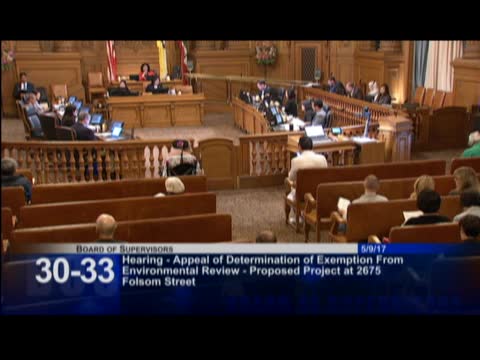
The San Francisco Board of Supervisors on Tuesday accepted a negotiated agreement between developer Access Development Group and neighborhood group Calle Viente Cuatro over a contested project at 2675 Folsom Street, and affirmed a planning-commission CEQA exemption tied to that settlement.
Supervisor Hillary Ronan, who led the negotiations, described a multi-part agreement that she characterized as “creative” and intended to preserve longtime neighborhood cultural assets while adding affordable housing. The board voted unanimously to adopt the motion to affirm the Planning Commission’s exemption (Item 31) and to table related appeals (Items 32 and 33).
Key elements of the agreement: Access Development agreed to an overall affordable set‑aside of roughly 27% of the project’s units. Ronan described the on-site affordability package as “19 units at 55% of Area Median Income and 4 units at 100% AMI.” In addition, Access agreed to purchase eight off‑site units through the Mayor’s Office of Housing small‑site acquisition framework to stabilize existing low‑income or working families at risk of displacement. Once acquired, those off‑site units would be transferred to an affordable‑housing nonprofit and maintained as permanently affordable housing.
Cultural protections: The agreement requires industry-standard removal and preservation of an existing mural that otherwise would be demolished. Access will donate the removed mural to Calle Viente Cuatro and will recreate a new mural based on the original concept. The developer also agreed to provide approximately 5,200 square feet of dedicated art space to be operated by a nonprofit for a nominal rent ($1 per year) for 55 years, and to create an art walk between the project buildings with about 4,000 square feet of programmable public space for murals and community art. Ronan said Access will “pay for the recreation of the mural” and pursue artwork on the building face facing Parque Niños Unidos where feasible.
Labor and community benefits: The project was described as a percent-union-labor development. Ronan said the agreement was meant to be a model for how developers, neighborhood organizations and labor can reach compromise while adding housing and neighborhood benefits.
Public comment and opposition: Several neighborhood residents and community members spoke in public comment opposing the development in principle. Neighbors raised concerns that market‑rate units would accelerate displacement and argued that the affordability commitments did not fully offset the scale of new market housing. Public commenters also raised traffic and safety concerns near Cesar Chavez Elementary School and said they preferred deeper affordability or different project choices.
Formal action: Ronan moved to adopt the Planning Commission’s CEQA exemption (Item 31) and to table the two appeals (Items 32 and 33). The motion passed unanimously (11 ayes) after public comment.
Why it matters: The deal uses on-site inclusionary units combined with off-site small-site acquisitions to stabilize at‑risk households — an approach supervisors described as an attempt to use private development resources to preserve long‑term affordability in a neighborhood experiencing intense market pressure.
Ending: Supporters framed the agreement as an example of neighborhood negotiation that produced tangible cultural and housing protections. Critics urged deeper affordability and broader anti‑displacement measures. The board’s action affirms the settlement and authorizes city staff to proceed consistent with the negotiated terms and the Planning Commission’s exemption.