Get Full Government Meeting Transcripts, Videos, & Alerts Forever!
Get email alerts on the Affordable Housing topic
No spam. Unsubscribe anytime.
Supervisors continue ordinance aiming to require reuse of cash-out proceeds from city-funded affordable housing
Summary
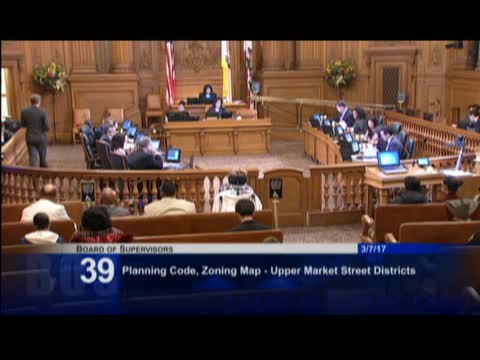
An ordinance introduced March 7 would require that cash‑out proceeds from affordable housing developments built with taxpayer funds be used only for affordable housing purposes.
An ordinance introduced March 7, 2017, would amend the administrative code to require that all cash‑out proceeds received by an owner of an affordable housing development supported in whole or in part by taxpayer funds be used only for residential and tenant services and the creation, development and preservation of affordable housing.
Supervisor Mark Farrell, the ordinance’s author, told the Board the measure is intended to prevent public subsidies for affordable housing from being converted into private political spending or other private purposes. Farrell cited a recent refinancing transaction in which he said a developer purchased or refinanced a city-supported affordable housing project, realized substantial gains, and then — he said — used funds on political measure committees. "There should never be the perception that public resources are potentially used for political purposes," Farrell said.
Nut graf: why this matters
The ordinance, as drafted, would direct the Mayor’s Office of Housing and Community Development (MOHCD) to enter into agreements ensuring that any excess proceeds from purchase or refinance of an affordable housing development built with city funds be used for capital or tenant improvements, acquisition of property for affordable housing, operating costs required for affordable housing creation, or resident, tenant or community services. Supporters said the goal is to ensure taxpayer‑supported housing returns value to affordable housing uses.
Questions from colleagues and stakeholders
Supervisors raised concerns that the ordinance, as written, could unintentionally restrict activities that community‑based affordable housing providers undertake using limited funds — including tenant outreach, voter-registration drives, or tenant education about immigration raids. Supervisor Hillary Ronan asked that the item be returned with MOHCD staff present; she said housing organizations in her district had raised questions about the ordinance’s impact on community services they now provide.
Supervisor Aaron Peskin said he shared the ordinance’s intent to prevent misuse of taxpayer funds, but warned against making findings that single out particular developers without evidence. Peskin suggested oversight hearings and possible referral to the district attorney or IRS if illegal conduct is found. He also suggested to broaden the ordinance concept to address other forms of public subsidy, such as tax breaks.
Outcome
After discussion and requests for additional amendments and dialogue with affordable housing providers, Supervisor Farrell moved to continue the item for one week to the March 14, 2017 meeting; Supervisor Ahmad Safai seconded the motion. Without objection, the Board continued the item to March 14 to allow further amendment drafting and consultation with stakeholders and the city attorney’s office.
Clarifying details
- The ordinance does not itself impose a numerical penalty amount in the text before the Board on March 7; enforcement mechanisms and detailed MOHCD processes were to be developed in amendments. - Farrell said the measure ‘‘does not restrict the use of a developer fee and does not give MOHCD new authority to grant line by line approval,’’ language he intended to clarify in forthcoming amendments. - Supervisors and stakeholder groups that requested further discussion included Mercy Housing, Tenderloin Neighborhood Development Clinic, the Housing Action Coalition and SPUR.
Next steps
The item was continued to March 14, 2017, with the sponsor and staff saying they would circulate proposed amendments and invite MOHCD representatives and interested housing providers to discuss the ordinance’s scope and enforcement language.