Get Full Government Meeting Transcripts, Videos, & Alerts Forever!
Get email alerts on the Police Reform topic
No spam. Unsubscribe anytime.
Board holds wide-ranging hearing on police reform; chief reports early drops in use-of-force
Summary
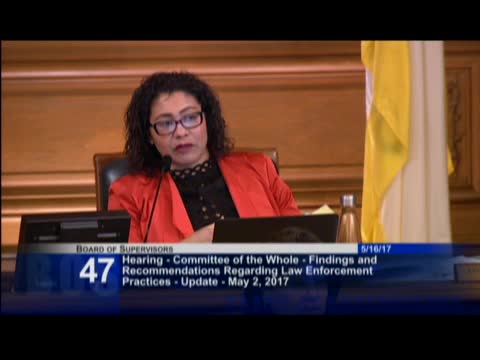
The San Francisco Board of Supervisors convened as a committee of the whole May 16 for a special hearing on reforms recommended by the U.S. Department of Justice and the blue‑ribbon panel on policing.
The San Francisco Board of Supervisors convened as a committee of the whole May 16 for a special hearing on reforms recommended by the U.S. Department of Justice and the blue‑ribbon panel on transparency, accountability and fairness in law enforcement.
The hearing drew hours of public comment from residents and advocates calling for faster officer‑involved‑shooting investigations, stronger civilian oversight and expanded crisis‑response alternatives. The board received presentations from Police Chief Bill Scott and District Attorney George Gascon and heard frequent public demand for timelier outcomes in high‑profile cases.
Chief Bill Scott summarized progress on the department’s implementation plan and said several early metrics show movement. “Total uses of force are down by 15.8%” in the first quarter of 2017 compared with the same period in 2016, Scott said, and he reported a roughly 45% drop in assaults on officers for the quarter. He told supervisors the department has implemented body‑worn cameras citywide and is rolling out a 60‑hour crisis intervention training (CIT) program for officers, with about 700 members of the force trained so far. Scott also said the department has begun auditing electronic communications and is restructuring recruiting and background units to improve oversight and data collection.
District Attorney George Gascon described the office’s newly created Independent Investigation Bureau (IIB), a unit funded last year to investigate officer‑involved shootings and in‑custody deaths. Gascon said hiring for attorneys and investigators has been slower than hoped because the office sought candidates with specialized experience, but that the unit is nearing full staffing. He said the office currently lists about 28 open matters related to officer‑involved shootings and in‑custody deaths, with 22 of those cases defined as backlogged (open more than 180 days). “Once the unit is fully staffed and we move through the backlog, we are committed to finishing these cases within 180 days unless there are extenuating circumstances,” Gascon said.
Gascon and Scott both told the board that a formal memorandum of understanding (MOU) between the DA’s office and the police department that would clarify how parallel criminal and administrative investigations are coordinated has not been finalized. Gascon said the MOU remains under review with the police department and the city attorney and urged timely completion so the new investigation unit can operate with full access.
Public commenters included family members of people killed during police contacts, mental‑health advocates and neighborhood leaders. Recurring demands included faster completion of officer‑involved‑shooting investigations, clearer public reporting, stronger community representation in oversight stakeholder groups, and rejection by several speakers of planned or potential taser deployment. Several speakers also urged more resources for crisis‑response alternatives to police interventions.
Supervisors asked detailed questions about metrics and implementation. Chief Scott pointed supervisors to the written “use‑of‑force” report included with the meeting packet and said the department will provide further breakdowns by officer demographics, precinct and incident type. He described plans for a multi‑vendor procurement to bring outside subject‑matter experts into data analysis, training and strategic planning.
Gascon said his office is focused on producing high‑quality, legally sound investigations that will meet criminal standards in court. He cautioned that criminal prosecutions of police officers face high legal thresholds and that a well‑documented, rigorous investigation is essential to any prosecutorial decision. He said the new IIB will also include a “conviction review” function after backlog work is completed.
Following the presentations and questions, the board accepted the hearing as held. Supervisor Cohen moved that the hearing be filed as heard; the motion was adopted.
Why it matters: The hearing assessed the city’s response to federal findings and community demands that policing be more transparent and accountable. Supervisors pressed for concrete timelines, budgeted resources and fuller community engagement as the city moves to implement roughly 272 recommendations from the federal review and related reports.
What’s next: Chief Scott said quarterly status updates will continue; supervisors and community members asked for more accessible public tracking of each recommendation and for the MOU between the DA and SFPD to be finalized so parallel investigations can proceed without delay.