Get Full Government Meeting Transcripts, Videos, & Alerts Forever!
Get email alerts on the Fleet Electrification topic
No spam. Unsubscribe anytime.
Board advances zero-emission municipal fleet ordinance with 2022 deadline, funding waiver and reuse rules
Summary
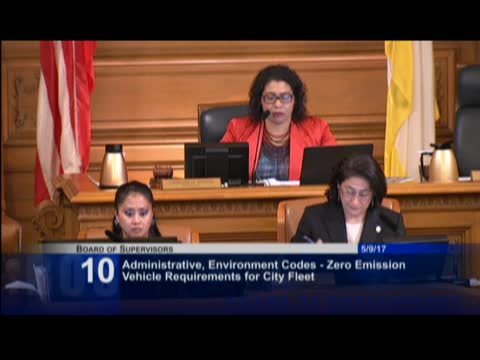
The San Francisco Board of Supervisors on Tuesday passed on first reading an ordinance requiring new city passenger vehicles to be zero-emission vehicles, preserving a Dec. 31, 2022 compliance date while adding a budget-based waiver, a rule to prioritize replacing the oldest light‑duty vehicles and a procurement policy to encourage intra‑city vehicle transfers.
The San Francisco Board of Supervisors on Tuesday passed on first reading an ordinance that would require newly procured city passenger vehicles to be zero-emission, while adding amendments that preserve the ordinance’s 12/31/2022 compliance target and create narrowly defined exceptions for departments lacking budget authority.
The ordinance, sponsored by Supervisor Katy Tang, originally set a citywide requirement that “any new passenger vehicle procured for the city fleet” be a zero-emission vehicle absent a waiver and that all city passenger vehicles become zero-emission by Dec. 31, 2022. Supervisors pressed for clarifying language and two substantive changes during debate before voting unanimously to pass the measure as amended.
The board kept the 2022 deadline but added three principal implementation provisions. First, departments must prioritize replacing the oldest light-duty passenger vehicles in their fleets when purchasing new vehicles. Second, departments may request a waiver if adequate appropriation has not been provided in that department’s budget to purchase sufficient zero-emission vehicles. Third, the city administrator will develop a procurement policy encouraging departments that station vehicles at non-city-owned locations to acquire usable light-duty passenger vehicles from other city departments before buying new units.
Why it matters: Supervisors framed the measure as a significant step toward reducing municipal greenhouse-gas emissions and improving local air quality. Opponents of a more aggressive near-term mandate argued that forced early replacement of vehicles could be environmentally counterproductive if it led to selling usable vehicles into the private market, and that costs and charging infrastructure require careful budgeting.
What the board heard: Tang told colleagues the ordinance targets roughly 400 light-duty passenger vehicles parked on city-owned facilities and presented cost scenarios produced by the city administrator’s office. Tang said, for example, “if we were to have 75% of those 400 vehicles be Smart electric drives, that would result in about $1,300,000 a year. Ford Focus electrics would result in about $1,500,000 a year. Chevy Volts would result in about $1,900,000 a year.” She also said an estimate for level 2 charging infrastructure — $16,000 per charger for about 400 spaces — would add roughly $1,060,000 on an annual basis.
Supervisor Aaron Peskin urged a policy that avoids selling still-serviceable vehicles simply to meet a calendar deadline, saying he “absolutely embrace[d] the fundamental thrust of this ordinance” but favored replacing vehicles at the end of their useful service life. Peskin offered language to remove the 2022 target; Tang and others said keeping a date was important to create an enforceable schedule.
City staff and unions: The city administrator’s office and SF Environment staff were present and briefed supervisors on technical feasibility and budget implications. Supervisors also requested that the municipal workforce and mechanics be included in implementation planning, and that Office of Economic and Workforce Development and City College workforce programs be engaged to train mechanics for electric-drive maintenance.
Formal action: Supervisor Tang moved the amendments described above. The board took the amendments without objection and then passed the ordinance as amended on first reading unanimously.
Implementation and next steps: The ordinance directs the city administrator to issue procurement guidance and the city attorney to prepare implementing language for the waiver and prioritization rules. Supervisors signaled an intent to work with departments on precise criteria (age and/or mileage) for determining which vehicles to cycle first. Tang committed to return with any additional clarifying language; the council will consider the ordinance again on a subsequent reading.
Costs and limits: The ordinance does not assume federal or state purchase credits; cost figures presented were illustrative of MSRP-plus assumptions. The waiver language requires departments to show inadequate appropriation before relief is granted. The procurement rule for intra‑city transfers applies to light-duty passenger vehicles stationed on non-city-owned lots, per the amendment.
Ending: The measure advances San Francisco’s municipal fleet toward zero emissions while leaving the budgetary and operational specifics to implementation documents and oversight in subsequent budget cycles. Proponents described the measure as a framework for a planned transition; dissenting supervisors sought added protections to avoid premature disposal of usable vehicles.