Get Full Government Meeting Transcripts, Videos, & Alerts Forever!
Get email alerts on the Police Reform topic
No spam. Unsubscribe anytime.
San Francisco police chief outlines progress on DOJ recommendations as public and supervisors demand faster action
Summary
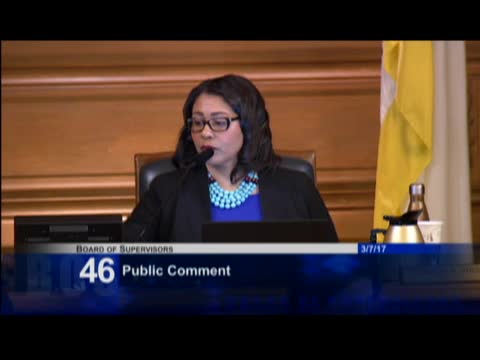
San Francisco’s Board of Supervisors convened as a Committee of the Whole on March 7 to receive updates from the San Francisco Police Department on the implementation of recommendations from the Department of Justice collaborative reform effort, the Blue Ribbon Panel on Transparency, Accountability and Fairness in Law Enforcement, and related reviews.
San Francisco’s Board of Supervisors convened as a Committee of the Whole on March 7 to receive updates from the San Francisco Police Department on the implementation of recommendations from the Department of Justice collaborative reform effort, the Blue Ribbon Panel on Transparency, Accountability and Fairness in Law Enforcement, and related reviews.
The meeting, led by Supervisor Malia Cohen, featured a presentation by Chief William Scott who said the department has reorganized personnel, created a community engagement division and moved to implement many of the reports’ recommendations. "These reforms are about delivery of service and how we police this city, and to police this city in a fair and constitutional manner," Chief Scott said, outlining a set of steps intended to institutionalize change.
Why it matters: The DOJ and local reviews identified systemic problems — particularly in data collection, oversight, officer training and use-of-force policy — following years of high-profile fatal encounters and community concern. Supervisors and dozens of public speakers pressed the department for faster timelines, clearer accountability and public reports that measure progress.
Key details and department priorities
Chief Scott and command staff told the board that the department is working on several fronts at once: implementing an updated use-of-force policy adopted in late 2016; rolling out crisis-intervention (CIT) training and field-tactics scenarios; deploying a body-worn camera program and an automated officer-involved-shooting notification system; and improving data collection on stops, citations and uses of force to allow academic analysis. Chief Scott said the department had recorded over 100,000 body-camera videos to date and reported 701 officer pointings of firearms in a recent quarter as an example of new data capture.
Scott described a reorganization that created a formal community engagement division led by a commander and a chief-of-staff office to build and sustain the reform effort. He said the department has identified about 58 immediate-priority recommendations across the various reviews and that work on most is underway; four had completed internal review and were awaiting submission to the DOJ at the time of the hearing.
Supervisors pressed for speed and transparency
Supervisor Hillary Ronan, whose district includes multiple fatal police-involved shootings, urged stronger implementation of crisis intervention and faster administrative review of officer-involved shootings so families would receive timely answers. "We need true, robust implementation of reform," Ronan said, citing cases including Luis Góngora Pat and others.
Supervisor Aaron Peskin emphasized that if there is evidence of criminal wrongdoing it should be referred to the district attorney and IRS as appropriate, and warned against making findings that point fingers without documented evidence.
Community members and advocates push for more accountability
More than a dozen public commenters, including family members of people killed by police and reform advocates, told the supervisors they wanted swifter disciplinary outcomes, greater transparency from the Police Commission and the department, and stronger independent oversight. Several speakers urged the board to use budget authority as leverage for reform and called for community-led performance goals.
Training, audits and academic partners
Chief Scott said all recruits and many officers will receive the department’s new principal-policing curriculum that embeds implicit-bias and procedural-justice modules; full in-service training for current officers is scheduled across a two-year cycle with the objective of department-wide completion by 2019. The department said it has begun identifying academic partners to analyze stop and use-of-force data and to evaluate the Early Intervention System so supervisors can identify and address at-risk behavior earlier.
Oversight and sustaining reform
Scott said the department is creating an internal audit/inspections function and an officer dashboard to give supervisors real-time metrics on deployments and behaviors. He stressed that the DOJ process is not a checklist and that sustaining change will require ongoing auditing and periodic re-evaluation.
What remains unresolved
Multiple supervisors and speakers said the timelines were too slow and asked why several specialized programs — notably a multidisciplinary mental-health response to assist police with crisis calls — had not been fully staffed despite public announcements. Chief Scott and Department of Public Health officials said hiring was underway and that several DPH positions had been filled; full field deployment and training were pending completion of the hiring process.
Ending note
Supervisors closed the hearing by thanking the command staff for appearing and by requesting more legible written materials and a revised hearing format so the board and public can review materials in advance and focus questioning on priorities. The Committee of the Whole will reconvene on police reform matters and supervisors said they will press for public benchmarks and clearer timelines for the remaining recommendations.