Get Full Government Meeting Transcripts, Videos, & Alerts Forever!
Get email alerts on the Municipal Fleet Electrification topic
No spam. Unsubscribe anytime.
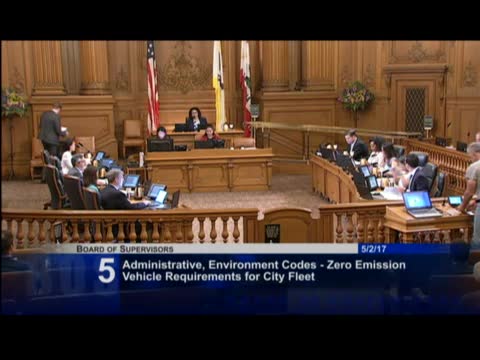
Supervisors debate and amend plan to shift city passenger fleet to zero-emission vehicles; item continued for cost analysis
Summary
The Board of Supervisors debated Supervisor Gordon Mar's (Supervisor Tang) ordinance to require light-duty city passenger vehicles to be zero-emission by 2022 with waivers and staged compliance; the board approved amendments and voted to continue the item one week for additional cost analysis.
San Francisco supervisors debated an ordinance to require the city's light-duty passenger fleet to transition to zero-emission vehicles by 2022, adopting several amendments and agreeing to continue the item to the May 9 meeting for additional fiscal analysis.
The ordinance, introduced by Supervisor Jane Kim (referred to in the transcript as Supervisor Tang's colleague during debate), and described by Supervisor Sophie Maxwell (Supervisor Tang was the author in the transcript), would require new passenger vehicles purchased for the municipal fleet to be zero-emission unless a waiver applies, and would set a 2022 deadline for the passenger vehicle portion of the fleet to reach zero-emission status. Supervisor Tang said the measure excludes public safety and emergency vehicles, and that waivers would be handled by the Office of the City Administrator for operational challenges such as lack of charging infrastructure. "The waivers would be submitted to the city administrator's office," Tang said during questions about waiver authority.
Why it matters: Supervisors framed the ordinance as part of the city's climate goals and an effort to reduce greenhouse gas emissions from municipal operations. The proposal drew sustained questions about estimated costs, the pace of fleet replacement, charging infrastructure, and whether reducing fleet size should be prioritized alongside vehicle electrification.
What the board did: During the May 2 hearing, supervisors adopted Tang's proposed amendments without objection, including a distinction between vehicles parked on city-owned lots and those parked on non-city lots, narrower compliance requirements for vehicles parked on non-city lots, and workforce-development language to support mechanics and training partnerships with City College and the Office of Economic and Workforce Development. Supervisor Tang clarified departments could use plug-in hybrids under limited waiver conditions and that level 1 chargers were generally sufficient for plug-in hybrids. Tang also said the city retires about 100 vehicles a year and that the 2022 timetable reflected those replacement rates.
Several supervisors asked for stronger cost estimates before final approval. Supervisor Kim asked for a range of likely costs for the portion of the fleet parked on city-owned lots and urged the board to "retire cars as soon as possible" where appropriate. Supervisor Peskin warned that prematurely removing functioning vehicles could be counterproductive if those vehicles are driven elsewhere. Supervisor Ronen and others supported the aims but asked to delay to better understand budget impacts and the mayor's budget office's updated analysis.
Formal actions recorded in the hearing: Supervisor Tang moved the amendments; the motion was seconded by Supervisor Farrell and adopted without objection. Later in the meeting Tang moved to continue the ordinance one week to the May 9 board meeting for additional cost analysis; that motion, seconded by Supervisor Ronen, passed without objection and the item was continued.
Next steps: The ordinance will return to the board for further consideration at the May 9 meeting with updated cost estimates from the mayor's budget office and additional information about expected waivers and charging infrastructure needs. Supervisor Tang said she would work with the budget office on the analysis in the coming week.
Quotes (excerpted from the meeting): "The waivers would be submitted to the city administrator's office," Supervisor Tang said when asked who would grant waivers. Supervisor Kim said, "I support the goal of the legislation... but it would be great to get that information before voting on this item." Supervisor Peskin cautioned that "in the short term, it will not be environmentally beneficial" if functioning vehicles are retired too early.
Ending: The board kept the ordinance alive and amended but withheld final action pending a more targeted fiscal analysis and updated cost estimates for implementing zero-emission vehicle requirements on the city's fleet.