Get Full Government Meeting Transcripts, Videos, & Alerts Forever!
Get email alerts on the Transportation topic
No spam. Unsubscribe anytime.
Board rejects Vision Zero general-plan amendment after debate over implementation and outreach
Summary
The Board of Supervisors voted down a general-plan amendment intended to incorporate Vision Zero pedestrian-safety policy into the city’s general plan, citing concerns about community outreach, equity language and implementation; vote was 10–1.
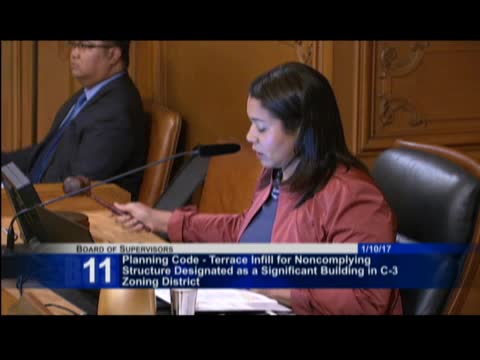
The San Francisco Board of Supervisors on Jan. 10 rejected a proposed amendment to the general plan meant to implement the city’s Vision Zero pedestrian-safety policy, voting 10–1 after extended debate about outreach, equity and how the amendment would be implemented.
Supervisor Peskin and several colleagues said the planning department had not adequately engaged affected neighborhoods and left implementation details and equity considerations to later documents. Supervisor Peskin said the board should “send a message to the commission and to staff that we can improve this process as it relates to all general plan amendments.”
Planning Department staff said the amendment provides high-level policy language that was intended to acknowledge Vision Zero in the general plan and that implementation details, engineering standards and community planning would flow through existing project review, MTA processes and subsequent implementation actions. Lily Langlois of the Planning Department said the department is “happy to work with your office to develop the language that you think would be sufficient for this policy.”
Supervisor Yee, Supervisor Tang and several others said they would prefer to take more time to get the language right rather than approve a document that could be seen as singling out neighborhoods or missing equity language. Supervisor Tang raised a specific concern about a policy presumption against actuated pedestrian signals and asked that MTA standards be respected on a case-by-case basis.
Deputy City Attorney John Giffner explained the board’s procedural options: under the city’s process for general plan amendments, the board must vote up or down within 90 days, and the period in this case would expire Jan. 25. He said the board could vote down the amendment and send it back to the Planning Commission or pass it on first reading to buy two weeks to negotiate commitments and then decide on second reading.
On the roll call the board recorded 1 aye (Supervisor Cohen) and 10 nos (Supervisors Breed, Farrell, Feuer, Kim, Peskin, Ronan, Safai, Sheehy, Tang and Yi). The measure failed.