Get Full Government Meeting Transcripts, Videos, & Alerts Forever!
Get email alerts on the Treasure Island Finance topic
No spam. Unsubscribe anytime.
Board approves Treasure Island financing districts and sets bond limits after unanimous special-election votes
Summary
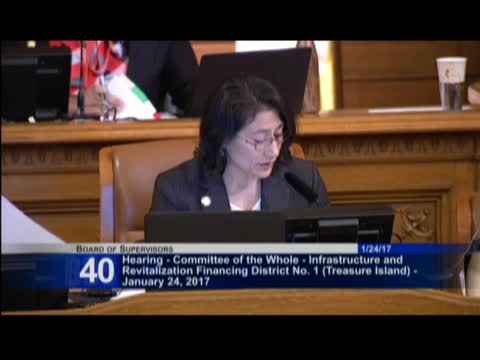
The San Francisco Board of Supervisors voted unanimously Tuesday to form an Infrastructure and Revitalization Financing District and a companion Community Facilities District for Treasure Island and Yerba Buena Island, establishing ballot results and authorizing initial bond limits and uses to reimburse infrastructure and to fund long‑term adaptation, parks and affordable housing.
The San Francisco Board of Supervisors voted unanimously Tuesday to form an Infrastructure and Revitalization Financing District (IRFD) and a companion Community Facilities District (CFD) for Treasure Island and Yerba Buena Island, adopting the associated financing plans, calling a special election and declaring the election results that clear the way for future bond sales.
The action authorizes the IRFD to support reimbursement of infrastructure and related project costs and sets a not‑to‑exceed aggregate principal amount for IRFD bond issuance at $780,000,000. The board also approved formation of a CFD to levy a supplemental special tax on properties in the district; a resolution before the board set the CFD’s not‑to‑exceed bonded indebtedness at $5,000,000,000 for the improvement area called improvement area No. 1.
Why it matters: The financing districts create the local revenue mechanisms that Treasure Island’s developer plans to use to reimburse costly public infrastructure and to fund long‑term adaptation and maintenance, including planned measures to address sea‑level rise and to support parks and open space on the islands. The board and staff said the package also commits a portion of IRFD revenues to affordable housing and is intended to leverage city and state contributions and future ballot measures.
City and project officials said the financing is a necessary step because site demolition and early construction work have begun and the developer is proceeding with utility, roadway and geotechnical contracts that will be eligible for reimbursement from district proceeds. "We need to bring these financing districts forward so that we can provide for reimbursement as improvements are made," Robert Beck, director of the Treasure Island Development Authority, told the board during the staff presentation.
Supervisor Jane Kim, the board sponsor, said new cost projections identified a funding shortfall for the affordable housing portion of the project: "we now have new revised projections that have identified a gap of $382,000,000 across the total cost of $968,000,000 to construct these affordable housing units," she said, urging that local financing be combined with mayoral and state commitments.
The board heard a string of public supporters from veterans' advocates, labor unions, affordable‑housing providers and community groups who said the project will create thousands of housing units, a large parks network and union construction jobs while enabling nonprofit providers to build permanent affordable units on the island. Sherry Williams, executive director of the Treasure Island Homeless Development Initiative, said without the districts "we can't move forward with developing any new affordable housing on Treasure Island, and we could potentially lose some much needed revenue to support those units."
Elections and ballots: The director of elections reported two timely ballots had been submitted for the special election called for the districts — one from the Treasure Island Development Authority and one from Treasure Island Series 1 LLC — and both were recorded as "yes" on each of the measures called by the resolutions. Following the board roll calls, the clerk recorded unanimous votes on the enabling resolutions and ordinances.
What the financing will pay for: Staff and consultants described the IRFD as a reimbursement mechanism for public infrastructure with the city committing 56.7 percent of the local property tax increment in the district to debt service and associated coverage, with 17.5 percent of IRFD proceeds committed to affordable housing across project areas. The CFD is structured to provide a funding source for ongoing operation and maintenance of the islands' public open space and to create a capital reserve for future sea‑level rise adaptations; staff said the CFD will transition into a maintenance district after reserves are established.
Next steps: Staff said the city will pursue technical state legislation to extend IRFD term limits and to seek state participation similar to historic redevelopment tools, and that the city intends to bring any actual bond issuance back to the board for separate approvals prior to sale. The administration also plans a court validation action for the IRFD formation documents to reduce future legal risk.
Votes and formal actions at a glance: - Items 40–45 (IRFD formation package, call for special election, ordinance adopting IFP; resolution authorizing bonds not to exceed $780,000,000): passed unanimously (11 ayes). - Items 46–52 (CFD formation and related measures, call and certification of special election; ordinance levying special taxes; resolution authorizing issuance of CFD bonds with a not‑to‑exceed indebtedness shown in the resolution): passed unanimously (11 ayes).
Community reaction and concerns: Supporters emphasized jobs, affordable housing and rising‑sea‑level planning; unions stressed labor agreements and local hiring, and veteran groups warned that delays could jeopardize state funding set aside for veteran housing. Several speakers including housing advocates requested regular six‑month progress reports to the board on affordable housing timelines and finance milestones.
Ending note: With demolition and early site work already underway and utilities and right‑of‑way contracts in procurement, staff and the developer said the financing districts must be in place to reimburse public‑purpose investments as the multi‑decade project proceeds.