Get Full Government Meeting Transcripts, Videos, & Alerts Forever!
Get email alerts on the Treasure Island Financing topic
No spam. Unsubscribe anytime.
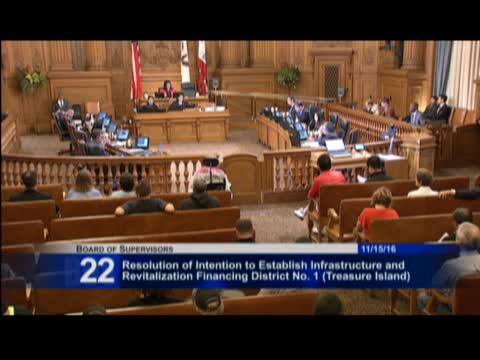
Supervisors press city on Treasure Island financing gap as staff seeks district formation delay
Summary
San Francisco supervisors and city finance staff spent more than an hour on Nov. 15 weighing how to close a multi-hundred-million-dollar funding gap to deliver the affordable housing promised for the Treasure Island/Yerba Buena Island redevelopment.
San Francisco supervisors and city finance staff spent more than an hour on Nov. 15 weighing how to close a multi-hundred-million-dollar funding gap to deliver the affordable housing promised for the Treasure Island/Yerba Buena Island redevelopment.
City finance staff told the Board the development agreement adopted in 2011 obliges the city to form an Infrastructure Financing/Revitalization District (IFD/IRFD) and a Community Facilities District (CFD) to pay for necessary infrastructure. The planning and finance presentation, led by Nadia Sasse, the mayor's Office of Public Finance, identified a current shortfall the staff described as roughly $382 million to build the initially planned affordable units.
The shortfall stems from multiple causes, staff said: higher construction costs than projected in 2011, the loss of redevelopment-era revenue tools, and lower-than-expected outside grant commitments. Sasse and other staff outlined a mix of potential solutions: a 5-year extension of the planned 40-year IFD term, a $30 million short-term commitment from the Mayor's Office of Housing and Community Development (MOHCD), pursuit of state grant programs, and the hope of recovering part of the ERAF (Educational Revenue Augmentation Fund) share that previously supported redevelopment. The staff repeatedly cautioned that the ERAF clawback is politically and legally uncertain and should not be relied upon as guaranteed funding.
Board members pressed for tangible guarantees that affordable units would be built in pace with market-rate development. "I want a little bit more of a guarantee than the land is deeded to us," said Supervisor Jane Kim, the district supervisor, asking what would pause market-rate construction if affordable-parcel funding fell short. Director Bob Beck, of the Treasure Island Development Authority (TIDA), told supervisors the existing development agreement does not include triggers to stop market-rate work if city-backed affordable funding lags; rather the city retains development rights and the authority intends to use parcel control and future revenue to complete commitments.
Supervisor Aaron Peskin and several colleagues urged alternative local options as better guarantees than reliance on Sacramento, including a potential general-obligation bond to fill the gap. "Rather than having the state give us anything, a Treasure Island G.O. bond would be a more certain guarantee," Peskin said. Others said a citywide bond might be more equitable, distributing affordable-housing investment across neighborhoods.
After extended questioning and requests for additional detail, Supervisor Kim asked to postpone the current set of legislative actions tied to forming the IFD so staff can return with more robust guarantee options and clearer commitments from MOHCD and other local partners. The Board later formally continued the Treasure Island items to Dec. 6, 2016, while staff pursues the additional analyses and outreach it described.
Why it matters: Treasure Island is planned for up to 8,000 housing units, of which the developer agreement aims for roughly 27.2% affordable units. If the city cannot secure the gap financing, that ratio could be substantially reduced or delayed for decades, with direct effects on thousands of households and city budgets.
What's next: Staff told the Board it would return with a timeline and additional financing detail, and confirmed the IFD formation materials were being held while the city continues negotiations for ERAF, state grant programs, MOHCD commitments and possible bond proposals.
Sources and attribution: The article is based on testimony and presentations by Supervisor Kim; Nadia Sasse, Director, Office of Public Finance; Bob Beck, Treasure Island Development Authority; and multiple members of the Board of Supervisors during the Nov. 15, 2016 meeting of the San Francisco Board of Supervisors. Quotations are taken verbatim from the meeting record.