Get Full Government Meeting Transcripts, Videos, & Alerts Forever!
Get email alerts on the Police Accountability topic
No spam. Unsubscribe anytime.
Board debate splits on police oversight: DPA charter amendment fails; public advocate fight continues
Summary
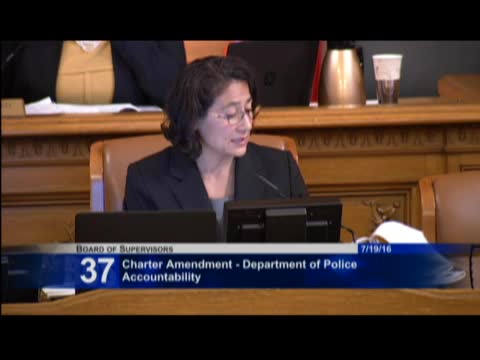
A stand‑alone charter amendment to create a strengthened Department of Police Accountability failed on a 5–6 vote, after lengthy board debate over whether the item should be presented alone to voters or folded into a larger public‑advocate proposal.
A proposal to create a Department of Police Accountability (DPA) with expanded oversight powers drew sharp debate at the July 19 Board of Supervisors meeting and failed to secure support as a stand‑alone charter amendment.
Supervisor Malia Cohen introduced an amendment to rename the Office of Citizens Complaints as the Department of Police Accountability and to give it autonomous budget authority and periodic audit powers. She framed the change as a response to public demands for greater transparency after a string of high‑profile police incidents and noted the city’s voters had recently backed additional oversight measures.
After extended debate, a motion to submit the DPA charter amendment as a stand‑alone ballot measure failed on a roll call vote. The final tally on item 37 was 5 ayes and 6 noes (ayes: Supervisors Farrell, Tang, Wiener, Breed and Cohen; noes: Supervisors Kim, Mar, Peskin, Yee, Avalos and Campos). Several supervisors argued the proposal should instead be folded into a larger public‑advocate charter amendment or that additional negotiation was needed; supporters urged a separate vote so voters could consider DPA on its own merits.
The discussion tied into a broader, contentious set of charter proposals on the agenda, including a separate measure to create an elected public advocate and other governance changes. Supporters of the DPA amendment said merging it into the broader public‑advocate proposal risked diluting an item many community groups had rallied behind; opponents said combining measures could avoid ballot congestion and allow coordinated reform.
Acting Police Chief Tony Chaplin told the board that placing an amount of the department’s budget in reserve would jeopardize core operations and training; board members and the department engaged in extensive back‑and‑forth about whether the board should withhold funds pending progress on reforms. Supervisor John Avalos proposed a temporary $30 million hold to incentivize implementation milestones; that proposal lacked broad support and was not adopted.
The board later voted to rescind and continue some votes on related public‑advocate and DPA items; the matter was continued to a future meeting for additional negotiation and possible resubmission to the ballot. Advocates and community organizations remained sharply engaged and will press supervisors as the items are refined.
What to watch: Whether DPA returns to the board as its own ballot measure or is folded into a public‑advocate charter amendment; detailed language on appointment powers and budget autonomy will be central to further negotiations.