Get Full Government Meeting Transcripts, Videos, & Alerts Forever!
Get email alerts on the Homelessness topic
No spam. Unsubscribe anytime.
Board approves ordinance to expand low-barrier navigation centers, with amendments and implementation flexibility
Summary
Supervisors adopted on first reading an ordinance directing the city to open at least six navigation centers within 24 months, with amendments to emphasize housing exits and allow department flexibility; the measure passed unanimously as amended.
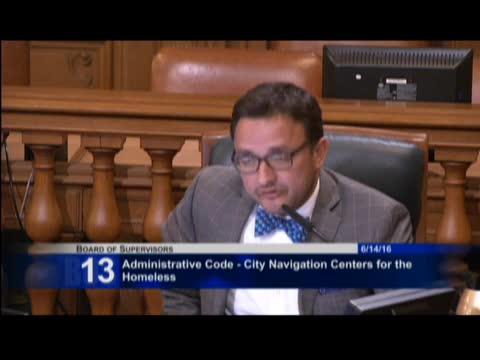
The Board of Supervisors on June 14 adopted an ordinance aimed at expanding San Francisco27s network of low-barrier navigation centers for people experiencing homelessness and encampments.
Supervisor David Campos, the ordinance27s lead sponsor, framed the measure as a step to add capacity and "move homeless people off the streets, out of encampments, and into transitional and permanent housing." He described navigation centers as "low-barrier shelters through case management and social service programs" that allow entry with partners and pets and focus on housing exits.
The ordinance was amended after consultation with Jeff Kositsky, the city's newly appointed director of homelessness services. Kositsky said the changes align legislation with the department27s planning process and the mayor27s budget and provide flexibility while retaining the goal of opening six new navigation centers within two years.
Supervisor Mark Farrell and other board members stressed that navigation centers must be paired with housing exits to be effective. The final motion that passed required additional provisions including a revenue plan and emphasis on converting existing shelters where appropriate.
Why it matters: San Francisco27s navigation centers are an alternative to traditional congregate shelters; they prioritize low barriers to entry and case management. The ordinance aims to scale that model but links success to the availability of housing and a financial plan to increase exit capacity.
Implementation notes: The ordinance passed unanimously as amended on first reading. The Board approved a set of technical amendments and directed coordination between the new homelessness director and supervisors' offices on site planning, shelter conversion and housing-exit targets.
Ending: The vote commits the city to add navigation-center capacity while giving the homelessness director flexibility to coordinate siting and conversions alongside existing shelter and housing efforts.