Get Full Government Meeting Transcripts, Videos, & Alerts Forever!
Get email alerts on the Code Enforcement topic
No spam. Unsubscribe anytime.
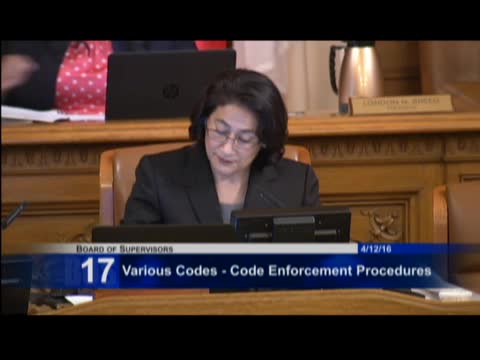
Board approves package of code-enforcement reforms and a revolving loan fund
Summary
The San Francisco Board of Supervisors approved three ordinances to consolidate and strengthen code-enforcement powers, create deadlines and reporting requirements, allow suspension of permits for repeat violators, and establish a revolving loan fund to help small property owners make code-related repairs.
The San Francisco Board of Supervisors on a unanimous voice vote approved three ordinances aimed at consolidating and strengthening the city’s code-enforcement system, Supervisor Scott Wiener said during the board meeting.
The ordinances create a unified code-enforcement process across the Department of Building Inspection, the Fire Department and the Department of Public Health; set deadlines for notices of violation and administrative steps; authorize the city attorney to initiate litigation without waiting for a department referral; and allow the director of building inspection to suspend all open permits on a project with repeated violations. The package also creates a mayor’s nuisance-abatement revolving loan fund to provide low-interest loans to qualified small property owners for repairs needed to abate code violations.
Supervisor Scott Wiener, who introduced the legislation, said the city’s “code enforcement system … is just not functioning as it should,” citing dilapidated buildings and construction projects that “start and never finish.” Wiener said the ordinances would improve coordination among departments, give the city attorney tools to go to court, and require quarterly reporting on problematic cases.
Supervisor Jane Cohen, a cosponsor of the ordinance establishing the revolving loan fund, urged support and said the changes would have “a significant impact” in neighborhoods such as Bayview where people live in properties that are not code compliant.
Key provisions include: clearer deadlines for issuing notices of violation and for administrative action; explicit authority for the city attorney to file suit to protect public welfare without requiring a prior department referral; quarterly reporting on problem cases to improve transparency; authority for the director of building inspection to suspend permits on projects with repeated code violations; and a revolving loan fund seeded with roughly $4,000,000 set aside in last year’s budget to make low-interest loans to small property owners to bring buildings up to code.
The board took the items together by unanimous consent. No roll-call objections were recorded; the clerk announced the ordinances “passed unanimously.”
Supporters said the changes favor compliance over punishment by giving owners a financing option to fix violations, while critics at earlier hearings had sought to ensure sufficient due process and guardrails around permit-suspension authority. The ordinances require departments to report on code-enforcement activities and direct the city administrator to prepare standardized citywide forms for code-enforcement proceedings.
The measures take effect as part of the city’s administrative and building code updates; departments will be responsible for implementing the new deadlines, reporting routines and the mechanics of the revolving loan fund. Supervisor Wiener said implementation details will be worked out with partner agencies and that the primary aim is to ensure quicker remedies for habitability concerns and unsafe construction.
The board’s action covered three separate ordinances and related administrative amendments adopted on first reading or final passage during the same session. The measures passed without objection and were recorded as unanimous.