Get Full Government Meeting Transcripts, Videos, & Alerts Forever!
Get email alerts on the Homelessness Care Not Cash topic
No spam. Unsubscribe anytime.
Board approves 3-year rental-assistance pilot for Care Not Cash participants
Summary
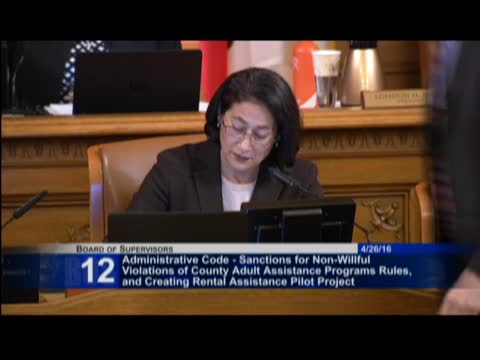
The San Francisco Board of Supervisors unanimously approved an ordinance to create a three-year rental assistance pilot for certain Care Not Cash participants who have repeated noncompliance with program rules; the city’s Human Services Agency will make rent payments during sanction months and report results annually.
Supervisor Mark Farrell introduced an ordinance directing the Human Services Agency (HSA) to create a three-year rental-assistance pilot for some Care Not Cash participants who incur non-willful program noncompliance sanctions.
The pilot is meant to keep participants housed during a one-month suspension of cash assistance after a third act of negligent noncompliance. Under the ordinance, HSA will pay rent directly to housing providers during the sanction month while the individual must reinstate benefits and third-party rent payment services to reestablish ongoing income for future rent payments.
Supervisor Farrell, who presented the ordinance, framed the change as a fix to what he called a ‘‘minor flaw in the program’’ that had resulted in a handful of evictions and cycling back into homelessness. ‘‘But clients who become sanctioned after their third noncompliance usually have no source of income to pay rent, and therefore have the high potential to have their housing security threatened,’’ Farrell said. He added the pilot is intended to ‘‘reduce homelessness and improve the health and welfare of homeless indigent adults receiving cash assistance through permanent supportive housing opportunities and enhanced services.’’
The ordinance specifies that participants whose benefits were discontinued for fraud, willful noncompliance, or loss of eligibility (including increased income or entry into another cash program) will not qualify for the rental payment. HSA will collect and analyze data on the number of individuals served under the pilot and must provide annual reports to the Board of Supervisors describing its effectiveness. HSA staff told the board they anticipate no net new costs because housing people is less expensive than treating people on the street.
Board members asked no further questions during the floor presentation. The ordinance was adopted unanimously on first reading under the board’s ‘‘same house, same call’’ procedure.
The pilot creates a temporary direct-pay rent mechanism tied to a five-step sanction-and-reinstatement process; it requires annual HSA reporting so the board can review outcomes and costs. If the pilot proceeds as described, the ordinance will remain a three-year program with the reporting requirement intended to measure whether the intervention reduces evictions and related service costs.
The board voted unanimously to pass the ordinance on its first reading.