Get Full Government Meeting Transcripts, Videos, & Alerts Forever!
Get email alerts on the Inclusionary Housing topic
No spam. Unsubscribe anytime.
Board continues inclusionary-housing charter hearing; sponsors and opponents seek technical fixes before ballot
Summary
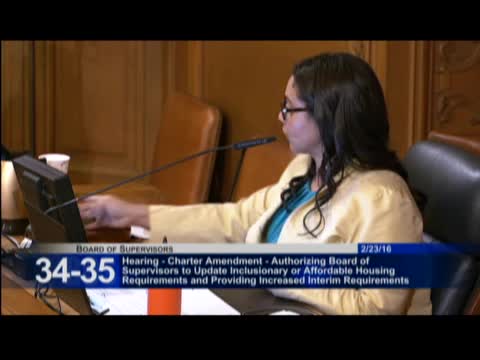
After a marathon public hearing Feb. 23, the Board of Supervisors continued consideration of a proposed charter amendment to move inclusionary-housing rules into the board’s authority and set interim on-site requirements at 25%, with the item continued to March 1.
The Board of Supervisors held a long, sometimes heated committee-of-the-whole hearing Feb. 23 on a proposed charter amendment that would remove the city’s inclusionary housing ceiling from the charter and impose interim controls that raise on-site affordability to 25% (15% low-income and 10% middle-income). After hours of testimony and debate, the board voted to continue the item to March 1.
Supervisor Jane Kim, the measure’s sponsor, said the amendment would remove the 2012 charter cap and enable the board to set inclusionary levels by ordinance. As an interim control, the measure would require 25% of units in new residential developments of a certain size to be below market rate: 15% targeted to lower-income households and 10% targeted to middle-income households (up to 120% of area median income), Kim said.
Supporters — including housing advocates, tenant organizations, community groups and some labor unions — urged immediate action, saying the city is losing residents who cannot afford to remain. “We need to build 28,870 units by 2022 to keep up with jobs growth,” Kim said, citing planning estimates of housing need. Speakers said the charter currently limits the board’s ability to increase inclusionary requirements and that raising the requirement is necessary to deliver more affordable units.
Opponents — including some developers, builders, and analysts — urged caution. They said the proposed 25% figure was set without a detailed economic feasibility study and warned that a uniform 25% requirement applied to all projects could lead to fewer units produced overall and could reduce the total number of affordable units. Dozens of speakers representing small and medium-sized development firms, contractors and lenders described rising construction costs and said an across-the-board increase could make neighborhood infill projects financially infeasible.
The Budget and Legislative Analyst and Controller presented options and said a feasibility analysis should inform any fixed percentage. Supervisor Malia Cohen offered amendments requiring a controller-led feasibility report and periodic reviews; debate revolved around whether that review should require the board to adopt the controller’s recommendation or simply consider it. The board was unable to finalize the language today and voted to continue the hearing to March 1 to allow further work and potential withdrawal of competing ballot initiatives that would otherwise go to voters.
Public comment included hundreds of speakers: tenants, seniors, veterans’ advocates, housing developers, builders and planners. Many tenant and community advocates urged the board to move the matter to the ballot; developers asked for more detailed economic analysis and for grandfathering protections for projects already in the pipeline. The board agreed to continue the item and pursue follow-up analysis, with the expectation of further negotiation among sponsors, the Mayor’s Office and other stakeholders before March.