Get Full Government Meeting Transcripts, Videos, & Alerts Forever!
Get email alerts on the Homelessness topic
No spam. Unsubscribe anytime.
Board declares a shelter crisis but debate exposes limits: ordinance clarifies community input and waivers won’t bypass laws
Summary
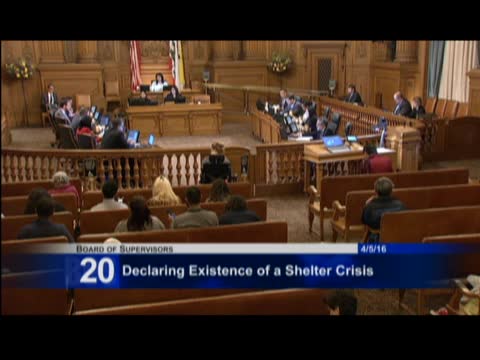
The San Francisco Board of Supervisors voted 8–3 on April 5 to declare a shelter crisis aimed at giving the city added flexibility to respond to homelessness, while an amendment requiring that community input and applicable city laws be observed limited the ordinance’s ability to expedite siting.
The San Francisco Board of Supervisors on April 5 voted 8–3 to declare a shelter crisis intended to give the city additional flexibility to respond to homelessness — but floor debate and a committee amendment left unclear how much the declaration will accelerate the opening of temporary shelters or navigation centers.
Sponsor Supervisor David Campos described the ordinance as a tool to “increase our city's capacity” to respond to street homelessness by allowing the city to suspend, for selected sites, some structural or habitability technical requirements when appropriate. He said the declaration would let officials more quickly convert locations into navigation centers or shelter sites while preserving community engagement in site selection.
Several supervisors warned that a committee amendment accepted by Campos undercuts the ordinance’s expedited-siting promise. The amendment says the board “does not suspend, waive, or otherwise limit the requirements of any applicable city law” for selecting and developing sites and preserves public notification and community outreach requirements.
That clarification convinced several members, including Supervisors Norman Yee and Jane Kim, to support the measure because it reaffirmed community process; others — including Supervisors Mark Farrell, London Breed and Scott Wiener — opposed the declaration on the ground that, as amended, it would not open new state or federal funding streams or meaningfully accelerate site openings.
“It's important that we actually take tangible steps to address the crisis on our streets with more permanent housing, with and yes, more shelter beds,” Wiener said in explaining his opposition. Farrell said the ordinance, as drafted, could divert attention from proven “housing first” approaches and lacks an accompanying plan or budget to open new facilities.
After floor debate, the board first voted and later rescinded an initial roll-call at the request of Supervisor Campos so the item could be considered with full membership; when the item was re-called the final vote was 8 in favor, 3 opposed (Supervisors Farrell, Tang and Wiener). The declaration allows certain regulatory waivers to be considered on a case-by-case basis but, because of the amendment, preserves community process and does not automatically free up additional state or federal funding.
Supporters and opponents agreed on the scale of the problem but disagreed on whether the declaration would have practical effect without an immediate funding plan and clearer authority to expedite sites. Several supervisors reiterated their support for scaling up permanent housing and navigation-center capacity in concert with services and housing exits.