Get Full Government Meeting Transcripts, Videos, & Alerts Forever!
Get email alerts on the Emergency Fund topic
No spam. Unsubscribe anytime.
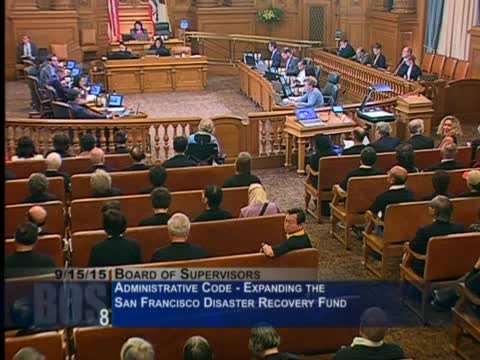
Supervisors debate private-donor disaster fund; amendment to require board approval for large expenditures fails
Summary
The board approved an ordinance to expand the San Francisco Disaster Recovery Fund into a broader Disaster and Emergency Response and Recovery Fund with automatic appropriation for limited emergency uses; an amendment requiring board approval for expenditures over $100,000 failed 4–7.
The San Francisco Board of Supervisors on Tuesday voted to expand a dormant private-donation disaster fund into a Disaster and Emergency Response and Recovery Fund intended to allow the City Administrator and Controller to quickly accept and spend designated private gifts during an emergency.
Supervisor London Breed recognized the item and Supervisor David Chiu? (transcript name: Tang) introduced the ordinance to allow private donors to designate funds for four categories: public infrastructure repair or replacement, emergency housing and relief, animal assistance, or unspecified uses to be allocated by the City Administrator. "The intention for this legislation is so that we can expeditiously provide funding if there is an emergency situation in San Francisco quickly," the sponsor said.
Deputy City Controller Todd Reedstrom told the board that donated monies are separately tracked and that the proposed ordinance defines how the controller and city administrator may spend funds and requires quarterly and annual reporting to increase transparency. Reedstrom also said the fund has received only $546 in 19 donations (between November 2011 and July 2013) and that no expenditures have been made.
Amendment and vote
Supervisor Norman Yee (listed in the transcript as Supervisor Yi) moved an amendment to require the board to approve any expenditure from the fund that exceeded $100,000; Supervisor John Avalos seconded the amendment. The sponsor opposed the amendment, saying it would defeat the purpose of allowing rapid spending for emergencies. The amendment failed on a roll-call vote, 4 ayes and 7 noes. The clerk recorded the ayes as four and the nos as seven, with Supervisors Cohen, Farrell, Mar, Tang, Wiener, Breed and Christensen casting "no" votes on the amendment.
The ordinance, as introduced (designating the fund a category 8 fund and adding the expanded emergency-response purposes and reporting requirements), then passed on first reading with an 8–3 vote. The clerk recorded 8 ayes and 3 noes for the first reading; supervisors Ye (Yi), Avalos and Campos were recorded as voting no on the ordinance.
What the law means
Under the city's administrative code a category 8 fund provides for an automatic appropriation without further board approval; the ordinance narrows the permissible uses to the four categories listed and requires quarterly inclusion of the fund's sources and uses in the Controller's quarterly budget report and an annual report to the mayor and board.
Speakers and positions
- Supervisor London Tang, sponsor (legislation author) - Supervisor Norman Yee (Yi), proposed amendment to require board approval for expenditures above $100,000 - Deputy City Controller Todd Reedstrom, explained internal controls and reporting
Clarifying details
- Donations to date: $546 from 19 donors (November 2011–July 2013). No expenditures to date. - Fund category: category 8 (automatic appropriation under the administrative code), but the ordinance narrows permitted uses and imposes quarterly and annual reporting.
Speakers quoted in this article
- Supervisor London Tang, author of the ordinance - Deputy City Controller Todd Reedstrom - Supervisor Norman Yee (Yi), mover of amendment
Ending
The ordinance passed on first reading; the board rejected the amendment that would have required prior board approval for large expenditures. The measure includes new reporting requirements; final adoption will follow the ordinary ordinance process and further committee review as required.