Get Full Government Meeting Transcripts, Videos, & Alerts Forever!
Get email alerts on the Jail Replacement 850 Bryant topic
No spam. Unsubscribe anytime.
Board affirms environmental finding for proposed 850 Bryant jail and authorizes state grant application amid protest
Summary
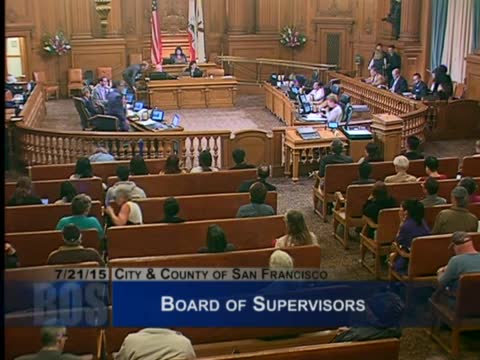
San Francisco—00—2�s Board of Supervisors on July 21 affirmed the Planning Department—00—2�s mitigated negative declaration for a proposed replacement of County Jails 3 and 4 at 850 Bryant Street and authorized the sheriff to apply for SB 863 state funds, after a lengthy public hearing and a 7-3 roll-call vote.
San Francisco—00—2�s Board of Supervisors on July 21 affirmed the Planning Department—00—2�s mitigated negative declaration (MND) for a proposed replacement facility adjacent to the Hall of Justice at 850 Bryant Street and authorized the sheriff—00—2�s office to apply for up to $80 million in state funding under Senate Bill 863. The board voted 7-3 on a motion to affirm the MND and, after amendments, approved the funding-application resolution 7-3.
The action follows a three-hour public hearing in which community groups, tenants—00—2� organizations and prison reform advocates urged the board to require a full environmental impact report and to explore noncarceral alternatives. Lisa Marie Alatorre of California—00—2�s United for a Responsible Budget (CURB) and other appellants argued the MND understates air-quality and wind impacts and fails to analyze outdoor exercise areas that the Board of State and Community Corrections (BSCC) might require. Planning Department environmental-review officer Sarah Jones and project staff said the MND analyzed the project as proposed, which does not include unenclosed outdoor exercise areas, and that additional environmental review would be required if the project description changes.
Why it matters: The Hall of Justice site currently contains aging, seismically deficient County Jails 3 and 4. Supervisors and department officials said the city must replace or remove the unsafe facilities and that achieving state funding would materially reduce local capital costs. Opponents called the state funding program a driver for a project they view as costly and punitive; supporters said state funds would free local dollars for supportive services within the complex and elsewhere.
What the board decided: Supervisor Scott Wiener moved to affirm the Planning Commission—00—2�s action and to table motions that would have overturned the MND; the motion was seconded and passed 7-3 (Breeds, Christensen, Cohen, Farrell, Tang, Weiner, Yee voted aye; Kim, Marr, Avalos voted no). Later the board approved a separate resolution authorizing the sheriff to submit the SB 863 application and taking related financing steps, with an amendment preserving the board—00—2�s future authority over contract approvals. That resolution also passed 7-3 with the same dissents.
Public testimony and technical debate: More than two dozen speakers addressed the board during the special order. Appellants raised four principal points: the potential need for outdoor exercise space under California detention standards (Title 24), Proposition M displacement obligations for SRO tenants, underestimated parking impacts, and wind impacts that would differ once the Hall of Justice is demolished. CURB—00—2�s presenters said BSCC minimum standards require outdoor exercise areas for Type 2/3 facilities and that an MND analyzing interior-only recreation could miss significant health impacts for people housed near freeway pollution.
Planning and city staff responses: Sarah Jones of the Planning Department said the department reviewed the project described in the application and found mitigation measures sufficient for the identified impacts; she said demolition of the remainder of the Hall of Justice was not part of the project description and would trigger separate environmental review if proposed. Deputy City Attorney John Givner explained that because the Board of Supervisors would be the first elected body to approve the project for CEQA purposes, CEQA appeal routes differ from typical planning-commission appeals and that court challenges remain available after the board acts. Public Works, Real Estate and the Sheriff—00—2�s Office said they have discussed mechanical-ventilation strategies intended to provide acceptable indoor air for exercise and that BSCC representatives have indicated they may accept ventilated indoor recreation as an alternative in multistory facilities.
Costs, capacity and alternatives: Controller—00—2�s staff told the board that if County Jails 3 and 4 at the Hall of Justice are taken offline and County Jail 6 in San Bruno remains unusable, the system would have roughly 1,232 procurable beds, fewer than the current daily population and below the 85% "classification" buffer normally kept to permit safe inmate housing. City presentations compared three scenarios (a 384-bed replacement at 850 Bryant, multi-site options including San Bruno, and larger combined solutions) and estimated different capital costs and eligibility for state funding. Public commenters and some supervisors pressed alternatives including expanded diversion and mental-health treatment, pretrial reform and housing investment as replacements for building new beds.
Supervisor remarks and next steps: Supervisor Breed said she would support the CEQA determination because the legal standard was met but pledged to retain board authority over later approvals and to press for stronger investments in diversion, mental health and reentry services; she said she would propose an amendment preserving the board—00—2�s discretion before construction contracts are executed. Supervisor Kim objected to proceeding now, saying the project description remains in flux and that the board should not finalize CEQA review years before detailed design and program decisions. The board also adopted a small amendment to the funding resolution to change a contract-approval threshold language.
Formal actions taken (selected): The board affirmed the mitigated negative declaration (Item 62) by roll-call vote, 7-3. The board then authorized the sheriff—00—2�s submission of the SB 863 funding application and conditionally approved related financing documents (Item 65) as amended, 7-3. In both recorded votes Supervisors Kim, Marr and Avalos voted no.
What remains open: Appellants were told that they may pursue court review of the board—00—2�s decision; Planning staff said any project changes (for example adding unenclosed exercise yards or demolition of the Hall of Justice) would require supplemental or new environmental review. City staff said they will continue design work and agency coordination; if the city receives state funds it must adhere to post-award timelines for site control and related steps.
Ending: The board—00—2�s votes leave the MND and the state-funding application in place while preserving pathways for additional review of the project—00—2�s design and for legal challenges. Supervisors and community groups signaled that the debate will continue as the city moves toward detailed design, tenant-relocation planning and the question of how capital funds will be balanced with investments in community-based alternatives.