Get Full Government Meeting Transcripts, Videos, & Alerts Forever!
Get email alerts on the Infrastructure topic
No spam. Unsubscribe anytime.
Supervisors pass streetlight policy ordinance on first reading to centralize and modernize system
Summary
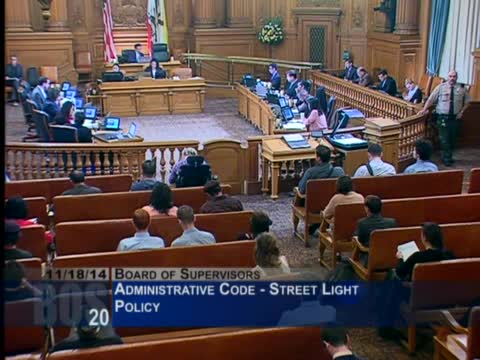
The Board of Supervisors on Nov. 18 approved on first reading an ordinance to create a single, citywide streetlight policy that directs the municipal conversion of PG&E lights, sets a 48‑hour response goal for outages, and calls for upgrades to LED and pedestrian‑scale fixtures.
The Board of Supervisors on Nov. 18 passed on first reading an ordinance establishing a citywide streetlight policy intended to provide a single, municipal standard and to accelerate modernization of San Francisco—s streetlight system.
Supervisor Wiener, the item—s sponsor, framed the measure as a response to long‑standing deferred maintenance and inconsistent ownership and maintenance practices between the San Francisco Public Utilities Commission (PUC) and Pacific Gas and Electric (PG&E). "A well maintained streetlight system is a very important priority for this city," Supervisor Wiener said during the discussion, noting the PUC then maintained roughly 60 percent of city lights and PG&E about 40 percent and that the city had identified millions in deferred maintenance.
The ordinance declares city policy in favor of a single municipally owned and managed streetlight system and directs the city to move toward acquisition of PG&E facilities over time, to include pedestrian‑scale lighting where needed, and to upgrade fixtures to LED technology. It also establishes a target response time for reported outages (48 hours) and directs coordination among city agencies on lighting projects.
Supervisor Wiener said earlier city efforts had identified $9 million in new funds to address deferred maintenance but that a policy framework was necessary to align agencies and establish response standards. The board agreed to pass the ordinance on first reading under "same house, same call," meaning it will return for a required second reading and final passage in a subsequent meeting.
The measure has implications for capital planning, PUC operations and any future agreements to acquire or take over PG&E‑owned lights within city limits. Project implementation details, funding timelines and acquisition mechanics will be addressed by the PUC and the mayor—s office following the ordinance—s adoption.
The ordinance passed its first reading without recorded objection and will return for a second reading.